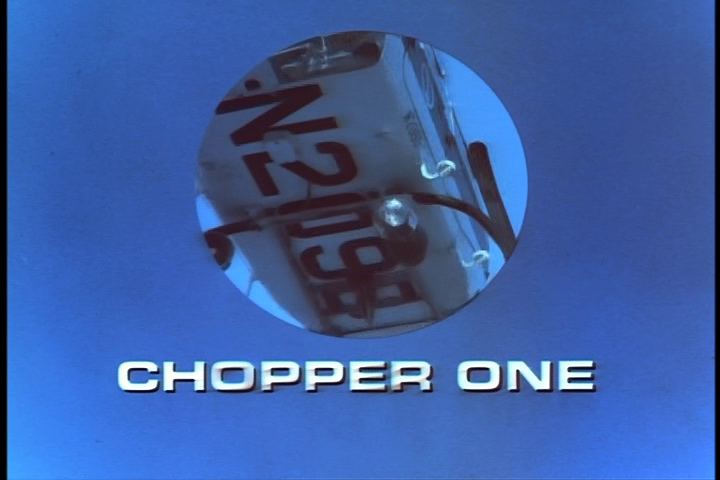
I have a list of ’70s cop shows that I want to watch. It’s definitely a wish list because not all of them are available on DVD or streaming, and the ones that are available, I’m not exactly getting around to them at a quick pace. When Dan and I were talking about covering another show for Eventually Supertrain, I decided to use it as an excuse to knock one short-lived, ’70s cop show off my list –Chopper One.
I pitched it to Dan like an adventure because neither one of us had seen the show, but from what I gathered from the series synopsis, it would be like Adam-12, but in a helicopter.
I was kind of wrong.
Running for 13 episodes, the 1974 half-hour series follows Officer Don Burdick (Jim McMullan) and Officer Gil Foley (Dirk Benedict) as they fly over Los Angeles and fight crime under the supervision of Captain McKeegan (Ted Hartley) and are kept in the air by mechanic Mitch (Lou Frizzell).
Like Adam-12, it’s a 30 minute cop show featuring partners and crime. And that’s kind of the end of the similarities. Chopper One has a different vibe to it, and that’s not a bad thing.
Most of the episodes begin with an unrelated opening crime that Foley and Burdick foil. Some of them are pretty entertaining, like the burglar masquerading as a pizza delivery guy who had no trouble scaling to a second story window to enter the house and then JUMPED out of the window once his ill-gotten gains were gained. Burdick and Foley spotting his shenanigans in the air and Burdick surprising the thief in his own car was pretty great.
Then there are openings that are amusing for the wrong reasons, like the pair of joy riders they chase down in the chopper. The couple looks to be in their thirties. Whose parents are these? Or the mugger in the bright red jacket who pushes random kids on the swings in the park as a cover before stealing a lady’s purse -in front of those kids!- and eventually getting caught on a baseball diamond. Sir, you deserve your fate and those kids need to be educated on stranger danger.
 A couple of episodes, including the pilot, opened with the chopper being utilized for non-crime reasons. In the pilot, a kid was in trouble on his sailboat way out to sea. Burdick and Foley rescued him. In another, the captain had Foley and Burdick pick up a star little league player from camp in order to make it to a game. Considering in the previous episode, the captain didn’t even want to authorize a kid who’d helped them catch some crooks go for a ride, I have questions.
Actually, this show left me and Dan with a lot of questions, but I’ll get to that.
After the opening, the episodes tended to focus on one crime. Now, I know what you’re thinking. How many ways can a police chopper be involved in an investigation? I wondered that, too, and it turns out that there are several. They got pretty creative about it. Over the course of the series, Burdick and Foley used their chopper to deal with hostage situations, robberies, rooftop shooters, ransom deliveries, abductions, and hijackings.
Mechanic Mitch became my favorite character pretty quickly, so it should be no surprise to those who know me that the episode “Killing Time”, in which his wife is kidnapped, is my favorite. I love to see my favorites go through it (yes, I’m a bad person). The reason that Mitch’s wife is kidnapped is so he’ll be persuaded to ground the chopper to avoid police interference in a political assassination plot orchestrated by Lloyd Bochner, who did more of the dirty work than I anticipated. Though Mitch initially does the usual thing of not telling anyone, he eventually comes clean and delivers the key clues to help rescue his wife, which leads to Burdick and Foley saving the day.
Though Burdick is older and therefore more of the veteran officer between the two, Foley isn’t exactly a rookie. From what little background we get on the two officers, it could be supposed that Foley has spent most of his police career in the chopper, perhaps recruited and/or joined the police force for that express purpose; whereas Burdick has obviously spent more time on the ground patrolling.
The episode “Downtime” really illustrates this. The chopper is grounded for repairs because they got a kite caught in their rotor and it’s done some damage. Instead of taking some time off, they’re put on patrol, with Captain McKeegan giving them a sarcastic lesson on what exactly a patrol car is and its function. The time on the ground reacquaints Burdick with a familiar thief played by Dub Taylor, and has Foley begging Mitch to get the repairs done so he can get off the ground. I would have actually liked that the entire episode was this light-hearted and fun, but then a bomber played by William Watson enters the mix and things get pretty serious as now they’re in a race to find the bomb before it goes off, which leads them to perform some trickery to get the bomber to reveal his secret. The second half of the episode is also good, and I wish that it was an episode of its own, too. But smooshed together, it’s still a good watch.
Other fabulous guest stars that either bedeviled Burdick and Foley or received their assistance include Laurie Prang, John Quade, and John Hudson; future Dirk Benedict foil William Lucking; Lew Brown, Skye Aubrey, and Austin Stoker; frequent TV guest stars France Nuyen, Norman Alden, and Frank Marth; Kim Hamilton, Kenneth Tobey, and Jamie Smith-Jackson; Vulcans Mark Lenard and Lawrence Montaigne; Tony Young, Jesse Vint, and Ross Elliot; Western alums Dabs Greer and Michael Ansara; Victor Argo, Eddie Firestone, and James Daughton; legends Dick Van Patten, William Windom and Bruce Kirby; Marvin Kaplan, Rick Hurst, and Harry Lauter; Hawaii Five-O guests Mitzi Hoag, Edward Binns, and Patricia Smith; Penny Fuller, James Luisi, and Jenifer Shaw; horror film alums Christopher Stone and Ford Rainey; Art Lund, Roy Jenson, and Arch Johnson; M*A*S*H alum Allan Arbus; Darleen Carr, Vince Howard, and Richard X. Slattery; and future star Nick Nolte.
Thirteen episodes isn’t a lot to work with, but Chopper One still managed to work in a few cop show tropes that I look for: a cop mentor either in trouble or causing it; a cop being investigated for something; and someone seeking vengeance on a cop or cops. If the show had continued, I’m sure we would have gotten a police-involved shooting episode.
 Thirteen episodes also isn’t much time for character development, not that cop shows of this time were super keen on it, but it did happen. But in the course of the short season, we did get a sense of our heroes. Foley might be young and spend most of his time in the air, but he could come up with some good ideas and he had a much better way of relating to people than Burdick. Burdick, the veteran officer, tended to be…we’ll say brusque sometimes. Okay, he was not above yelling at people in situations that didn’t necessarily require a raised voice. His hard-nosed approach to policing served him well in the line of duty, leading him to take risks other cops might not take. Jim McMullan and Dirk Benedict have great chemistry, so their lighter moments played just as well as the heavier stuff.
Captain McKeegan might have changed most over the course of the very short series, going from an unreasonable, shouty prick in the beginning, to a more reasonable, less shouty, not quite prick by the final episode. Mitch pretty much remained Mitch throughout, a loveable, sometimes snarky mechanic. Practically perfect in ever way.
Given what must have been a huge budget thanks to the helicopter and required helicopter stunts (Jim McMullen getting in on a few of them towards the end of the run), only a huge hit right out of the gate would have guaranteed a renewal. Unfortunately, this was a series that could have used a little more time to find itself. Overall, the quality is pretty good, though there are a few episodes that feel a little off. Dan suggested that some of the writers weren’t well-versed in making a 30 minute drama and I think he might be on to something. Some episodes felt like they could have benefited from a full 60 minutes to allow us to get to know the victims were were supposed to be sympathizing with better.
The short run time also left us with questions. How exactly is this wheelchair-using child that apparently can never leave his house getting an education? With his single mother working all day, what happens if he has an incident and falls out of his chair? Were there no support systems in 1974? Why is official firearm disposal procedure just dumping guns into the ocean? How the hell was Lloyd Bochner going to shoot this politician in a moving car from his crane? How could he be sure where he was sitting? Why sacrifice Mitch’s wife instead of using a decoy in the motorcade since they couldn’t change the route or ground the helicopter? What was the point of Ginger? We could have the entire episode without her and nothing would have changed. Do helicopter mufflers really exist? If so, do they really work like silencers? (Actually, don’t answer that one. We live in bliss believing they do.)
Lingering questions aside, the show is very watchable. Even the episodes that I wasn’t keen on aren’t awful. It’s a fine ’70s cop show and I would have loved to have seen what it could have become if it ran longer.
We could have seen what that chopper could really do.
 If you’re at all into reruns (and you must be if you’re here), then you’re probably familiar with the words “a Quinn Martin production”. A legendary producer during the ’60s and ’70s, the man had a gift for running a TV show. Sure, not all of them were multi-season successes and not all of his pilots were picked up, but he’s got more than one classic to his name.


 Let me just disclaimer this by saying that I haven’t thoroughly researched this post. I’ve just been thinking about it.


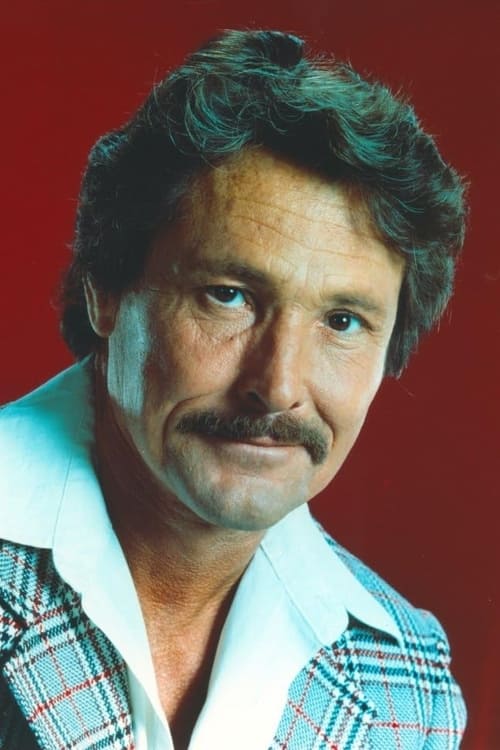 William Smith has a great face. Rugged. Handsome. A big, strong guy, it wasn’t hard for him to be imposing. He could be that rough good guy or a nasty bad guy. And anything in between. He had quite a few movie roles and plenty of guest star spots, but not nearly enough regular/recurring roles on shows. A guy like that deserves to be seen on a regular basis.
 As a guest star, he spent a lot of time on Westerns like Stoney Burke, Wagon Train, The Virginian, Daniel Boone, Death Valley Days, Alias Smith and Jones, Gunsmoke, and The Young Riders. He also turned up on plenty of cop shows like Mod Squad, Columbo, The Streets of San Francisco, S.W.A.T., The Blue Knight, Dan August, Bert D’Angelo/Superstar, CHiPs, T.J. Hooker, Ohara, Houston Knights, Due South, Hunter, Walker, Texas Ranger, and Nash Bridges.
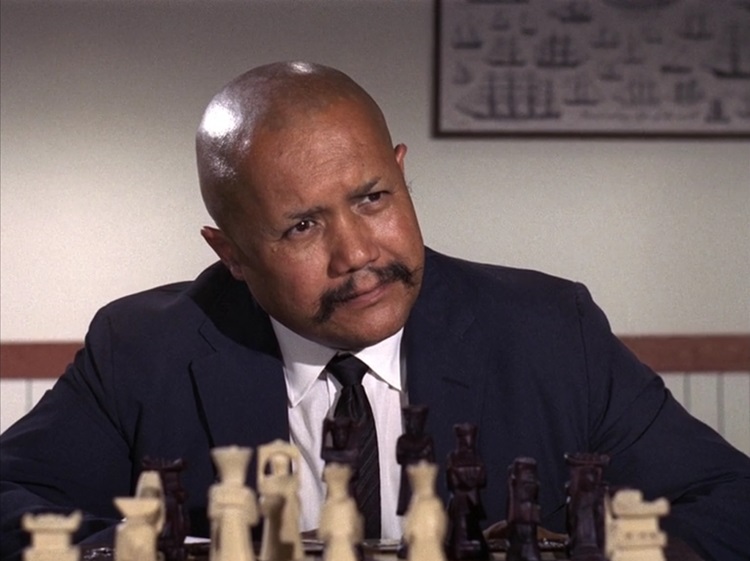 Police procedurals will sometimes brush their heroes up against the international. However being set in Oahu during the Cold War, it made sense that Hawaii Five-O would feature perhaps more than the average politically based storylines. So, naturally, a recurring villain of this caliber would be a perfect nemesis for the great Steve McGarrett. Enter the most diabolical foreign agent to ever grace the Hawaiian Islands: Wo Fat.
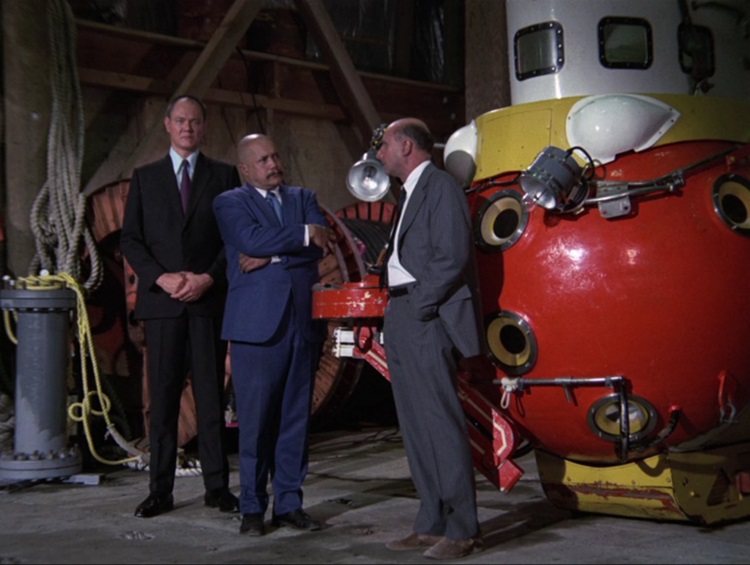 It’s intricate, meticulous planning that proves to be a Wo Fat trademark. The man would rather go big and then go home. Whether it be an elaborate frame, faking a tidal wave, using his spies to brainwash people into murder, kidnapping children as a form of leverage, working with the Russians to obtain counterfeit currency plates, orchestrating two murders to smuggle a device out of the country, stealing deadly toxins, Wo Fat’s flair for the dramatic is on display. What else could you expect from a man with his own submarine and a few doubles of his own?
 That one scene adds so much complexity to an already intriguing character. His actions -his elaborate plots and plans executed over the course of 12 seasons and 13 episodes- take on a new depth when viewed through that framework.
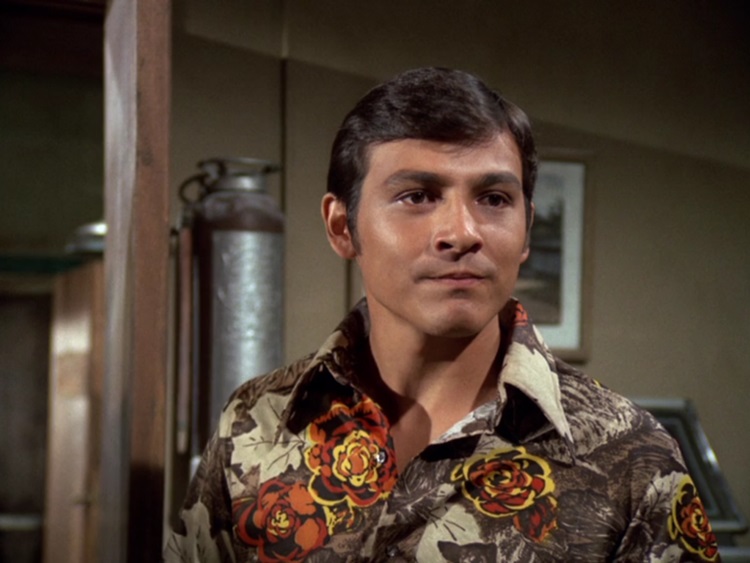
 In an episode of the short-lived ’70s cop show Chopper One called “The Informer”, Dick Van Patten is in police protective custody so he can testify against a mobster. Our mains, Foley and Burdick, use the police helicopter to take him to a safe house…where he later calls his wife and tells her exactly where he is so she can come see him.
 aka KikiWrites