“What’s Your Favorite TV Show?”

First of all, how dare you ask me an unanswerable question.

Yes it is THE question I cannot answer. I can’t even make a top five list. I can barely make a top ten.

The truth is that my love is forever, but my favorites change.

Also massive commitment issues, but that’s a post for a different blog.

It’s probably easiest to stay general and go with the types of shows I like best.

I have a strong love for ’70s cop shows (they are my ultimate jam, it would seem) and ’80s private detective shows. I’m not a big fan of sitcoms, but most of the ones I like are from the ’60s. I grew up on ’80s action and old ladies being awesome. I’m fond of a handful of sci-fi shows from the late ’90s and the ’00s. I discovered an affinity for some Westerns from the ’50s and ’60s. I like shows produced by Jack Webb and shows that star Raymond Burr. Yes, I don’t like many current shows, but I’ve still found some that I truly enjoy.

Of those genres, I could start naming names. Hawaii Five-O, obviously, but also Barney Miller and Starsky and Hutch and CHiPs. Magnum PI and Simon and Simon. The Monkees and Gilligan’s Island and The Addams Family. The A-Team and Air Wolf and Murder, She Wrote and The Golden Girls. Stargate: Atlantis and Stargate: Universe. The Big Valley and The Rifleman and Gunsmoke and Bonanza. Dragnet and Emergency! and Adam-12. Ironside and Perry Mason. I watched NCIS: New Orleans from pilot to finale. I’m enjoying the reboots of Magnum PI (despite its -in some instances glaring- flaws) and The Equalizer. I even finally came to appreciate the 2010 Hawaii Five-0.

But distilling it down to a single choice is impossible.

Think of all of the shows I haven’t watched yet. The first two seasons of The Rookies still sits on my shelf, unseen. So does Werewolf. Chopper One is on my wishlist, as is Longstreet and Dan August. Tales of the Gold Monkey is just waiting for me to borrow from the library. I would kill to see Dirty Sally, Gunsmoke‘s only spin-off, and Trauma Center, the 4th Glen A. Larson short-lived series to come out of 1983.

So, really, it would be premature of me to pick a favorite at this point. Even a top ten list might be considered irresponsible at this juncture.

I continue to discover new reruns that hit me on all cylinders, that thrill me. I’m always rediscovering old loves that I haven’t watched for years, some I’ve even forgotten about. Some shows I love for all the wrong reasons; a few I love for the right ones.

There are shows that only briefly capture my attention, but do it so intensely that they almost become a fixation. Other shows, never leave me, really. Then there are those that come and go, roll in and out of my life like waves, letting me rediscover them over and over again. And of course, there are my white whales and holy grails, the ones that I’ve been looking for and hope that one day I’ll finally get to watch.

So, what’s my favorite TV show?

I’ll let you know.

Educational Television

Several years ago now, I saw a movie called Chi-Raq which is a retelling of the story of Lysistrata set in present day Chicago. It’s a great movie, but judging by some of the comments I saw at the time, it seemed that some people missed the fact that it was a retelling of a Greek play by Aristophanes.

Naturally, people pointed out that they didn’t know that because they’d never learned about it in school.

I never learned about Lysistrata in school either, but I still knew the story. How?

Gilligan’s Island.

The first season episode “St. Gilligan and the Dragon” invokes a G-rated version of the story. The women, frustrated with the men and feeling disrespected, decide to go off on their own and stop doing the “women’s work” for the fellas. Mrs. Howell is actually the instigator, citing Lysistrata to explain to Mary Ann and Ginger what they should do.

So at six years old, I learned about Lysistrata. Thirty-some years later, I finally put that knowledge to use to be smug at strangers on the Internet.

Television has a funny way of educating folks like that. They just sneak it in on you and the next thing you know you’re answering the Daily Double on Jeopardy correctly.

Or realizing what the school curriculum didn’t cover.

After the statue of slave trader Edwin Colston was pulled down and dumped in the sea in Bristol, England, someone on Twitter pointed out that much of the racist history of Britain wasn’t addressed in their history classes there. One of these events that they cited was the Mau Mau Uprising, a violent resistance to colonialism by the Kenya Land and Freedom Army against the British.

It seems odd that the Brits might not to learn something about this, even a glossy, white-washed version it. It makes more sense that an American like myself wouldn’t know about it. After all, our high school history classes barely get past World War II.

But I’d heard of it. Why?

Magnum PI.

The third season episode “Black on White” deals specifically with the Mau Mau Uprising, particularly Higgins’s role in it since the men in his unit who were there are being killed off. It’s not an exact retelling of history, of course, but it does capture the brutality of the conflict, something most Americans might not have otherwise heard of.

A little history lesson snuck in between the action and Aloha shirts.

This sort of thing still happens in today’s television. A whole slew of folks were introduced to the Tulsa Race Massacre thanks to Watchmen. In 1921, white residents attacked the Black residents of the Greenwood district in Tulsa, destroying the wealthiest Black community at the time, injuring hundreds, and killing an estimated 75 to 100 people (according to a 2001 commission; 39 deaths were confirmed). Not many US high school history classes paused to even mention that in the race from WWI to the Great Depression.

They say that too much television can rot your brain. And I suppose it can. Too much of anything isn’t good for you. Television is no different, especially some of the so-called mindless junk (I do love me some intellectual Twinkies as a way to soothe my tendency to overthink). But it’s not all brainless twaddle.

Pay attention next time.

You might just learn something.

When the Stars Go Out

It’s been a sad week here in Rerun Junkie Land.
In the last few days we’ve lost both Markie Post (less than a month after her Night Court co-star Charles Robinson at that) and Alex Cord, as well as observing the anniversary of Robin Williams’s death.
It’s a strange thing when celebrities die. It’s a given that their family and friends will mourn them (unless they are absolute pricks, but it never seems like an asshole dies). But they also end up being mourned by strangers who thought of them as friends and/or family because by virtue of technology they became important and familiar.
However, even more curious is how -when you really stop to think about it- they aren’t really gone in the way that fans know them. Yes, they’ve gone beyond the horizon to have some new adventures, but the way that we as fans know them best is left behind. They’re gone, but they’re not.
It sort of ends up being this weird grief echo that surrounds that person.
Take Davy Jones and Peter Tork, for example. I was devastated when both men died. We’re talking straight up disbelief followed by heartbreak that lasted for days. Understandable given that I’ve been a huge Monkees fan since I was six. But my access to them hasn’t changed. I can listen to them whenever I want, watch episodes of the show whenever I want. They’re gone, but they’re not. And sometimes, I forget that they’re gone. It’s always for a brief moment and then I remind myself, but it’s always a disconcerting sort of feeling. Like, oh yeah. They’re gone.
I know that happens to people when someone they know personally dies, too. They have that brief bliss of forgetting that their loved one is gone before the reality comes crashing down. But the very nature of celebrity makes this a default. It’s so easy to forget that they’re gone because they’re always there.
And that echo reverberates differently for different people, and not always in a way that makes sense.
I was understandably heartbroken when two of my TV boyfriends, Martin Milner and James MacArthur, passed away, but the reminders that they’ve beyond the horizon don’t hit me as hard as you would think they would. In contrast, I was also sad when Ron Glass and David Ogden Stiers died, but for some reason, the reminders of them being gone are much harsher. I have no explanation for this.
I have no real point to any of this. Only my own observations on a phenomenon that might only exist in my head. But it’s something that I think about every time an old favorite takes that horizon ride.

I guess what I’m saying is that some stars never really go out.

Rerun Junkie Guest Stars–Dabbs Greer

I like to say that I see Dabbs Greer once a week on my reruns and the best part is that I’m not really joking. The man has 319 credits listed on IMDB, the first once being an uncredited appearance in the 1939 movie Jesse James. His last credit is an episode of Lizzie McGuire in 2003.

It’s no exaggeration to say that the man did everything in between.

Probably best known as Reverend Alden on Little House on the Prairie, he also had recurring roles on The Ghost and Mrs. Muir, Picket Fences, Maybe It’s Me, Hank, and Gunsmoke. However, he often showed up on shows more than once even if he wasn’t playing the same character. Dabbs had multiple appearances on The Rifleman, Bonanza, The Wild Wild West, Rawhide, Wagon Train, Perry Mason, The Fugitive, The FBI, and The Loretta Young Show.

He joined Dick Van Dyke on both the Dick Van Dyke Show and Diagnosis Murder. He stopped by Mayberry multiple times on The Andy Griffith Show. He went to both The Twilight Zone and The Outer Limits.

He was a doctor suffering from an aortic aneurysm on Emergency!, a family man in need of help in Gomer Pyle: USMC, a drunk on Big Valley, a moonshiner on Charlie’s Angels, and a doctor up to no good on The Incredible Hulk.

Dabbs Greer had the kind of long and varied career that a lot of actors dream of. He was never really a star, so to speak, but as a character actor who was in everything, he was instantly recognizable. And he could do just about anything. Sitcoms like The Many Loves of Dobie Gillis, Empty Nest, Petticoat Junction, Rosanne, and Ann Jillian were no problem. Do you like private investigators? He was on Mannix, Cannon, Barnaby Jones, and The Rockford Files. He also did cop dramas like The Streets of San Francisco, Adam-12, Mod Squad, The Rookies, and Chopper One. He covered all of the westerns, including Laredo, Laramie, and The Virginian. He even went out of this world with The Invaders and The Greatest American Hero.

And if all of that isn’t enough, he played the minister who married two famous sitcom couples:  Rob and Laura Petrie on The Dick Van Dyke Show and Mike and Carol Brady on The Brady Bunch. Then came back twenty years later and married Bobby Brady and Tracy Wagner on The Bradys. Because Dabbs Greer was unstoppable.

I think that’s what I like best about him. That he is such a familiar, constant presence on my rerun viewing. I don’t really have any favorites where he’s concerned because I always enjoy when he pops up on my TV. Sometimes he’s a good guy, sometimes he’s a bad guy, sometimes he’s just a bit part, sometimes he’s the episode.

But he’s always there.

The ever-present Dabbs Greer.

Welcome to aka KikiWrites

I am one of those people who likes to watch, write about, and talk about old TV shows. So much so that I had to create an entire site just to contain that aspect of my existence.

aka KikiWrites is the official home of my podcast, Book ’em, Danno: An Old Hawaii Five-O podcast, which covers the 1968 Hawaii Five-O series. You’ll also find my guest spots on other podcasts, usually talking about old TV shows, but sometimes I do actually talk about other things, too. Rarely, but it’s been known to happen.

Since I’m a writer by nature, it’s only natural that I’d spare a few hundred thousand words on reruns. My Rerun Junkie posts cover shows, guest stars, characters, episodes, and context.

And if you happen to like the content, feel free to buy me a cup of coffee or two over on Ko-Fi.

So, settle in, find a channel, and enjoy.

Rerun Junkie Guest Stars–Boy George on The A-Team

Season 4 of The A-Team featured a lot of what I call stunt casting: guest stars that are extremely popular at the time and are put on a show to capitalize on that. Now there can be a fine line between a genuine guest starring role and a stunt casting, but you’ll know it when you see it because you really can’t ignore it.

During The A-Team’s fourth season, they had Hulk Hogan (twice!), Rick James, Pat Sajak and Vanna White had cameos because Murdock went on Wheel of Fortune for some reason, and, of course, there was Boy George.

I know, right?

The episode is called “Cowboy George” and the basic plot is Face is doing some talent booking, working with some dude named Dash, who screws him over on his contract by exercising a clause that allows for substitutions. So instead of getting Cowboy George for some honkytonk gig, he gets Boy George and Culture Club, who have been led to believe they’re going to be playing the Arizona Forum, not a dance hall called The Floor ’em. This poses a problem to LQ Jones, who demanded Cowboy George to insure the show would be a sellout. The he and his buddies could rob the audience’s payroll. To get help get out of the jam, Hannibal impersonates Cowboy George, but Boy George and Culture Club perform, which first angers and then charms the audience. The A-Team also thwarts the robbery and takes the bad guys to the sheriff, but it turns out the local replacement sheriff isn’t really a sheriff; he’s in on the whole thing, too, and the real sheriff is dead in one of the cells were Hannibal, BA, and Face are being held. Outside, a mob of angry workers are trying to break in to hang them because they think the three men stole their payroll. Which means it’s up to Murdock (who has an obsession with the Lennon Sisters in this episode) and Boy George to get them out of trouble.

Now, here’s why I think this is the greatest bit of guest casting in the history of television.

Unlike the Hulk Hogan or Rick James episodes (which I enjoy, don’t get me wrong), The A-Team aren’t hired by Boy George to do a job. They just sort of stumble into this scenario and Boy George happens to be involved and he goes along for the ride.

And he is clearly having a good time.

Boy George is an amiable guy, willing to cut down the band’s contracted fee from $1.2 million to $600,000 and he’s confident that Culture Club can draw the kind of crowd necessary to make that kind of money if they can get some advertising. Everyone loves Culture Club (fact check: this is true). He’s not put off by the booing rednecks, either, though his first impression of the dance hall isn’t the best. He and the band go out and start their set. Of course, the crowd falls in love with them.

When the trouble starts and Face, Hannibal, and BA get thrown in jail, the not-sheriff interrupts the show to tell the crowd what happened to their payroll, hoping to work up a lynch mob. It’s Boy George to the rescue. He acts quickly, going to the radio station where Murdock has locked himself in a booth to both get publicity for the Culture Club shows, and to also play every Lennon Sisters song he can get access to.

The two of them then break into a shop because they need some supplies and a plan to save the guys. Murdock struggles to pick the lock, even when Boy George provides him with a bobby pin. In the end, Boy George just kicks the door in. He even has a funny quip!

Murdock: See, a really honest man doesn’t really have an appetite for this sort of thing.

Boy George: Yeah, but who needs honesty?

Isn’t that great?!

Murdock gets the idea to smuggle some explosives into the besieged jail by dressing up as the pregnant wife of one of the guys and Boy George gives helpful critiques of Murdock’s clothing choices.

Boy George rides along after the jailbreak to stop the bad guys at the airport. And then he and Culture Club perform one final song for a very pleased crowd of cowboys.

I know. It sounds ludicrous. It shouldn’t work at all. And it probably would fall absolutely flat if not for Boy George being slightly amused the whole time. It’s not that he doesn’t take any of it seriously. He’s not goofing nor is he acting like it’s all beneath him. He comes across as very oh-you-crazy-yanks bemused and decides to enjoy the craziness. He gets the spirit of a show in which cars flip and explode and the people in them crawl out looking a little disoriented and disheveled.

Boy George brings the joy to the episode. Pure, blessed joy.

And we are all better for it.

Rerun Junkie Episodes–“The Fugitive”

You can blame Tom Elliot and The Twilight Zone Podcast for this. And then you can go listen to Tom Elliot and The Twilight Zone Podcast (and support him and the show on Patreon!) because both the host and show are damn nifty.

In a recent episode of the podcast, Tom discussed The Twilight Zone episode “The Fugitive”. While I encourage you to give the whole episode a listen, particularly if you’re not familiar with the episode at the heart of the discussion, I’ll give you a quick rundown here:

J. Pat O’Malley plays Old Ben, a kindly old man that plays with the neighborhood children and has a particular kinship with one little girl with a lame leg named Jenny. Jenny has it pretty rough. The other kids don’t like playing with her because she’s a girl and she wears a leg brace. The aunt whom she lives with is horribly abusive towards her. Old Ben is a bright spot in her life.

Old Ben can do magic, like turn himself into other things, because he’s really an alien. When two men show up looking for him, he first tells Jenny it’s because he’s a fugitive. He then heals Jenny’s leg and leaves. In an attempt to get Old Ben to come back, the men zap Jenny into a kind of coma. He shows up to heal her and that’s when the real truth comes out: Old Ben is actually a king. In the end, he takes Jenny with him to his planet. Rod Serling’s closing narration informs the audience that the picture Jenny left under her pillow for her aunt to find is of Ben’s true form. He’s actually a young man. And her aunt will never guess that her niece will one day be a queen.

The discussion of this episode brought up an uncomfortable, but valid interpretation of the relationship between Old Ben and Jenny, insinuating that Old Ben’s interest in Jenny was more than platonic and the fact that he’s actually a young man in disguise doesn’t really make it better since the king in the picture could easily be nineteen or twenty and Jenny is only about twelve. It makes certain scenes and some dialogue rather squicky and distasteful when viewed in this particular light.

Now, like I said. It’s a perfectly valid interpretation of the episode, though I don’t think it was all written with that intent. It was meant to be something like a sci-fi fairy tale. And I’ve never even thought of it in that light when I’ve watched it. That could, of course, be my J. Pat O’Malley bias here. I love that man and I really need to write a post on him. It might be why I always looked at Old Ben as a kindly grandfather figure, someone who went an extra mile to be caring with Jenny because she had so little caring in the rest of her life. Even the reveal at the end didn’t sway my perceptions. I never took the relationship to be anything more than innocent.

And that’s probably because of the fairy tale aspect of the story.

Little girls are groomed from baby-age to be princesses and aspire to be queens. That Old Ben was really a young king and wanted Jenny to be his queen is supposed to be every little girl’s dream, age of consent be damned. We’re actually taught to look for someone older to take care of us. That this would be the ending to this fairy tale isn’t at all out of the norm.

It also plays on another trope common in children’s stories: the abused/neglected kid somehow being special and escaping their situation. That’s what the story really struck me as. That fairy tale of escaping some hostile situation that you, as a child, are powerless to change. That Jenny became queen later never felt that important; you could have left it out all together and the story would ring just as true. If Jenny had been Danny, there would never have been a need for any postscript crowns.

And if Jenny had been Danny, I doubt that as many people would arrive at the less-than-innocent interpretation of the episode because people still struggle with the idea that boys are also sexually abused.

There’s a societal conditioning concerning gender roles that I think plays into both interpretations of the episode. Old men prey on little girls. Little girls want to be princesses and queens.

And while the episode is definitely a product of its time, the lens we view it through hasn’t aged as much as we think.

Rerun Junkie Episodes–Favorite Christmas Episodes

Bah humbug.

Yes, we’re all very aware that Christmas isn’t my favorite time of the year. Too many years working retail and running the holiday gauntlet have put a permanent crimp in my holiday spirit. And that goes for my reruns, too. I find most Christmas episodes to be too saccharine and overly-sentimental. They run that commercialized holly jolly through the society-approval filter and trim it with some moral lessons and it’s just enough to be nauseating.

However, there are a few episodes that have captured my heart, either because they forego these tropes, skewer them, or dress them in a silver pantsuit that’s absolutely to-die-for.

“‘Twas the Night Before Christmas”, The Golden Girls– The women are all planning on spending Christmas with their families. The bemoaning of the commercialization of Christmas leads them to exchanging homemade gifts, including Rose’s whittled maple syrup spigots and Blanche’s “Men of Blanche’s Boudoir” calendar, opened the night before they leave. On Christmas Eve, Blanche and Dorothy show up at the counseling center to pick up Rose, who is working a morning shift, only to be held up by a Santa (Terry Kiser), who demands they all celebrate Christmas together. Thanks to Sophia, they’re able to get out of that jam and to the airport, only to see their flights home cancelled. Later, at a diner, the women realize that they already are spending Christmas with family.

The ending is a bit sweet, what with it snowing in Miami and all, but Rose hitting “Surfin’ Safari” on the jukebox instead of a Christmas song saves it. Though I’ve always found it bizarre that they decorated the house, tree included, even though they wouldn’t be there for Christmas, I’m glad they did. They have some really lovely decorations and the tree is gorgeous. And Blanche’s pantsuit is fabulous.
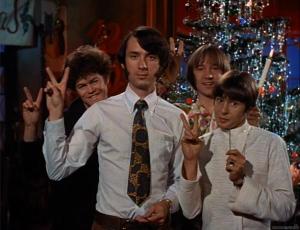
“The Christmas Show”, The Monkees– The Monkees, in their forever pursuit of the next gig, end up getting hired to mind Melvin (Butch Patrick), a disgruntled forty-year old trapped in a twelve-year old’s body, while his aunt is away on a Christmas cruise. Turns out, Melvin isn’t much for Christmas. When the boys try to get him into the holiday spirit, they end up blowing through all of their money and aggravating Melvin to the point that he goes home. It’s only then that Mike realizes what’s been missing the whole time.

It could be a typical “lesson of Christmas” episode, but it’s The Monkees. They don’t do typical. Instead, they do madcap that involves them chopping down their own tree (while apparently stoned), Peter wrecking a department store while shopping for toys, Micky and Davy dressing as Santa and his elf and going down the chimney, a happy ending, and capping the whole thing off with an a capella version of “Riu Chiu”. It’s zany and sweet and the crew getting their time in front of the camera during the credits is a lovely gesture.

“Dear Sis”, M*A*S*H– In a letter home to his sister, Father Mulcahy expresses his frustration in not feeling very useful. Most everyone in camp has the holiday blues, but it seems that it’s hitting Father Mulcahy the hardest as nothing he does is really helpful. He even ends up decking a combative patient (who hit him first, so he had it coming). It’s only during the Christmas party in the mess tent that Father Mulcahy realizes that he has made something of a good impact, first when Charles thanks him for having his mother send him his old toboggan cap, and then later when Hawkeye singles him out during a toast.

M*A*S*H did several Christmas episodes during its eleven year run, but this one stands out to me for several reasons. One, it centers much of the episode on Father Mulcahy, which didn’t happen very often. Two, instead of singing a traditional Christmas song, Hawkeye leads everyone in singing a lovely version of “Dona Nobis Pacem”. And three, the episode ends with one of my favorite lines from the series. As the party is broken up by incoming casualties, the voiceover reading of Father Mulcahy’s letter to his sister says, “You know, sis, it doesn’t matter whether or not you feel useful when you’re moving from one disaster to another. The trick, I guess, is to just keep moving.”

“The Christmas Story”, Dragnet– A local church’s baby Jesus has gone missing from its nativity scene and Friday and Gannon are on the case. The statue has little monetary value, but it’s sentimental value can’t be measured and the parishioners would be very sad to go a Christmas without it. Being diligent detectives, Friday and Gannon follow a tip provided by an altar boy (Barry Williams) that leads them to a suspect (Bobby Troup), but he only borrowed a friend’s car and got into a little fender bender; he didn’t take any baby Jesus. Dejected, Joe and Bill go to the church to let the padre know they didn’t find the baby Jesus, but they’d keep looking. Just as they start to leave, a little boy pulling baby Jesus in a wagon comes into the church. It turns out that he’d prayed to baby Jesus for a new wagon and promised Him that if he got it, he’d give Him the first ride.

I’m not one for religion. I tend to cringe and shy away when people ram home the “Christ” in Christmas. But this episode is an exception and it’s all in the handling of the case and the ending. Our detectives are pursuing this matter seriously, as they usually do, but the justice is less nabbing a thief and more doing right for a congregation. The little boy who took the statue was fulfilling a promise, something that is more in tune with the holiday spirit than any of the sappy treacle that often gets splattered on the screen.

“Christmas with the Addam’s Family”, The Addam’s Family– It’s the common holiday problem that all sitcom parents face at one point or another: Santa. Pugsley and Wednesday are told by the Addams’s unkind neighbor that Santa doesn’t exist. The family bands together and elects Uncle Fester to play the role to restore the children’s faith. When he gets stuck in the chimney, each member of the clan takes it upon themselves to prove that there really is a Santa.

This could easily be a mediocre, overly-sweet episode, but this is the Addams family. This delightfully loving family is weird and wonderful and only they could pull off a Santa overload with such sincerity.

“Operation: Silent Night”, Magnum P.I.– While ferrying Magnum, Rick, and Higgins to their various destinations before he catches a flight home to New Orleans, T.C.’s chopper crashes on a deserted island that the Navy uses for target practice. Though Rick is convinced they’re all going to die, everyone else is pretty confident that they’ll get off the island soon enough. T.C. works on the chopper while Higgins forages for food and Rick and Magnum gather firewood for a signal fire. They end up discovering a downed Japanese WWII plane, which Higgins salvages to create a boat, which later sinks. Rick falls in a bog that he thinks is quicksand, which causes him to imagine his own funeral. T.C. despairs over his inability to fix the chopper and as such, he’ll miss his flight home. And Magnum, who was going to play Santa to some orphans, dons the outfit once again and provides the group with a Christmas tree to boost their spirits. All the while, the guys are unaware that off-shore, a Navy commander (Ed Lauter) with no Christmas spirit is about to bombard the island for practice.

What I love about this Christmas episode is how it’s so tangentially related to Christmas. There are obvious Christmas references and elements (Magnum dressed as Santa is hard to ignore), and there’s even a Scrooge in the form of the Navy commander insisting that his crew do drills on Christmas Eve/Christmas Day. But the episode isn’t dressed up in garland and lights and bows. There’s no heavy-handed true Christmas spirit bashing us over our heads. It’s four friends coming together in a difficult situation not because of some of magical holiday emotion but because that’s just what they do. There’s also the nod to another December holiday celebration. In addition to Christmas, T.C. also celebrates Kwanzaa, which he educates Higgins (and the audience) about.

Okay, I might have gone on a little long, but don’t for a minute think that’s because I’m having a change of heart about Christmas or Christmas episodes.

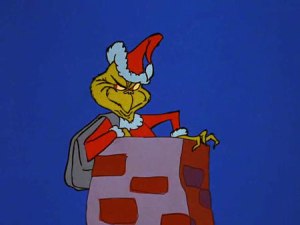
Oh no. Does my heart look three sizes bigger to you?
Reboots of Reruns

Reboots of TV shows aren’t new. The New Monkees, The New Adam-12, The New Odd Couple, The New Gidget, The New Perry Mason, which aired while the old Perry Mason, Raymond Burr, was starring in Ironside, which would later be rebooted in 2013. Oh, and there’s reportedly another Perry Mason reboot in the works. From Dragnet to Kojak, Love Boat to Fantasy Island, Dark Shadows to Mission: Impossible, reboots have always been a thing.

I’ve changed my stance on reboots somewhat. As much as I would love for the people in charge to stop dipping into the pop culture well of yesterday and instead invest in fresh ideas written and performed by those not necessarily straight, white, cis, and mostly male, I’m no longer screaming about the originals that are being rebooted as being untouchable and sacrosanct.

Why?

The reboots are not for me.

If the reboots were for me, they’d just put the reruns on. I mean I love shows that went off the air before I was born. But. Why can’t they be redone, updated, and polished for a new audience? It worked for Battlestar Galactica. The original ran only one season, written off as a hokey Star Wars rip-off, though it was followed by the single-season sequel Galactica 1980. The reboot ran four season, garnered quite a bit of attention and acclaim, and created quite an enthusiastic fanbase. I never got into it as I prefer my Cylons shiny and the bad guy to have a purple light bulb for a head and wear a disco cloak, but even I know that we were all blessed having Richard Hatch back on our TVs on a somewhat regular basis.

I cried foul when it was announced that Hawaii Five-O was being rebooted. But it’s in its ninth season now. The only episodes of it I’ve watched pertain directly to the original (the remake of “Hookman”, Ed Asner’s character from “Wooden Model of a Rat” coming back, their take on “Cocoon” for the season 9 opener) and while I appreciated those episodes and the fact that show goes out of its way to pay such homage and respect to the original, I’ve never felt compelled to watch it on the reg. It’s not for me. But other people enjoy it plenty.

To me, it’s actually a good example of a reboot. The love for the original is plainly visible. The important elements are intact. The stories and cast have been updated, the characters tweaked, but at their core, they’re very familiar.

The reboot of Magnum PI appears to be going in this direction, which makes sense since the guy who developed it also developed the Hawaii Five-0 and MacGyver reboots. I watched the first few episodes, and I think the respect is very much there. No, Magnum doesn’t have a mustache (though there was a mustache reference in the second episode), but he’s still a handsome and charming war vet turned private investigator and all-around do-gooder and at his core, that’s who Magnum is. There is an unfortunate lack of short-shorts, though. We’re being denied man thighs.

But that’s a personal complaint.

Also greater than the mustache is that this Magnum is Latino. That’s one nice aspect that reboots can provide. Diversity. Yes, there’s always squawking when a male character is recast as a woman (Starbuck on Battlestar Galactica, Kono on Hawaii Five-0, Higgins on Magnum PI), which tells more about the squawkers than it does about the shows. But let’s be real, kids. Television, particularly action and sci-fi shows, are largely sausage fests. There’s nothing wrong with women cast as known characters provided that the characters reflect the change.

Getting non-white actors in those classic roles, too, opens up a world of storytelling provided the change is reflected. There are now new dimensions added because the characters aren’t working what’s considered the default. The reboot of One Day at a Time features a Cuban-American family. Back in the ’80s, The New Odd Couple (not to be confused with the 2015 reboot of The Odd Couple) featured a Black duo played by Ron Glass and Demond Wilson. Reboots also offer the opportunity to create new characters that could be played by non-white, non-male, non-straight, non-cis actors.

Reboots aren’t going away. So long as they can be viewed as a pop culture lure to draw in old fans while creating new, something with a vague scent of money to it, they’re going to keep getting the green light. And some of them are going to be positively horrid bombs that spit all over their source material and they should be rightfully shunned.

But others won’t be. Others will end up being pretty okay. And if we can’t enjoy them, then we should leave them to those that do because we still have the originals.

And if they ever need a consultant, I’m available.

Best Characters to Join a Show After the First Season

One day a question floated across my Twitter timeline: Who’s the best character to join a show after the first season?

And my immediate response was, “I can’t answer this with a tweet. I need a blog post!”

So here I am, months later, finally getting around to answering that highly subjective question. In order to keep from rambling, I only picked characters from shows I’ve written about here. And even then, I restrained myself to keep it down to a dull roar.

Let’s start off with a couple of the more subjective ones and work our way (okay, my way) closer to objective.

Ben Kokua (Al Harrington) and Duke Lukela (Herman Wedemeyer), Hawaii Five-OYeah, you’re going to have to fight me on this one. Ben replaced Kono (Zulu) at the beginning of the fifth season and stayed through the seventh season. I feel he made a nice addition to the team. Solid, native, not flashy, except when he was undercover and had to wear ugly shirts as part of the gig. Al Harrington had already been on the show a few times, playing other (and usually bad) guys, and has since had a recurring role on the new show (playing yet another character). Clearly, every version of this show needs Al Harrington in some form, though I maintain Ben was the best.

Duke is a legend in my mind. Though Herman Wedemeyer was there from the beginning, the character of Duke didn’t actually happen until the fourth season. Of the 155 episodes that Herman Wedemeyer is credited for, only seven were not as Duke Lukela. Better yet, we get to watch as Duke goes from uniformed officer bit role to a detective with a starring credit in the final season. How marvelous is that? And if you still doubt that Duke should be on this list, then let me point out that the current show also has a Duke Lukela and he’s played by Dennis Chun, the son of the original Chin Ho, Kam Fong. Now that’s legend.

Sheriff Mort Metzger (Ron Masak), Murder, She Wrote–When Tom Bosley left the show, Cabot Cove needed a new sheriff. With Amos Tupper retired, the new law in town came in the form of Mort Metzger, a city cop who didn’t understand why the murder rate of a small town was so high and why some old woman was so involved in solving them. It was the fish-out-of-water aspect of Ron Masak’s character that not only separated him from Amos, but from everyone else in town. He spent half of his time bewildered by the goings-on of the locals, his hard line approach not so effective in a town where everybody knows everybody. Considering Ron Masak was in episodes of both The Monkees and Land of the Lost, it’s no wonder he was able to bring a touch of brilliance to this character and even make his never-seen, often-referred to wife Adelle come to life.

Detective Arthur Dietrich (Steve Landesberg) and Officer Carl Levitt (Ron Carey), Barney Miller–Both Steve Landesberg and Ron Carey appeared on the show as different characters prior to becoming the two of the characters on this list. Steve Landesburg first appeared as Father Paul in the first episode of season 2. The 12th episode of that same season, he made his first appearance as Dietrich, a dry-humored, incredibly intelligent detective who came in as Fish was going out. Of course, the two would appear together for over a season until Abe Vigoda’s official departure at the beginning of season 4. Many of his first episodes involved him trying to find a place in the 12th precinct. By the time the show ended, it was hard to imagine what it was like without him.

Ron Carey’s first appearance was as a character called The Mole in the last episode of the second season. It was only the third episode of the third season when he made his first appearance as Carl Levitt, a short, overly-enthusiastic uniform keen on making detective some day and taking every available opportunity to get into plain clothes. Not just a punchline, Levitt got to be the hero by saving some kids, ratted out the squad room with petty grievances to both protect them and to express his displeasure from being put down all the time, and eventually made detective in the final episode. As well he should.

Festus Haggen (Ken Curtis), Gunsmoke–This twenty-year show was on the air nine years before Festus Haggen settled in Dodge City permanently. It’s hard to imagine Gunsmoke without Ken Curtis, especially since most of the syndication packages typically show the later episodes, but Dennis Weaver played Chester Good for 290 episodes (1955-1964). Festus’s first appearance actually came in 1962, but he became a regular in 1964 after Dennis Weaver left and ended up becoming such an iconic character that it’s hard to imagine Ken Curtis as anyone else (he was, though, playing a few different characters on the show before becoming Festus). Dodge City wouldn’t be the same without him.

This list is far from complete, of course. And it’s far from objective, as I warned. I might just answer this question again sometime in the future. New list, new shows, new characters. The answers are endless.

Who do you think the best characters are that joined a show after the first season?