The Complicated Legacy

I had mixed feelings when Kirstie Alley passed away in December.

She was one of my birthday buddies and our first names are similar, something my mother loved to point out. I was never a big fan of Cheers, though I did watch it when I was younger, and I only watched Veronica’s Closet a little bit. When I think of her, I tend to think of her movie work first, primarily Look Who’s Talking and Summer School because we watched those flicks an ungodly number of times when I was a kid. I always enjoyed her whenever she showed up in something. I liked her.

But.

In the last several years of her life, I didn’t like her, at least not on a Twitter level. Social media exposed her as the sort of person I did not care to know. Not just the scientology, but some of her personal and political opinions were just, well, garbage.

So, it was strange for me when she passed away because while I did respect her work, I didn’t really respect her all that much as a person anymore. I was sad, but not? Somewhere closer to unaffected. Like I should have been sadder than I was given that I used to be quite fond of her. Something like that. It’s hard to explain. It was even further complicated when the people who knew her mourned her as being so kind to them and then trying to reconcile that with some of the hateful shit she said online. I realize humans are complex creatures, but damn. I shouldn’t be this twisted up about someone I only experienced, but never knew.

I think those conflicted feelings are not uncommon when it comes to actors, particularly those who play roles that we like so well, but the person playing them turns out to be not so great. There are some people who can separate the artist from the art, but for others, it’s not so simple. The revelation that the actor is some kind of nasty less-than cannot be bested by the suspension of disbelief.

The actor doesn’t have to die for that conflict to kick in either.

Take Stephen Collins for example.

I’ve talked about how good he was in Tales of the Gold Monkey. And he spent multiple seasons playing the perfect father on 7th Heaven. But the reality is that the guy is garbage of the inappropriate touching variety. I can’t speak for 7th Heaven fans, but in my own experience watching Tales of the Gold Monkey, that legacy hangs over the whole show. It’s not something I can just forget about while I’m watching.

Nor should I.

There’s is nothing wrong with me not being able to separate the art from the artist, particularly if the artist is someone who has done something so despicable. I have conflicted feelings about enjoying Tales of the Gold Monkey because of Stephen Collins’s role in the show. How I deal with that is up to me to work out.

There are some people I will never give money or attention to again because of their actions (the wizarding TERF comes to mind). Those are the easy ones. It’s the ones like Kirstie Alley that are a little more difficult for me to reconcile.

People are complicated and so are their legacies.

And, yeah, that affects their art.

Rerun Junkie Characters–Calleigh Duquense

When I watched CSI: Miami first run, I liked Calleigh Duquense, but it wasn’t until I watched the series again more recently that I really came to appreciate her. She’s a fascinating character played exquisitely by Emily Proctor and her evolution across 10 seasons of the show is equally interesting.

Calleigh Duquense is a CSI with a ballistics specialty which is a gilded invitation to a “strong woman” stereotype. A woman with the nickname “Bullet Girl” would be expected to be something of a tomboy, someone who’s stern and unemotionally tough, who eschews the “girly” things and wears a lot of denim and camo. Instead, we’re treated to a different kind of “strong woman”, one who’s bubbly and sunny and embraces the feminine and isn’t afraid to show emotions, but at the same time has excellent control over them. She’s tough without question, but she’s not what I’d call hard.

She shows up in the first episode of the series with braided pigtails and a sunny determination in the middle of a plane crash. It’s a beautiful introduction to the character. At one point in the second season, Speed says that Calleigh is entirely too cheerful. And he’s not wrong. “Cheerful” is a different direction when it comes to characters on cop dramas. They might be funny, but that humor is typically used to mask some sort of past trauma or toll the job takes on them. Everybody has a past and many times on shows like this, the characters end up leaning into the melancholy of it in order to give them depth. Calleigh doesn’t do that. She doesn’t have to.

This isn’t to say that she’s had a painless life and that she’s immune to trauma. She actually endures quite a bit during the show’s ten season run. And that does take its toll.

Calleigh is arguably at her sunshine most in the first couple of seasons, but even then she was dealing with her alcoholic father. Kenwall “Duke” Duquense isn’t a rough drunk. He doesn’t get violent. He’s not abusive. He’s usually a happy drunk, but he can be a morose one, too. Either way, taking care of him falls on Calleigh. She’s the one who scoops him up from the bar and delivers him home safe. Most of the time. A drunk driving incident leaves her dad looking at a murder charge, but he’s eventually cleared. As relieved as Calleigh is, she also takes his keys. She can’t stop him from drinking -she’s been supportive of every trip he’s made on the wagon and wants nothing more for him to stay there, but he’s a grown man who has to make his own choices- so she stops him from driving. There’s no question that she loves her father, but the man is also a challenge. It’s a great storyline that shows a different side of our tough sunshine girl.

Some of Calleigh’s bubbly personality begins to recede in the third season, and it’s understandable. First Speed, her friend and colleague, dies in a shootout, a fear realized as she’d warned him to keep his gun clean. Then her father’s DUI incident. And then her former boyfriend John Hagen ends a difficult period in his life by shooting himself in front of her in the ballistics lab. The lingering impact of that final blow drives her out of ballistics and away from her identity as bullet girl. At least for a little while. She eventually finds that you can go home again, in a sense.

Over the rest of the series, we watch as Calleigh’s accumulated experience -including two close brushes with death- matures her in the sense that her sunshine dims a little bit. It doesn’t go away entirely. She still smiles and she still makes jokes, but not as much as she used to (her teasing Walter with an eyeball hits me almost as a glimpse of the old Calleigh in a way). She becomes much more serious over time. Even her wardrobe reflects the change. She goes from wearing brighter colors to a more muted palette. The later seasons almost make me sad given how much black she wears (I acknowledge that Emily Proctor was pregnant during Season 9 so the black was more strategic then). It makes me long for the vibrant Calleigh of the early seasons.

Despite this apparent dissipation in effervescence, her experiences do sharpen certain aspects of her character. Not one given to pettiness to begin with, she outpaces almost everyone except Horatio when it comes to reason and emotional control, particularly in regards to her coworkers. She rarely flies off the handle with any of them and when she does get angry with them, you totally understand it. And even then, she’s not one for dramatics or cheap shots. It might be heated, but it’s direct. She leaves no room for misinterpretation.

Her ability to remain in control when dealing with difficult coworkers, suspects, witnesses, and situations sets her apart from the rest. While Eric and Ryan are still pouting over the revelation that Natalia was the lab mole for the FBI and is now working as a CSI, Calleigh has already reconciled that betrayal and is ready to move on. When Ryan whines about going out on a case with Natalia, Calleigh lands on Natalia’s side, giving her a vote of confidence. And when Natalia makes a mistake on a case, Calleigh helps her fix it. She gives her the consideration that the pouty boys wouldn’t until they were forced. Calleigh lives in the present.

Another episode that illustrates this skill is when Calleigh is being investigated for an off-duty shooting in which it appears her actions lead to a woman’s death. She’s distraught by this, visibly upset as she talks with Eric in the ambulance after the fact. But it’s a different story when she’s dealing with Stetler and internal affairs. She takes his insinuations that she was inebriated during the incident and basically rams it down his throat; she can’t tell him what the remaining suspect looks like, but she can describe in detail the gun he stuck in her face. She’s pissed, but she doesn’t lose it.

She also doesn’t lose it when she’s taken hostage buy a couple of shitheads who want her to help them cover up a murder. Calleigh keeps her cool, does what she can to acquiesce to their demands in order to stay alive, while also leaving a trail for her fellow CSIs to find. Her faith in her team is unshakeable and so is she. Calleigh might be effected by the whole experience, but she doesn’t fall apart, at least not until she knows it’s safe. And even then, she doesn’t so much fall apart as she relaxes and allows herself to breathe a shaky sigh of relief.

It would be easy in light of these trials and traumas for Calleigh to lose her empathy and caring nature, but she doesn’t. She still has a way of connecting with victims and witnesses, sympathizing with them and supporting them through a terrible moment in their lives. And of course she has this softness for her friends and coworkers as well in big and little ways. It never fails to hit the mushiest part of me when a gazebo comes down on Dr. Tara Price’s head and Calleigh calls her “babe” while tending to her. It’s not a shipper thing, it’s just sweet. Calleigh is just sweet tea sweet with the people she cares about.

It’s part and parcel with her loyalty to them. She’s ride or die with Horatio and will come to the defense of every single one of her team members. Like with her father, Calleigh wants to be as supportive as possible of them. Even when they kinda don’t deserve it. Or you could understand if she didn’t. Let’s face it, nearly everyone she’s worked with and cared about have lied to her big time. It would be easy to hold that grudge, but she doesn’t. They may have to earn her trust again, but she forgives them. And she doesn’t give up on them. Like I said, Calleigh lives in the present.

Calleigh has her share of romantic relationships (none of those men are good enough for her, though, not even Eric; I will not be moved on this), and while you get the sense she’d like a happily ever after, it’s not a defining aspect of her life. Neither is having children. She’s at no point reduced to a walking biological clock. What’s interesting is that when Calleigh does show interest in having kids, it’s a specific brother and sister she encounters on a case. She doesn’t just want to have a baby or adopt a child; Calleigh wants those two specific children. She’s bonded with them (particularly the older boy) and she’s willing to alter her life for them. And does, successfully adopting them in what would be the final episode of the series. It would have been intriguing to watch how she coped as a working single mom of two, how that would have changed her character.

I have a feeling that it only would have made Calleigh better.

She’s already pretty great.

Rerun Junkie Confession–Gimme That Found Family Vibe

I’ve written before about how Gilligan’s Island was the first rerun that really made an impression on me, something that I totally fell in love with even though I was so young. It is most likely responsible for my love of reruns today.

It’s also one of the earliest indications that shows with a found family vibe were going to be in my wheelhouse.

Maybe it’s my own strong desire to belong somewhere, but those shows that feature a group of people coming together to form a family get me on a soul level.

Look at Gilligan’s Island. Seven people thrown together in an unlikely and extreme situation, forced to survive. Okay, that’s a dramatic explanation for a sitcom, but it’s not wrong. They have to come together as a family to survive. Sure, they bicker and quarrel and many times want to drown Gilligan after one of his fuck ups, but ultimately, they care about each other. This never would have happened if they hadn’t gotten shipwrecked. They’d have completed their 3 hour tour (with an unnecessary amount of luggage) and then gone their separate ways. Fate (and Sherwood Schwartz) threw them together and gave them a bond that even being rescued couldn’t break.

But it’s not just that extreme found family vibe I’m looking for. Chosen family is a kind of found family and that works for me, too.

Take for example another early love of mine, The Monkees. It’s a show about a band trying to make it. Obviously, these four guys came together to form a band, so they must have at least known and liked each other before they moved into a beach house together. It’s less fate and more struggling dream that has them scraping together rent and playing gigs. But they’re no different than four brothers, squabbling on occasion, but always having each other’s back. Just look at the episode “Success Story”. Davy’s grandfather is going to take him back to England and the fellas do everything they can to keep him in America. After all, they may not be blood, but they love each other like they were.

It’s this found family/chosen family vibe that could account for my love (at least in part) of cop shows. Be it partners, a team, or a whole squad room, you end up with people who come for the job and stay for the family.

Barney Miller is a great example of this. There’s a squad room of detectives who are paid to be there, but the nature of the job means that they have to have each other’s backs. It’s inevitable that this would eventually extend into their personal lives to an extent. When the final episode sees the precinct closed and everyone split up, you still get the sense that even if they aren’t working together, and maybe if they never see each other again, they all hold a very special place in each other’s lives. The way blood bonds family, they’re bonded by experience.

CSI: Miami not only has a similar vibe, but even has Ryan saying that they’re his family in the final episode.

Starsky & Hutch are akin to blood brothers given how many times one has been near death and the other has bailed him out. Adam-12 has a similar feel even though most of the series focused on the mundane aspects of the job. When you’re riding in a car with a guy for 8-12 hours a day, there’s only a couple of ways your relationship is going to go.

Emergency!, The A-Team, The Golden Girls, Stargate: Atlantis, F-Troop, Magnum PI…the one thing they have in common is that they all have a found family/chosen family vibe.

And I simply cannot get enough of it.

Rerun Junkie Guest Stars–Ron Masak

When Sheriff Amos Tupper (Tom Bosley) left Cabot Cove, there were some big law enforcement shoes to fill. Enter Ron Masak as Sheriff Mort Metzger.
Arguably the role he’s most recognized for, Ron Masak brought life to the New York City cop learning the ins and outs of a small town with a high murder rate on Murder, She Wrote. His interactions with the citizens of Cabot Cove while he tries to help Jessica Fletcher solve murders add a touch of humor to the rampant killings. And maybe it should be no surprise that he ended up fitting in so well. He had guest starred as two different law enforcement characters earlier in the series.

In addition to the role of Charlie Wilson on the short-lived series Love Thy Neighbor and a small recurring role of Woody on Webster, quite a few of Ron Masak’s 122 credits are on the small screen.

Mr. Masak has several memorable appearances on TV shows, sometimes in only a scene or two. One of my favorites is on Barney Miller. In the episode “Horse Thief”, a handsome cab owner has his horse stolen. In order not to lose any business, he steals a police horse. Mr. Masak plays the officer with the missing horse. The character is funny, odd, and maybe a little overzealous. In the end, he and the horse thief end up on the same side because as it turns out, the handsome cab owner took a different horse…which means another officer took his horse…and he uses spurs.

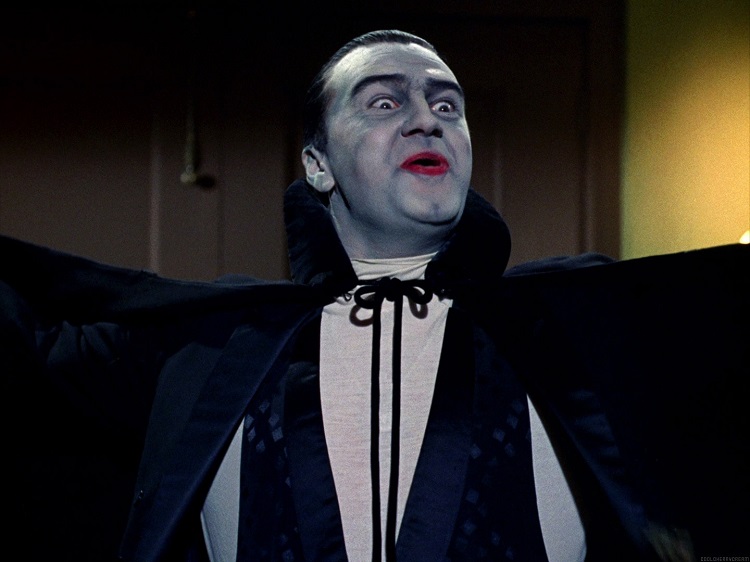
One of my other favorite guest spots is a second season episode of The Monkees called “Monstrous Monkee Mash” in which he plays The Count. Are the Monkees getting into shenanigans with horror characters like a Count Dracula-ish vampire, his niece, a mummy, and a wolfman? Absolutely. It’s a funny episode, bits of which have firmly implanted themselves into my brain. It’s also noteworthy to mention that the Monkees were a little more out of control during the second season, which could frustrate guest actors. However, Ron Masak kept up, kept his cool, and pulled off a fun and funny vampire. He would have made a fitting mentor for Vampire Davy Jones if he hadn’t been vanquished.

I will admit that his appearance blew my young mind when I realized it was him because until that moment, he’d always been Sheriff Metzger to me. Him appearing on a ’60s show didn’t seem possible to my young self.

Some other ’60s shows Ron Masak appeared on include The Flying Nun, Get Smart, I Dream of Jeannie, Bewitched, and The Good Guys.

He spied on Mission: Impossible, took a trip to the Twilight Zone, and visited the Land of the Lost; privately investigated on The Rockford Files, Magnum PI, Longstreet, Barnaby Jones, Mannix, Remington Steele, and The Law and Harry McGraw (a Murder, She Wrote spin-off in which he played yet another cop character); checked in on Marcus Welby MD, Medical Center, and E/R; visited Mayberry RFD and rode the Supertrain; tangled with the law on Police Story, Police Woman, Ironside, The Feather and Father Gang, She’s the Sheriff, McMillan & Wife, and Columbo; lent his voice to The Real Ghostbusters; hung out with some names on The Mary Tyler Moore Show, The Bob Newhart Show, Quincy ME, and Alice; he had Good Times and Diff’rent Strokes; leapt into action on Emergency! and Wonder Woman; enjoyed some Love, American Style; and got unexpectedly soapy on The Yellow Rose, Falcon Crest, and The Bold and the Beautiful.

Ron Masak made an impression on every show he guested on, be it a recurring role or only one scene. He had a way of taking a character, making it memorable, and adding a bright spot to every episode he was in.

And we’re lucky to indulge in his shining light.

Five TV Tropes I Hate

During one of our Eventually Supertrain discussions, Dan suggested I write “10 TV tropes I Hate” and I decided to take his suggestion. However, I chose to cut the number in half. It felt a little aggressive to do ten.

I figure I can make a series out of this if I am so inclined.

And given how many tropes irritate me…

So, here they are in no particular order.

Five TV Tropes I Hate.

  1. The Bickering Couple -Blame the societal standard that het couples should detest each other. Married or dating or unresolved sexual tension, this seems to be the go-to way to show that two people are meant to be. Look at how they bicker with each other! Sure, couples bicker. They give each other shit. But if this is their sole way of communicating, it’s fucking annoying. I complained about this during the discussion of the Tales of the Gold Monkey episode that inspired this post. Jake and former-lover-turned-nun Bridget spent most of their conversations bickering, to the extent that if one of them said the sky was blue, the other one would disagree. That’s not chemistry. That’s grating. It’s hard to enjoy an episode when you’re irritated the entire time.
  2. Will They or Won’t They? -I don’t care. I don’t care about the arbitrary obstacles thrown in the couple’s way to prevent them from coming together and drag out the unresolved sexual tension as long as possible. I don’t care how they’re obviously meant for each other and any other human they interact with is an agent of the devil sent to prevent this holy union. It’s boring and takes up valuable screen time that could be spent on something more interesting, including getting these two characters together in a more creative way.
  3. A Good Ol’ Miscommunication -You know what I’m talking about. If one person would just talk to another person, it would all be worked out. Granted, the episode would only be about four minutes long, but still. I wouldn’t be subjected to all of the justifications of why this simple solution hasn’t happened yet. Same with seeing two characters interacting from a distance and then jumping to a conclusion. If this person is supposed to be close with one or both, wouldn’t they just ask? Yeah, they would. Because assuming makes asses of us all.
  4. Secretively Bratty Children -I’ve already discussed how I’m not big on children in TV shows to begin with. I feel they’re written so poorly. But of all of the TV children I despise, the secretly bratty kids make me wish it were possible to reach through the TV and slap someone. I’m not talking about the Eddie Haskells, who are shit to their fellow young people, but kiss asses to the adults. Nor am I talking about the spoiled kids whose parents will always defend them. I’m talking about the kids who are shitty to one adult in particular and then an angel to every other adult, making those adults doubt the other adult. Yes, this is a very specific hate. This sort of trope is usually played for laughs, but I’m not amused. My blood pressure is elevated just writing about it. I don’t advocate violence against children, but seriously, throw those kids in the trash. You think they’re cute now, but they’re going to grow up to be your least favorite coworker.
  5. No Sunglasses When It’s Sunny -This is less of a trope and more of a petty hill I will die on, but I think it’s absolutely ludicrous that you stick characters in sunshiny locations and then deprive them of the appropriate eyewear. Especially when they’re driving. I don’t want to share the road with these people who are squinting so hard to see that they’re giving me a headache. I realize that the justification of this is so we can properly see the actors emote, but I will counter that argument with Darth Vader and the Mandolorian. They don’t seem to have a problem. Y’all make fun of Horatio Caine for rocking his sunnies, but you don’t see him squinting, now do you? No.

Are all of these dislikes a little petty? Yes. Will listing them out like this change the course of television writing? No. Writers are going to continue to execute these tropes to their dullest and I’m going to continue to roll my eyes and pine for the rare instances when writers choose to subvert or even all together avoid them.

Hope springs eternal and these tropes will no doubt last forever.

Rerun Junkie Guest Star–Joyce Van Patten

“I didn’t know Dick Van Patten had a sister,” my roommate said.
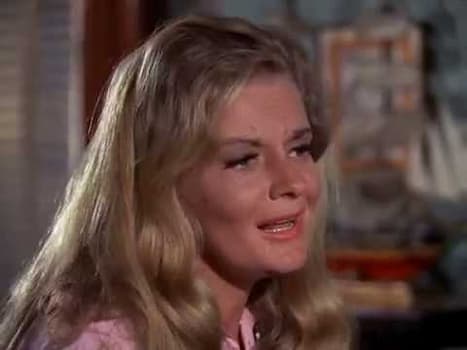
Now I could take that two ways. One, my roommate didn’t know who Joyce Van Patten was or two, she knew who Joyce Van Patten was, but just didn’t realize that she was Dick Van Patten’s sister.

It turns out it was the latter and that stands to reason. Joyce Van Patten has had quite the solid career, built upon her own fantastic talents. A little nepotism really wasn’t necessary in her case.

She was Claudia Gramus on The Good Guys, Iris Chapman on The Mary Tyler Moore Hour, and Maureen Slattery on Unhappily Ever After. And she has a slew of guest credits on a wide variety of TV shows.

Two of my favorite guest appearances of hers happened to be on the same show, Hawaii Five-O.

Miss Van Patten made her first appearance in the Season 3 episode “The Payoff”. She plays a woman helping out an old friend that she’s sweet on. The only thing is that her old friend was involved in a kidnapping for ransom that ended in murder and now he’s been gut shot by one of his co-conspirators. She’s desperate in multiple ways –desperate to help Jace, desperate to have Jace feel for her what she feels for him, and desperate to evade the law. Unfortunately, none of it works out for her and the scene in Steve’s office where she spills her guts has you aching for her.

Her second appearance came in the Season 5 episode “I’m a Family Crook–Don’t Shoot!” I picked this as my favorite episode of that season and with good reason. Joyce Van Patten plays the matriarch of a swindling, thieving family with Andy Griffith as her husband. The family pulls their bump and grab routine on a mob bagman and lets just say that it doesn’t work out well for them. These crooks are obviously the lesser of the evils in this ep, and even though they are crooks, you can’t help but like them. The way that Miss Van Patten plays both outlaw and doting mother is a unique blend that feels real. She is all about her family, it’s just that the family business is illegal.

She also tangled with the law on episodes of The Untouchables, The Defenders, Perry Mason, Men at Law, The FBI, McCloud, The Streets of San Francisco, Amy Prentiss, Columbo, Law & Order, and NYPD Blue; worked with Jack Lord on Stoney Burke and Andy Griffith on The Andy Griffith Show; checked in on Ben Casey, Dr. Kildare and Young Dr. Kildare, The Bold Ones: The New Doctors, Medical Center, and Diagnosis Murder; got laughs on The Many Loves of Dobie Gillis, The Odd Couple, The New Dick Van Dyke Show, and Love, American Style; worked with Bob Newhart on The Bob Newhart Show and Bob; went west on Gunsmoke and The Virginian; went to jail on Oz and got in with mob on The Sopranos; privately investigated on Cannon and The Rockford Files; got spooky on The Alfred Hitchcock Hour, The Twilight Zone, and the 1960s Outer Limits; was family oriented on Family, Sisters, Touched by an Angel, and Judging Amy; made headlines on Lou Grant and disappeared on Without a Trace; went back in time on Boardwalk Empire and Brooklyn Bridge; and got soapy for several episodes on All My Children.

Joyce Van Patten has a charm that shines across genres, no matter the role or the show. She’s eye-catching in a subtle way, and compelling whether she’s making you laugh or pulling at your heart strings. Her older brother may have been pretty great, but she holds her own. As the paraphrased saying goes…thank God for little sisters.

Rerun Junkie Episodes–“The Duke of Squigman”

In case it escaped your attention, I guested on an episode of Night After Night to talk about this episode as Squiggy is my favorite. During our discussion of the episode, I said I could write a blog post about the tag scene.
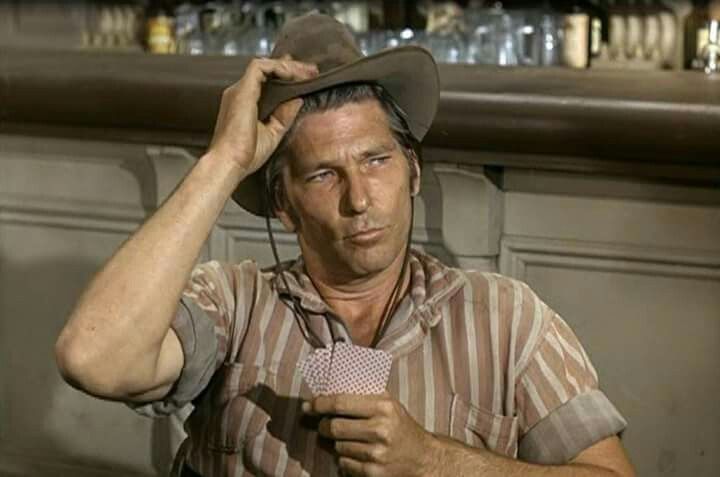
This is that blog post.

Because I feel that the tag scene of this episode is a perfect example of how reruns should be viewed in two different contexts.

If you haven’t seen “The Duke of Squigman” and/or listened to me, Lisa, and Chris discuss it (why the hell not? you’re missing out on some good shit), the quick synopsis of the episode is that Squiggy has been sleepwalking and when he does, he adopts the persona of -you guessed it- the Duke of Squigman. It turns out the reason that Squiggy is sleepwalking is because he can’t accept the fact that some people just don’t like him.

I know. I find that hard to believe as well.

The episode does a fabulous job of balancing the funny, the sweet, the absurd, and the emotional.

And then there’s the tag scene.

After the emotional conversation between Lenny and Squiggy about the psychological motivation of Squiggy’s sleepwalking, the boys are at the Pizza Bowl and Squiggy is attempting to hit on a woman sitting at a table. Naturally, she rejects him. Squiggy consults with Lenny about whether or not his feelings are hurt by this and Lenny affirms that they are. Squiggy acknowledges this and decides that he doesn’t care. He then proceeds to kiss the woman right on the mouth.

It should go without saying that this has aged poorly.

In the time this show was set (late ’50/early ’60s) and the time it was filmed (mid-late ’70s/early ’80s), this type of mild sexual assault was normalized and typically played for laughs. Of course it was. We don’t want to think of our favorites as sex pests.

Watching this scene in the context of the now, it’s not the laugh that it’s supposed to be. It’s uncomfortable. It doesn’t necessarily spoil the episode, but it definitely ends it on a sour note. As a woman, if a dude I had rejected forced a kiss on me, it wouldn’t be funny. It’d be a felony. ‘Cause I’d be going to jail. Living in a society in which there is a constant struggle in regards to the entitlement men believe to have to women’s bodies, in which violations of these boundaries are categorized and graded and the acceptable responses to them dictated by a certain script that ultimately makes them easier to dismiss, it’s kind of difficult to find the humor in the joke.

However.

In the context of the narrative, it makes complete sense.

Squiggy has confronted the issue that makes him sleepwalk. When presented with his next rejection, he checks in with Lenny, acknowledges that his feelings are hurt, and then soldiers on. That’s growth. Not a lot of growth, but it’s the growth that you’d expect to get from a character like Squiggy. At least he’s acknowledged that the woman has rejected him and that, yes, his feelings are hurt. But he ultimately decides that he doesn’t care. Now whether or not this is another form of denial is another story. But for Squiggy, just acknowledging it is progress.

Could this be accomplished without the forced kiss? Sure. No doubt that Squiggy could have showed his little bit of growth before insinuating himself into this woman’s space without forcing affections, and probably could have been done in such a way that would have garnered the same volume of laughs, with the added benefit of retaining much of those laughs in future viewings.

However, in the context of when the show was set and when it was written, it makes perfect sense that this would be the gag used to convey Squiggy’s limited growth, especially given the established behavior of the character being just a little bit slimy with the opposite sex sometimes.

In viewing the episode in these two contexts, I’m able to both acknowledge the problematic content without condemning the entire episode. I’m not absolving it of its offenses, but I am putting those offenses into proper perspective.

This approach allows me to have a more enjoyable viewing experience.

Rerun Junkie Confession–I’m Somehow Not Big on Horror TV Shows

If you asked me what my favorite TV horror is I’d say Kolchak: The Night Stalker.

If you asked me to name my top five, I’d have to strain to do it.

For a fan of horror movies and horror stories and a writer of horror stories, you’d think I’d be attracted immediately to any television show with a hint of horror and as it turns out…I’m not.

That’s right. For whatever reason, I’m not a big fan of TV horror.

Once again, this confession is not a slight on the quality of such programming. It’s just that it doesn’t seem to be my bag…and it should be. These are the kinds of shows that should be tailor-made for me, and yet I find myself to be rather meh on the idea of even watching them.

The list of horror TV shows that I found has some questionable entries, but to be fair, much of the horror TV ends up crossing over with other genres, quite often with Sci-Fi. And there are shows like that -namely the ’60s Twilight Zone and the ’60s The Outer Limits– that qualify as both Sci-Fi and horror and in that case, they’d make my top five list. Thriller and Alfred Hitchcock Presents are good, but to me they’re more suspense than horror and that keeps them off of my list even though you could argue that suspense is integral to horror. Somehow The Munsters and The Addams Family made the list and I just can’t accept that. Yes, one is a family of classic monsters and the other is the antithesis of suburbia, but come on.

I will accept Scooby-Doo, Where Are You!, though. Maybe it’s a cartoon mystery, but some of the fake whatsits those meddling kids were dealing with were terrifying to the right age group. Kids deserve their horror, too. Put that one on my list.

I don’t think my disinterest has to do with the heavier censoring involved in most television. As much as I love slashers, my horror doesn’t have to have gore. I like the quiet, unsettling, psychological horror, too. Hauntings are a low-key favorite of mine. But make it 42-55 minutes for 20-30 episodes and I’m less than enthused.

That’s my only guess for why I’m not drawn to TV horror more. I must prefer it in one large chunk, be it movie or book or short story, rather than be repeatedly exposed to it over a number of weeks.

And I know what you’re thinking. “Just binge it!” I totally could. I did that with the first season of Stranger Things, which I enjoyed. But that was also apparently enough. I’ve never felt compelled to watch any of the other seasons.

By no means am I completely writing off this TV genre. It will perhaps take me a little more effort to find the gems in it that I like since I’m not naturally drawn to it. But I will find them. Most likely by stumbling over them on some late night rerun schedule, like I did with Night Gallery. That one can go on my list, too.

Like I said, it took some work, but I made my top five.

Rerun Junkie Guest Star–L.Q. Jones

When I think of L.Q. Jones, I usually think of him with a cowboy hat. Or a mustache. Or both. Maybe because the roles I associate with him most are cowboys. Maybe it’s because he’s a Texas native. Maybe it’s both. But Mr. Jones played more than just a cowboy and though his film roles might have been bigger, he’s always been around on the small screen as well. With 165 credits from 1955-2006, he had plenty of opportunity to do more than hang out on the range.
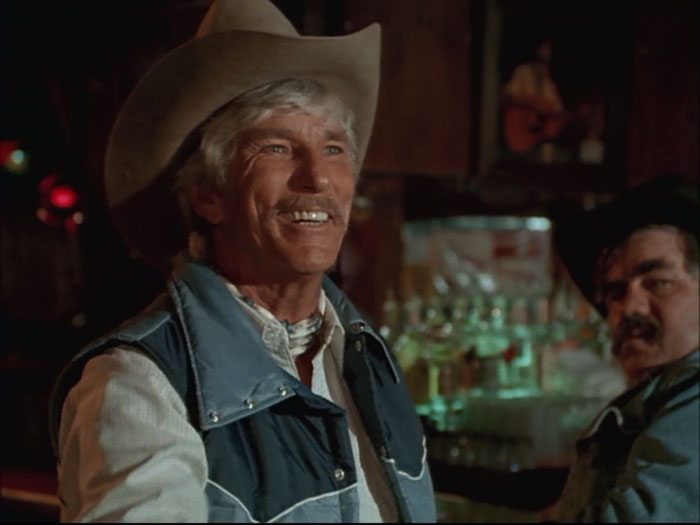
However, he did hang out there a lot as Belden on The Virginian and Sheriff Lew Wallace on The Yellow Rose. He also did a stint on the show Renegade, which sounds like it could have been a Western, but was really more of a “What if The Fugitive became a bounty hunter?” show.

My personal favorite guest role of L.Q. Jones is his appearance in the Season 4 episode of The A-Team, “Cowboy George”, in which he gets to be a cowboy villain in a decidedly non-Western show. He plays Chuck Danford who owns the “Floor ’em” where Face has booked Cowboy George to play. Little does Face know that a loophole in the talent contract allowing for substitutions results in Boy George being sent to play the country joint instead. Face is also unaware that the entire purpose of the concert is so Chuck’s associates can rip off the armored car carrying the intended audience’s payroll. It’s not easy playing a bad guy against The A-Team. After all, you’re guaranteed to lose. But L.Q. Jones pulls it off brilliantly. The ease in which he appears to be a good guy right up until he isn’t is great because you buy him as both. He could totally be an innocent business owner or a guy plotting to get The A-Team lynched for the crime that he orchestrated.

Mr. Jones didn’t have to have a big role to make an impression on me. He’s in two episodes that stick in my mind. One is called “A Purge of Madness” from Season 4 of The Bold Ones: The New Doctors. Ross Martin plays a man given to bouts of psychotic rage and the doctors decide to treat it through psychiatric neurosurgery. L.Q. Jones is one of the doctors (along with Milton Berle!) consulting on the case. A small, but integral role that he filled well.

Another one was in the Season 1 episode of Hawaii Five-O called “King of the Hill”. Yaphet Kotto plays a marine suffering from severe PTSD which leads to him shooting Danny before taking him hostage in a hospital room under the belief that he’s protecting a wounded friend and holding a hill until help arrives. Mr. Jones plays a colonel who helps fill in some of the blanks Five-O needs to resolve the situation safely. Again it’s a small role, but an important one. It’s not easy to give convincing exposition.

A natural in a cowboy hat, L.Q. Jones really did pop up on a lot of Westerns, including Alias Smith and Jones, Lancer, Gunsmoke, The Big Valley, Cimarron Strip, Branded, Rawhide, Hondo, Laramie, The Rebel, Have Gun, Will Travel, Death Valley Days, The Rifleman, Tales of Wells Fargo, Cheyenne, Johnny Ringo, The Rebel, and Wagon Train.

He went to the dogs on Lassie and The Adventures of Rin Tin Tin; joined up on Men of Annapolis; tangled with the law on The New Adam-12, Columbo, Walker, Texas Ranger, The FBI, McCloud, Ironside, CHiPs, and Perry Mason; messed around with some good ‘ol boys on The Dukes of Hazzard and Enos; checked in on Ben Casey; privately investigated with Charlie’s Angels, Vega$, Matt Houston, and Cannon; wandered on Kung Fu and Route 66; time-traveled on Voyagers!; and hung on with Bill Bixby on My Favorite Martian, The Magician, and The Incredible Hulk.

Yeah, I don’t know how he missed The Courtship of Eddie’s Father, either.

With or without a cowboy hat, with or without a mustache, if you need a charming villain or a villain with a real mean streak -or both- or even a good guy with a Texas edge, then L.Q. Jones is your man. And we’re all so lucky to have him riding our TV range.

Weaving the Fabric of Pop Culture

I’ll be honest with you: I heard the phrase “Book ’em, Danno” long before I started watching Hawaii Five-O in my early thirties. Considering the show went off the year a few months after I was born, that’s pretty impressive. This one little catchphrase (which wasn’t even designed to be a catchphrase; in fact, Steve McGarrett goes the entire third season without saying it) became a thread that had itself woven into the fabric of pop culture. So has the term “Five-O” as a way to refer to the police. That entered the lexicon before the show even went off the air.

Not bad for a police drama.

I talked a little bit about this phenomenon when I confessed that I’d never watched Seinfeld. Some shows just get into the collective consciousness. Seinfeld was one of those. Intensely popular, I may have never watched an episode, but everyone around me did. Immersed in that situation, I absorbed the show via diffusion. Because the show became so cemented into pop culture, I know all about Festivus, Elaine dancing, George’s fiancee dying, Jerry’s puffy shirt, Kramer’s…everything, yet never experienced any of these things in the context of their episodes.

Much like people recognizing and/or using the phrase “Book ’em, Danno” but have never actually seen Steve McGarrett say it in an episode.

Some shows just get absorbed into pop culture.

A sunglasses-quip combo. “I’m so excited!” A nose twitch. “Hello!” Turkey Drop. “To the moon, Alice!” A ponytail flip. “Dammit, Jim.” Tapping the sides of your fists together instead of flipping the bird. “Who loves ya, baby?” The Monkee Walk. “Marcia! Marcia! Marcia!” The Bart Dance. “Dyn-o-mite!”

There is an excellent chance you recognized more than one of these. And there’s also a chance that you might not have watched all of the shows these came from.

Who’s to say why some shows find themselves a place in pop culture and some don’t. Popularity plays into it, naturally, but not necessarily longevity. Star Trek only lasted 3 seasons, but it’s impact has lasted a lifetime. Obviously, the fans of the show play a big role, not only in making the show popular, but also identifying what bits and pieces will become meme’d and gif’d in some cases decades later.

There’s no telling what show might catch on, or what bit of it might embed itself into the conscious collective mind. Not every super popular show finds its staying power. You never know what little bit people will discover and latch onto and blow up. Or who will latch onto it.

Say “How rude” or “Did I do that?” to a Gen Xer or older Millennial who lived on TGIF and you’ll get a different response than maybe a member of Gen Z who hasn’t discovered that bit of nostalgia yet. Some of these bits of fabric are truly generational, while other bits span the scope.

If I were an educated person, I might better be able to analyze this sort of thing. Pick it a part and understand how it all comes together.

But I’m not.

Instead, I just marvel at all of the colorful bits and pieces woven into the pop culture fabric.

Holy tapestry, Batman!