The Truth Is Always Best…Unless You’re a Cop

Despite my love of cop shows, I’ve never really been into the Law & Order franchise. Never had the urge or inclination to watch any of the shows. Then Charge changed their line-up, I was too lazy to change the channel, and now I’m hooked on Law & Order: Criminal Intent. I blame Vincent D’Onofrio and Kathryn Erbe.
The character of Detective Robert Goren says at one point during the final season that everybody lies all the time. Granted, this is said during a therapy session because my guy has some issues and he learned this lesson from his father telling him to lie to his mother about his father’s affairs, but it sort of makes sense that he would believe that anyway since he kind of lives this truth in his work. During the course of their investigations, he and Detective Alex Eames lie a whole lot to suspects. They lie about evidence, they lie about conversations, they lie about circumstances. I’m not talking about undercover work -though they do that a bit in the series. I’m talking about straight up lying to the people they’re questioning.

This behavior is totally legal. Cops are allowed to lie to the people they’re questioning. Just another reason why it’s important for folks to exercise their rights and ask for a lawyer.

But these are the good guys. Their lies are justified. It’s all in the pursuit of justice. Evidence is fine. A confession is better. In the world of fictional cops, confessions aren’t just the goal; they’re the norm. There’s a narrative to be served here.

Goren and Eames do have their own moral code when it comes to lying to suspects. For example, they won’t pressure a mentally fragile suspect, but instead lie and manipulate the suspect’s psychiatrist, who is responsible for the suspect’s destroyed mental state and ultimately, his crime.

They also right a wrong of a coerced confession from a group of minors accused of assaulting a woman. The cops in the interrogation video don’t do anything that Goren and Eames haven’t done before -lying to and manipulating their suspects- but the difference is these boys are innocent and the cops know it.

Fun fact: it only became illegal in Illinois for cops to lie to minors they’re interrogating in 2022. It’s still legal in other states. This is also why it’s important for minors to know their rights and for their guardians to know them, too.

I know it seems like I’m picking on Law & Order: Criminal Intent, but this is prevalent in just about every cop show. Steve McGarrett wasn’t above lying to suspects on Hawaii Five-O. In the case of some criminals, I think he took a certain amount of pleasure in lying to them just to see the look on their faces when they were caught. He had mean streak when it came to justice.

I’m sure that even the saintly Barney Miller lied to a suspect or two, but I can’t remember any instances off hand and I’m too lazy to do any research on it. It’s not like the 12th precinct arrested the kind of criminals the required an intensive interrogation. Most of them were caught in the act anyway.

The point of copaganda is to normalize some of the worst behaviors of the police and though it is legal for cops to lie to suspects during questioning, it doesn’t necessarily make it a good thing. It’s a manipulation tactic that’s seen more than a few innocent people put behind bars.

Some things are better left to the likes of Goren and Eames.

Book ’em, Danno–Episode 69

Book 'em Danno Podcast

Political motives and personal vendettas collide in “A Bullet for El Diablo”. And then counterfeit bonds and murder are the means to a million dollars in “The Finishing Touch”.

The episodes this season have been running a bit long, so I made a conscious effort to cut down my synopsis and stop rambling so much. As a result, this episode is under an hour. I think we’re all better off.

Also, it’s episode 69, so of course it’s nice.

Listen on Soundcloud, Apple Podcasts, and Spotify.

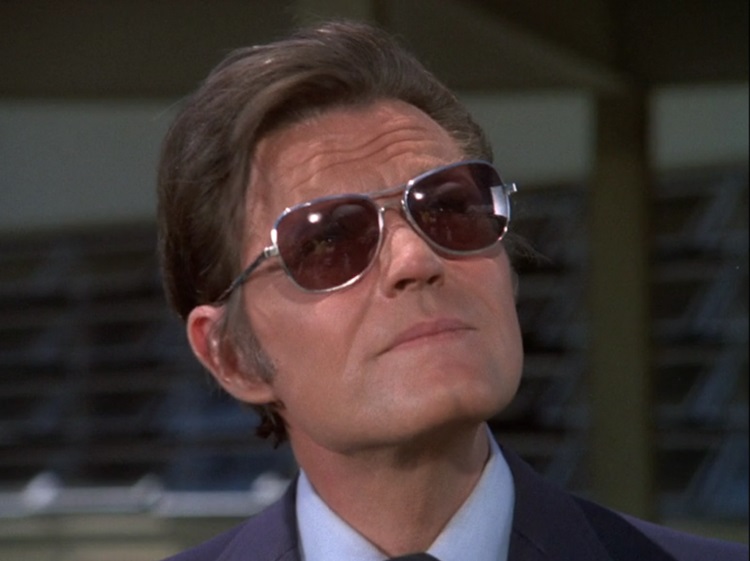
Check out Steve McGarrett setting the sunglasses standard that Horatio Caine would later make iconic. Yes, Steve did do a “putting the sunglasses on to emphasize the dialogue” move.

Jack Lord as Steve McGarret, a serious looking white man in his fifities with brown hair wearing silver framed sunglasses and a dark blue suit.

Hyperfixation Reruns

I’ve talked before about how I can’t answer the question of what my favorite TV show is. I realized recently that I don’t have favorites because I have hyperfixations.

I’ve never been officially diagnosed with any neurodivergency, but my tendency to hyperfixate on things has been with me all of my life. When I find something that truly grabs my attention for whatever reason, I can and will deep dive on it for days, weeks, months, and sometimes, off and on for years.

With this knowledge, it should come as no surprise that some reruns have reached hyperfixation level.

There are two kinds of hyperfixation for me when I fixate on a rerun. One kind has me watching the show repeatedly and picking it apart, wanting to analyze it and write about every conclusion I come to. I don’t share everything I write, obviously, but believe me, it happens. CSI: Miami is probably the most recent hyperfixation rerun of this type. I’ve pulled that show apart and looked at it from all angles and analyzed all sorts of bits and pieces. I’ve written about it. I’ve kept much of what I want to write about it to myself because I don’t want to overwhelm you. My analysis is stunning in a “get a life” sort of way.

The other kind of hyperfixation is when merely watching and analyzing isn’t enough. I have to learn everything I can about the show, the behind-the-scenes stories, and the people who made it. Jack Webb shows fit this bill. It wasn’t enough for me to watch Dragnet, Adam-12, and Emergency! multiple times and analyze the episodes and characters and cases. I had to dig into the background of the shows and learn about the creator and the actors. I had to know more about them than would be asked on Jeopardy. And then once that was satiated, I was able to move on.

Why do I fixate on the shows that I do? I have no idea. Something about them captures my attention and triggers something that makes it hard for me to let it go. I do not know what that magical attribute is because I’ve fixated on a variety of reruns over the years. Okay, yes, there have been a lot of cop shows, but there have been other, decidedly not cop shows, too. The answer isn’t that simple.

How long do the fixations last? It depends. When it comes to reruns, it averages a few months. Typically, enough time to watch the series through multiple times and let my brain mull it over and pick its bones clean. Some shows stay in my brain for much longer; others fall out of my head in record time. The length of time I spend fixating on a show doesn’t seem to affect the intensity. It’s called a hyperfixation for a reason. Regardless of the time spent, the focus is intense.

The one good thing about this particular hyperfixation thing is that it sometimes makes for some interesting blog posts about reruns. The other good thing is that I learn new things and it puts my critical thinking skills to good use in a different way.

It won’t get me rich, but I’ll have some really offbeat trivia to share in conversation.

Brace yourselves.

Book ’em, Danno–Episode 68

Book 'em Danno Podcast

The greed monster is back! First it appears in the form of a questionable inheritance company in “Why Wait ‘Til Uncle Kevin Dies?”. The company fronts heirs a portion of their inheritance before their benefactor dies and then they collect what they’re owed when the benefactor kicks it. Yeah. It’s sketchy and lends itself perfectly to murder. And then some illegal opals spark a whole lot of greed in “Flash of Color, Flash of Death”. Dollar sign obsessions can really ruin a man.

Listen on Soundcloud, Apple Podcasts, and Spotify.

Here are two ambitious men. One is a little off-beat. The other is a little unhinged. See if you can tell which is which.

Book ’em, Danno–Episode 67

Book 'em Danno Podcast

Five-O deals with a killer in their midst in “Murder Is a Taxing Affair” and then tries to keep a group of pimps from going to war with a loan shark in “Tricks Are Not Treats”. Come for the soul crushing government jobs, stay for the ’70s mack fashion.

I’m not sure why I’ve gotten so long-winded on these last few episodes. Hopefully, you’re sleeping well to my extra words.

Listen on Soundcloud, Apple Podcasts, and Spotify.

As I said in the episode, if our love doesn’t include matching vacation outfits, don’t even bother proposing.

matching vacation outfits

Book ’em, Danno–Episode 66

Book 'em Danno Podcast

Season 6 starts to find its groove with this episode. First up, we’ve got murderous hillbillies in “One Big Happy Family”, and then arson with an agenda in “The Sunday Torch”. Heads up for some racism in the former and mental illness discussion in the latter.

Listen on Soundcloud, Apple Podcasts, and Spotify.

In the meantime, please enjoy Slim Pickens and Barbara Baxley straight up ruining a snobby hotel clerk’s day.

slim pickens and barbara baxley

Rerun Junkie Books–Quinn Martin, Producer by Jonathan Etter

If you’re at all into reruns (and you must be if you’re here), then you’re probably familiar with the words “a Quinn Martin production”. A legendary producer during the ’60s and ’70s, the man had a gift for running a TV show. Sure, not all of them were multi-season successes and not all of his pilots were picked up, but he’s got more than one classic to his name.

First published in 2003, Quinn Martin, Producer: A Behind-The-Scenes History of QM Productions and Its Founder by Jonathan Etter covers Quinn Martin’s career as a producer via interviews conducted during the ’90s and early ’00s with actors, writers, directors, producers, and other behind-the-scenes staff who worked with Quinn Martin and for QM Productions during its run.

Starting with an introduction that covers the early life of Quinn Martin, including how he chose his name (he was born Irwin Martin Cohn), the book then covers his career show by show, starting with his executive producing stint on The Untouchables. The book goes into detail on Martin’s hit shows like The Fugitive, The FBI, Cannon, The Streets of San Francisco, and Barnaby Jones; the one season wonders like The New Breed, The Invaders, Dan August, and Banyon; and the shows that seemed to be doomed from the start like Caribe, Bert D’Angelo/Superstar, and The Runaways.

Because the history is covered via interviews, there are some unflinching takes, some dirt dished, and some conflicting views. Lynda Day George, who was the most frequent QM guest star, gushes about her experiences on most of the shows, but also isn’t afraid to be kindly honest about less than stellar times. The interviews with the crew, particularly the writers, directors, and other producers, are fascinating, not only dishing the details of Martin’s shows, but also illuminating how television was done back in the day.

Jonathan Etter does a fine job of organizing and incorporating the interviews with his research. He even includes failed pilots, TV movies, and Martin’s brief time producing films.

As this book was first released almost 20 years ago, many of those interviewed are no longer with us. I admit that seeing some of the names (like Robert Forster) was a gut-punch of sadness. But I’m also grateful that these experiences were preserved for posterity.

This book can be acquired at McFarland Books and Amazon.

Book ’em, Danno–Episode 65

Season 6 has barely started and we’re already to my favorite episode.

Our favorite, Dan Budnik from Eventually Supertrain joins me to talk about “Draw Me a Killer” and “Charter for Death”. Minor trigger warning for animal death for “Charter for Death”. We do discuss it.

And of course, you can find spoilers for the episodes at 47:08 to 58:47 and 1:48:30 and 2:03:55.

Listen on Soundcloud, Apple Podcasts, and Spotify.

Dan and I are covering all the topics in this episode: socks with sandals, grindhouse movies, alternate-universe Cousin Oliver, currents, comics, Bert Convy in a see-through shirt. You’re not going to want to miss a second.

Pimpin’ Ain’t Easy

Let me just disclaimer this by saying that I haven’t thoroughly researched this post. I’ve just been thinking about it.

And what got me thinking about the depiction of sex work in cop shows, particularly pimps in the ’70s, was an episode of Hawaii Five-O that I just covered for an episode of Book ’em, Danno called “Tricks Are Not Treats”. The basic plot of the episode is a group of pimps (called “macks” in the episode for some reason because they’ve had no problem calling a pimp a “pimp” in previous episodes) led by Harley Dartson, played by Glynn Turman, are at odds with a loan shark named Lolo, played by Gregory Sierra, who is taxing their business.

The episode was shot and aired in 1973. Without watching it, I bet you know what the pimps look like, act like, and sound like. There is a certain image that’s been embedded into popular culture when it comes to pimps, particularly of the 1970s variety. These pimps fit that image.

Most of the pimps in this co-op are Black, though there is at least one Native Hawaiian, one Asian, and one token white guy with a ‘fro. All of them are decked out in the classic pimp styles: slick suits, bright colors, fab shoes, and fetching hats. Oh, the hats! It may be stereotypical as hell, but they had style. These Honolulu pimps would have been able to blend into any city on the mainland. They had the look.

The characterization of the pimps of this time period in particular lends them to be very convenient bad guys on cop shows. Just get them in the right outfit and the audience doesn’t need much more than that. It was understood that pimps were bad because prostitution was against the law. Pimps exploited the women who worked for them and weren’t above using violence to get the women to turn their tricks. Frequently, it was these violent tendencies that had them crossing paths with our police heroes. And it was probably not an accident that it seems like a majority of pimps depicted on TV at this time were Black. It seemed like if it was a white pimp as a main villain -and this is just my impression as I have no scientific data or research to back this up because I’m lazy- that he was depicted more as a businessman. He had “escorts”. He had an office. He wore respectable suits. He might not be above committing violence, but at least he was “classier” when he did it.

In “Tricks Are Not Treats”, Harley Dartson is positioned as sort of a good guy in comparison to Lolo, an unlikely and uncommon position for a pimp at the time. The pimps in the episode are humanized beyond the stereotypes that they’re usually presented as. Their line of work isn’t excused and it’s mentioned that they are still willing to use violence against the women in their stables to keep them in line, but that isn’t the focus. It’s them against Lolo and the writers want you on their side. So, they make them likeable, relatable. J. Paul (Ron Glass), prior to his demise, comes across as a funny, friendly guy. Wunton (Moe Keale) is deeply affected by his friend’s death, to the point of losing his cool to defend J. Paul’s memory.

Harley, our main mack, is given a normal home life with a wife, who used to be on the streets as one of his girls, and two children. Sure, Semantha (Lynn Ellen Hollinger) is still very much involved in the administration aspect of the business, keeping track of the women in Harley’s stable and the jobs they’re doing (or should be doing, as she does threaten one woman over the phone to get to a hardware convention before Harley takes a coat hanger to her), but it’s treated as a normal Mom and Pop kind of business. Pimps are having a meeting out on the lanai and Semantha is tracking tricks while the kids eat lunch at the kitchen counter and Harley fusses at the older boy about doing his homework. It’s a rare depiction to get that much into a pimp’s personal life and have it be so suburban.

(It’s also worth mentioning that Harley and Semantha were an interracial couple with biracial children, something else not often seen on TV in 1973.)

There’s a pimp with a heart of gold in an episode of Barney Miller as well. In “The Hero”, Carl Gibson’s mack character Mayflower is arrested for pushing a trick out of a window and ends up helping the guys put a baby Todd Bridges back on the straight and narrow. Sure, he’s doing it in part to ease his own punishment, but a pimp on another cop show wouldn’t have done it at all.

The bad buy blueprints for cop shows are interesting in how they both contribute to stereotypes and then deviate from the stereotypes they helped create. The way pimps are used in these shows is a great example of that.

Imagine what I might discover if I actually applied myself and researched it.

Book ’em, Danno–Episode 64

Book 'em Danno Podcast

Season 6 kicks off with a unique kind of bang. It’s a compare and contrast episode between the original 1968 series and the 2010 reboot. In 1973, Season 6 kicked off with what would become the legendary episode “Hookman”. In 2013, the reboot remade this legendary episode, sticking remarkably close to the original while updating and tweaking it to fit their timeline and canon.

In both episodes, a double amputee with an agenda is sniping cops and it’s up to Five-O to find out who he is, what his motive is, and stop him.

Listen on Soundcloud, Apple Podcasts, and Spotify.

Because I’m doing a full compare and contrast, I will be talking about the endings of both episodes. Mind the Spoiler Warnings from about 30:01 to about 34:18 and 50:15 to about 54:19.

Please enjoy this visual compare and contrast of our Hookmen and our heroes.