Wasn’t That Guy Already On This Show?

Drawing of an old school TV with antenna, a dark orange casing, brown legs, and a grey screen.I was scrolling through Instagram one day, afflicted by the way it insists on showing me posts from people I do not follow, when I happened across a video in which a young person was questioning a TV show’s choice of using an actor that had already guest starred on the show once to guest star again in a different role. They went so far as to question whether or not the casting department should keep a list so things like this don’t happen.

And I thought, “You sweet summer child. You absolute infant. Let me show you the history.”

Because this was the rule not the exception back in the long, long ago, and even the not-so-long ago, and I had no idea (thanks to my lack of watching many current shows) that it has become something not as common in the present tense.

My first thought upon seeing this video, the first example that popped into my mind was Gunsmoke. It was the source of employment for many actors in the course of its 20 years on the air, and had frequent repeat guest stars who showed up in multiple episodes and never played the same character twice.

My dad is currently binge watching this series, so it feels like every time I come into the room, Victor French (18 episodes), Morgan Woodward (19 episodes), Jack Elam (15 episodes), Denver Pyle (14 episodes), John Dehner (12 episodes), and John Anderson (12 episodes) are on. I’m not complaining. I love them all. But binge watching makes it obvious just how much they were on and how many of those episodes were in the same season.

It was commonplace, particularly in long running shows, to have those kinds of repeats. In the case of Hawaii Five-O and Magnum P.I., the location made it necessary to use a lot of the local talent multiple times. Not only are they showing off the unique and diverse culture of Hawai’i, but also, not everyone could be flown in from the mainland.

When you find a good actor, you want to keep them around. Jack Webb had a sort of stable of actors that he would draw from. Tim Donnelly and Marco Lopez, for example, appeared in multiple episodes of both Dragnet and Adam-12. And those guest spots scored both men a regular gig on Emergency!

Which brings me to the next recurring guest star practice that might blow this questioning young person’s mind.

Guest starring is how some actors found their regular gig. Both Ken Curtis and Buck Taylor appeared as different characters on Gunsmoke before landing their regular roles of Festus and Newly, respectively. Harry Morgan appeared as a general before being cast as Colonel Potter on M*A*S*H.

And sometimes you get the flip side of that.

An actor that had been a recurring character coming back later as a different character. On The Monkees, Henry Cordon spent the first season playing the band’s landlord in several episodes before coming back as a completely different character (in another location even!) in the second season. John Orchard was Captain “Ugly John” Black in the first season of M*A*S*H before coming back much later in the 8th season as a completely different character for an episode.

And even though I can’t think of an example off the top of my head (because I’m too lazy to do actual in-depth research), I’m positive I’ve come across instances in which an actor played a recurring character, guested as a different character in an episode, and then resumed their recurring role. Drop me a comment if you think of one.

I suppose what I’m getting at is that this is the nature of the business and our part is to suspend our disbelief and pretend that Ed Flanders is a different guy every time he decides to take on Steve McGarrett.

Let’s have some fun.

Hyperfixation Reruns

I’ve talked before about how I can’t answer the question of what my favorite TV show is. I realized recently that I don’t have favorites because I have hyperfixations.

I’ve never been officially diagnosed with any neurodivergency, but my tendency to hyperfixate on things has been with me all of my life. When I find something that truly grabs my attention for whatever reason, I can and will deep dive on it for days, weeks, months, and sometimes, off and on for years.

With this knowledge, it should come as no surprise that some reruns have reached hyperfixation level.

There are two kinds of hyperfixation for me when I fixate on a rerun. One kind has me watching the show repeatedly and picking it apart, wanting to analyze it and write about every conclusion I come to. I don’t share everything I write, obviously, but believe me, it happens. CSI: Miami is probably the most recent hyperfixation rerun of this type. I’ve pulled that show apart and looked at it from all angles and analyzed all sorts of bits and pieces. I’ve written about it. I’ve kept much of what I want to write about it to myself because I don’t want to overwhelm you. My analysis is stunning in a “get a life” sort of way.

The other kind of hyperfixation is when merely watching and analyzing isn’t enough. I have to learn everything I can about the show, the behind-the-scenes stories, and the people who made it. Jack Webb shows fit this bill. It wasn’t enough for me to watch Dragnet, Adam-12, and Emergency! multiple times and analyze the episodes and characters and cases. I had to dig into the background of the shows and learn about the creator and the actors. I had to know more about them than would be asked on Jeopardy. And then once that was satiated, I was able to move on.

Why do I fixate on the shows that I do? I have no idea. Something about them captures my attention and triggers something that makes it hard for me to let it go. I do not know what that magical attribute is because I’ve fixated on a variety of reruns over the years. Okay, yes, there have been a lot of cop shows, but there have been other, decidedly not cop shows, too. The answer isn’t that simple.

How long do the fixations last? It depends. When it comes to reruns, it averages a few months. Typically, enough time to watch the series through multiple times and let my brain mull it over and pick its bones clean. Some shows stay in my brain for much longer; others fall out of my head in record time. The length of time I spend fixating on a show doesn’t seem to affect the intensity. It’s called a hyperfixation for a reason. Regardless of the time spent, the focus is intense.

The one good thing about this particular hyperfixation thing is that it sometimes makes for some interesting blog posts about reruns. The other good thing is that I learn new things and it puts my critical thinking skills to good use in a different way.

It won’t get me rich, but I’ll have some really offbeat trivia to share in conversation.

Brace yourselves.

Where Do Your Sympathies Lie?

Minor trigger warning for mentions of sexual assault.

Something I frequently encounter while watching my cop shows are the grey moral areas that our heroes wander into. Specifically -at least for this post- I’m thinking of the victims and culprits and the audience’s perception of them.

For example, in the Hawaii Five-O episode “Little Girl Blue”, the two men who kidnap the little girl of the title aren’t your typical hardened criminals. Luther -played by Ron Feinberg- is a 6ft 7in beast of a man who has the mental equivalency of a child thanks to a brain injury incurred during his service in Vietnam. Meanwhile, Frank -played by Jackie Coogan- is a former orderly with a bad heart and considered the brains of the operation only because he’s at least functioning at an adult level. It’s not quite a Lenny and George scenario from Of Mice and Men, but it has that flavor.

We know from the initial kidnapping that these aren’t your ordinary criminals. The two men take the time to wrap the little girl up in a blanket and put her slippers on her. In fact, if their getaway hadn’t been interrupted, little Debbie would have been treated to a picnic while waiting for the ransom to be paid and everything to work out. None of the violence we saw would have happened if that cop hadn’t pulled Luther and Frank over. And really, the only reason Luther panicked in the first place was because the cop asked him for his license and he didn’t have one. It’s just an unfortunate series of events that land these two guys in hotter water than they’d intended to boil.

You just kinda feel bad for these guys. Obviously, Luther’s diminished capacity and Frank’s bad heart and bad choices don’t absolve them of their behavior, but you’re not exactly rooting for Five-O to come down hard on them.

Or maybe the audience was back when this episode aired in 1973. Maybe the deaths of two cops was enough to erase any shred of sympathy the viewer might feel for Luther and Frank. Or maybe when the kidnapping went sideways and Debbie was crying for her mom, maybe that was enough to alienate the viewers and have them rooting for Luther and Frank to get what was coming to them.

Or maybe they felt just as torn about it then as we do now. Or at least I do.

Then there’s the flip side. When the victim isn’t that great and you’re kind of not sorry they’re dead.

In the CSI: Miami episode “Forced Entry” a burglar/rapist gets what he gives in the exact fashion that he gave it. Only, he didn’t kill his victims. Instead, one of them kills herself and it looks very much like the grieving husband might have exacted revenge. Who else would know how the victims were bound, gagged, and assaulted so that they could recreate it with such detail?

The husband in question points out how cruel it is that the police are more concerned with finding the killer of his wife’s rapist than they are with his wife’s assault, which led to her suicide. And it is a cruel. Even Speed says that killing this piece of shit should earn the husband a medal if he did it. I’m on Speed’s side here. My guy played around and lost big. Oh well.

But that’s not how these sorts of episodes work. We might be on the side of the killer, but as it’s pointed out, it’s not the killer’s job to dispense justice. I don’t know about that. I think they didn’t a pretty good job here.

Okay, yes, there’s the whole concept that nobody deserves to die, and maybe that’s true, but that doesn’t mean we have to feel bad when some vile garbage gets their comeuppance. We’re not in the wrong to save our sympathy for the killer when justice is served because it feels like it’s being served to the wrong person.

These sort of muddy moral waters are interesting because of how they age. Some are timeless. Some switches the sympathies, swinging them around from the original, intended person to someone else. Just look at hippies. They were the villains in many cop shows back in the day, particularly Dragnet. Nowadays, though, you’d probably find more people on their side than on Joe Friday’s. Especially when it comes to marijuana.

I love exploring these moral grey episodes. They make me angry and they make me uncomfortable and they make me think and it’s fascinating to see how that shade of grey can turn black or white over time.

In the end, I find it quite colorful.

Rerun Junkie Episode–“The Christmas Story”

I’m not the biggest fan of Christmas (though I do love a holiday with a theme), but I do have my favorite Christmas episodes of shows, which I’ve listed before. On that list is the Season 2 episode of Dragnet called “The Christmas Story”.

The plot is pretty simple. Friday and Gannon are working right before Christmas when they get a call about a theft at a church. The baby Jesus (Friday keeps calling the child Jesus and for some reason that makes my eye twitch) has been stolen from the nativity scene. The nativity scene was bought by the parishioners years ago and the baby Jesus doesn’t have much in the way of monetary value, but it’s important to the congregation. For some who’ve been coming to that church since they were children, this is the only Jesus they’ve ever known. And for some children who’ve passed away, this was the only Jesus they ever knew.

Do I instantly tear up at that line? Yes. Yes, I do. My Grinchy heart isn’t entirely made of stone. But the takeaway from this is that it’s really important to have that statue back for Christmas mass.

If you’re at all familiar with Dragnet, then you know how serious business and methodical Friday and Gannon are when it comes to investigating a crime. Even though they’re just looking for a baby Jesus statue, the men, knowing how important it is to the church, take the investigation very seriously.

They start by questioning the altar boys and checking in with religious art shops to see if the statue might have been sold. This is Dragnet, so the shop owner we see them converse with is an absolute trip. One altar boy saw nothing, but the other altar boy, who’s played by a pre-Brady Bunch Barry Williams, saw a man leaving the church with a bundle that could have contained the baby Jesus.

They follow this lead to where the man works as the altar boy didn’t know his name, and this leads them to a name and an address at men’s hotel. The man they’re looking for, Claude –played by Jack Webb regular Bobby Troup- is out, but the front desk man expects him back since they can’t do their annual Christmas show without him.

While they wait for the call from the front desk man that Claude has returned, Friday and Gannon continue to check pawn shops in the hopes of finding the baby Jesus.

The Bah Humbug of this episode comes in the form of their captain. Friday and Gannon have been waiting to hear about a suspect in another case and when he’s pinched, the captain orders Friday and Gannon to run up and fetch him, which will take several hours. They plead their case –or rather Father Rojas’s case- about the missing baby Jesus, but the captain feels that’s something the Foothills Division can do. Friday then whips out a manipulation Uno reverse by asking the captain to call Father Rojas and explain to him that they won’t be able to look for the baby Jesus statue until after Christmas. The captain wisely relents rather than risk the disappointment of a priest.

Friday and Gannon finally get their opportunity to interrogate Claude in sort of a sad scene. Claude thinks they’re questioning him about a car he was allowed to borrow, but this time he didn’t ask first. When questioned about the bundle he was taking out of the church, he explains that it was his other pair of pants that he had fixed for the Christmas show at the men’s hotel. It’s established early on that Claude has a rap sheet, but it’s made pretty clear that this guy has given up his criminal ways (minus taking a car without explicit permission) and has fallen into what Friday and Gannon might consider a pathetic life, though there’s something sweet about how much the Christmas show means to him and the other men at the hotel.

Out of leads, out of luck, and out of time, Friday and Gannon have no choice but to go to Father Rojas and say they won’t be able to get the baby Jesus back in time for Christmas mass. Father Rojas is understanding, but disappointed.

But since this is a Christmas episode, it’s only right to have a miracle. Or in this case, a Paco.

As the men are standing there feeling sad about the lack of baby Jesus in the manager, a little boy by the name of Paco comes up the aisle pulling the missing statue in his red wagon. It seems that Paco has been asking for a red wagon from Santa for years, but this year he prayed to the baby Jesus for one and promised that if he got a red wagon, baby Jesus would get the first ride. Thanks to the local fireman who collect and refurbish old toys, Paco got his red wagon and kept his promise.

christmas story paco

Do I cry at this ending scene every time I watch it? Yes, I do. Did I tear up while writing about it? I absolutely did.

As someone who isn’t religious, this Christmas episode about a missing statue of baby Jesus might be considered an odd choice as a favorite for me. I do tend to avoid the overly religious aspect of the holiday season as Christianity has effectively alienated me, particularly in recent years. But this one is just too good for me to dislike. It’s a wonderfully weird melding on the “just the facts, ma’am” Dragnet episode and a sweet story about a little boy getting his Christmas wish and keeping his promise.

This episode carries the innocent spirit of the holiday season, stripped of tinsel and preachiness. The baby Jesus at the heart of the story is so much more than some religious symbol. The sentimental value attached to it is so much deeper not because of the religion, but because of the community surrounding it. And it’s a member of that community that ends up honoring his faith in such a sweet and unique way.

Merry Christmas, Paco.

Make It Fashion

It’s no secret that one of the things that caught my interest when I started watching Hawaii Five-O was the fashion. Sure, our team is typically dressed in conservative suits, but their personal and undercover fits are a sight to behold. Not to mention that you’re dealing with an island vacation spot in the late ’60s and throughout the ’70s. So many bright colors, bold patterns, and a broad assortment of people wearing them.

It’s a glorious time capsule.

In fact, it covers the end of one decade, the entirety of the next decade, and the very beginning of a third decade, which shows off the evolution of fashion during that particular time period. In that time span, dresses are going from short shifts to waist-defined and below the knees; the skirts go from minis to maxis; bell bottoms grow and waist-lines lower; even the suits change, with the widths of lapels and ties changing.

Not only that, this is Hawai’i fashion. In addition to what you might find on TV at the time, the standard styles and the styles indicative of certain groups like hippies, you also got island fashion, both residential and vacation. Yes, there are a lot of Aloha shirts and matching Aloha outfits and other threads common to vacationers and required of those working in the tourist trade. And the colors and patterns are glorious. But there’s also what the average, everyday people wear while working in the markets or on boats or doing their shopping. And there are muumuus. So many glorious muumuus.

That’s what’s so great about Rerun Fashion: it tells us so much.

Iris Apfel once talked about fashion as being a sort of record for history. You can tell what was going on in the world at the time by what people wore.

I feel that way about TV fashion as well (however I’m not nearly as cool or as well-dressed as Iris Apfel). We’re not only getting a glimpse into the fashion and styles of the time, which provides its own little insight into what the world was like, but we’re also getting that all filtered through the characters that are wearing it.

Obviously, Steve McGarrett is my favorite example of this.

While the Five-O team wore their conservative suits at work, they’re off-duty attire was much more relaxed for the most part, polos and Aloha shirts. And then there was Steve. Conservative, by-the-book Steve had an affinity for ascots, whites suits, pops of color, and some pretty fab hats. You never would have thought it from a man like him, but he was a bit of a fashionista. While some hard-nosed cops have a softer side off-duty, Steve McGarrett had a stylish side.

There’s something especially fab about characters you’re used to seeing in uniform in their street clothes. When the guys at Station 51 on Emergency! change into their street gear, you not only get a glimpse into their off-duty personalities, you also get a glimpse into their off-duty personalities as filtered through the ’70s. That’s why Johnny Gage is sporting these patchwork jeans. Of which I had a similar pair in high school in the ’90s when some ’70s styles had a resurgence.

I would wear them again today, no hesitation.

Speaking of out of uniform, given how infrequently everyone on Stargate Atlantis gets to don street clothes, it feels particularly monumental when they show up in those duds of the aughts.

If you want to look for character definition through wardrobe, look no further than The A-Team. Each character is defined by their clothes. Hannibal with his safari jacket, Face with his leather jacket, BA with his gold chains and perpetual lack of sleeves. A ball cap, bomber jacket, and pair of Chuck Taylors is Murdock. You can see that from space.

There was a similar situation on the ’60s Dragnet. Joe Friday and Bill Gannon wore the same suits every episode.

One other thing that I find fun to look out for is how the wardrobe department of shows not only dress characters for their personalities, but also how they coordinate the characters with each other.

One of my favorite things about CSI:Miami is that starting in the second season, wardrobe started doing a little color matchy-matchy between characters. Calleigh’s shirt matching Frank’s tie. Delko and Speed wearing similar colored shirts. By the fourth season, it was full-tilt coordination. It seems like at least one character in each episode is guaranteed to match Frank’s tie. And there are some episodes when there’s obviously a color theme. Everybody sporting a shade of one color. It’s glorious.

On the flip side of that, wardrobe on The Golden Girls did their best to make each woman stand out on their own. Not much in the way of matchy-matchy unless there was a specific reason. There’s one episode that sticks out in my mind in which Dorothy, Rose, and Blanche are sitting on the couch looking like a stoplight -red, yellow, green.

Just like the plots and slang, the fashion of reruns can either be dated or timeless, however it never fails to deliver some sort of statement.

Just pay closer attention to the threads.

Policing Copaganda

It’s no secret that one of my favorite TV genres is ‘70s cop shows. I don’t know why. You can say it’s because my father was a police officer for twenty-five years, but I think that has little to do with it considering very little of what I’ve seen on the screen reflected what he dealt with policing my small town in the middle of a cornfield.

But that could be why even though I love these shows, I never really thought about them accurately reflecting reality. Maybe because my dad would point out the inaccuracies in these shows. Maybe because as soon as I got my license, my dad drilled it into me that if I got pulled over not to allow the cop to search my car without a warrant. Maybe because my dad has always told me never talk to cops without a lawyer.

I’m sure that’s why I get all swoony when I see someone exercise their rights on these shows. That is like reality in that it doesn’t happen often. Most people don’t know them, let alone use them.

The point of these shows is entertainment, of course. Even Adam-12, which had episodes shown in police academies to illustrate certain situations because it was so accurate to uniformed officer life, had more hostage situations and shoot outs than even a cop in the busiest metropolitan area would encounter.

Action, drama, a witty one-liner or seven, and the good guys (usually) win. I can’t help it. I’m a sucker for it.

And it’s all, of course, fiction.

I think of it as the depiction of ideal policing and justice. It’s what we want it to be, what it’s supposed to be, what the people in power try to convince us that it is (when it’s absolutely not). The police are there to protect and serve, the justice system is fair, the good guys get the bad guys, and the bad guys get punished. It’s all make believe and I prefer to see it on the small screen. Sort of like my affinity for slasher movies. I prefer my violence to happen fictionally.

I blame Jack Webb for some of that. He was a devout believer in law enforcement and the justice system. The Los Angeles police department was wildly corrupt back in the long, long ago (save your jokes) and underwent a huge reform (I said save your jokes), which made an impression on Webb. While Dragnet and Adam-12 depicted a lot of the work detectives and uniformed officers do accurately, it was still idealized. A sanitized depiction of the job, the life, and justice. This is the way things work when everything works as it’s supposed to.

The police involved shootings on most of these cop shows is where this idealization is most evident. Adam-12 probably had the best technical depiction, though Hawaii Five-O had a thorough one as well with “And They Painted Daisies on His Coffin”. Even Joe Friday himself had to have his shooting of a burglary suspect investigated. And while they all present the idea that lethal force is harshly scrutinized and thoroughly investigated, these episodes are also constructed to insure the audience’s maximum sympathy to our protagonist cops. Of course, every shooting is always justified.

It’s been said that cops (including my father) felt that Barney Miller is probably the most accurate and realistic when it comes to the depiction of law enforcement. Maybe because it was a comedy it had no trouble depicting some of the mundane realities of police work: the paperwork, the bureaucracy, the budgets, the lack of manpower, the limitations and inadequacy of the law and the justice system. The 12th precinct wasn’t dealing with non-stop homicides like most cop shows. They were dealing with what cops actually deal with the most: petty shit. The show might be a little too honest to be pure copaganda, but it still does its part, if only in a ‘not all cops” kind of way.

The ideal depiction of police and justice continues today.

According to this article, police procedurals today distort the view of how policing and the justice system actually work. These shows don’t accurately reflect the imbalances in the justice system, the abuse of power by the police, the inherent racism, white supremacy, and wealth-bias that’s integral to the system.

And if you watch enough reruns of cop shows, particularly from the ‘70s, you can see how that groundwork was laid. It’s easy to forgive and/or overlook our protagonists playing fast and loose with the law and people’s rights because they’re the good guys.

After all, they’ll tell you that themselves.

Rerun Junkie Episodes–Favorite Christmas Episodes

Bah humbug.

Yes, we’re all very aware that Christmas isn’t my favorite time of the year. Too many years working retail and running the holiday gauntlet have put a permanent crimp in my holiday spirit. And that goes for my reruns, too. I find most Christmas episodes to be too saccharine and overly-sentimental. They run that commercialized holly jolly through the society-approval filter and trim it with some moral lessons and it’s just enough to be nauseating.

However, there are a few episodes that have captured my heart, either because they forego these tropes, skewer them, or dress them in a silver pantsuit that’s absolutely to-die-for.

“‘Twas the Night Before Christmas”, The Golden Girls– The women are all planning on spending Christmas with their families. The bemoaning of the commercialization of Christmas leads them to exchanging homemade gifts, including Rose’s whittled maple syrup spigots and Blanche’s “Men of Blanche’s Boudoir” calendar, opened the night before they leave. On Christmas Eve, Blanche and Dorothy show up at the counseling center to pick up Rose, who is working a morning shift, only to be held up by a Santa (Terry Kiser), who demands they all celebrate Christmas together. Thanks to Sophia, they’re able to get out of that jam and to the airport, only to see their flights home cancelled. Later, at a diner, the women realize that they already are spending Christmas with family.

The ending is a bit sweet, what with it snowing in Miami and all, but Rose hitting “Surfin’ Safari” on the jukebox instead of a Christmas song saves it. Though I’ve always found it bizarre that they decorated the house, tree included, even though they wouldn’t be there for Christmas, I’m glad they did. They have some really lovely decorations and the tree is gorgeous. And Blanche’s pantsuit is fabulous.
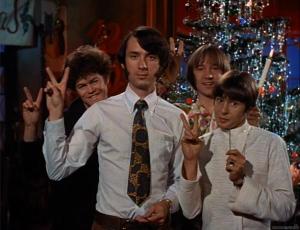
“The Christmas Show”, The Monkees– The Monkees, in their forever pursuit of the next gig, end up getting hired to mind Melvin (Butch Patrick), a disgruntled forty-year old trapped in a twelve-year old’s body, while his aunt is away on a Christmas cruise. Turns out, Melvin isn’t much for Christmas. When the boys try to get him into the holiday spirit, they end up blowing through all of their money and aggravating Melvin to the point that he goes home. It’s only then that Mike realizes what’s been missing the whole time.

It could be a typical “lesson of Christmas” episode, but it’s The Monkees. They don’t do typical. Instead, they do madcap that involves them chopping down their own tree (while apparently stoned), Peter wrecking a department store while shopping for toys, Micky and Davy dressing as Santa and his elf and going down the chimney, a happy ending, and capping the whole thing off with an a capella version of “Riu Chiu”. It’s zany and sweet and the crew getting their time in front of the camera during the credits is a lovely gesture.

“Dear Sis”, M*A*S*H– In a letter home to his sister, Father Mulcahy expresses his frustration in not feeling very useful. Most everyone in camp has the holiday blues, but it seems that it’s hitting Father Mulcahy the hardest as nothing he does is really helpful. He even ends up decking a combative patient (who hit him first, so he had it coming). It’s only during the Christmas party in the mess tent that Father Mulcahy realizes that he has made something of a good impact, first when Charles thanks him for having his mother send him his old toboggan cap, and then later when Hawkeye singles him out during a toast.

M*A*S*H did several Christmas episodes during its eleven year run, but this one stands out to me for several reasons. One, it centers much of the episode on Father Mulcahy, which didn’t happen very often. Two, instead of singing a traditional Christmas song, Hawkeye leads everyone in singing a lovely version of “Dona Nobis Pacem”. And three, the episode ends with one of my favorite lines from the series. As the party is broken up by incoming casualties, the voiceover reading of Father Mulcahy’s letter to his sister says, “You know, sis, it doesn’t matter whether or not you feel useful when you’re moving from one disaster to another. The trick, I guess, is to just keep moving.”

“The Christmas Story”, Dragnet– A local church’s baby Jesus has gone missing from its nativity scene and Friday and Gannon are on the case. The statue has little monetary value, but it’s sentimental value can’t be measured and the parishioners would be very sad to go a Christmas without it. Being diligent detectives, Friday and Gannon follow a tip provided by an altar boy (Barry Williams) that leads them to a suspect (Bobby Troup), but he only borrowed a friend’s car and got into a little fender bender; he didn’t take any baby Jesus. Dejected, Joe and Bill go to the church to let the padre know they didn’t find the baby Jesus, but they’d keep looking. Just as they start to leave, a little boy pulling baby Jesus in a wagon comes into the church. It turns out that he’d prayed to baby Jesus for a new wagon and promised Him that if he got it, he’d give Him the first ride.

I’m not one for religion. I tend to cringe and shy away when people ram home the “Christ” in Christmas. But this episode is an exception and it’s all in the handling of the case and the ending. Our detectives are pursuing this matter seriously, as they usually do, but the justice is less nabbing a thief and more doing right for a congregation. The little boy who took the statue was fulfilling a promise, something that is more in tune with the holiday spirit than any of the sappy treacle that often gets splattered on the screen.

“Christmas with the Addam’s Family”, The Addam’s Family– It’s the common holiday problem that all sitcom parents face at one point or another: Santa. Pugsley and Wednesday are told by the Addams’s unkind neighbor that Santa doesn’t exist. The family bands together and elects Uncle Fester to play the role to restore the children’s faith. When he gets stuck in the chimney, each member of the clan takes it upon themselves to prove that there really is a Santa.

This could easily be a mediocre, overly-sweet episode, but this is the Addams family. This delightfully loving family is weird and wonderful and only they could pull off a Santa overload with such sincerity.

“Operation: Silent Night”, Magnum P.I.– While ferrying Magnum, Rick, and Higgins to their various destinations before he catches a flight home to New Orleans, T.C.’s chopper crashes on a deserted island that the Navy uses for target practice. Though Rick is convinced they’re all going to die, everyone else is pretty confident that they’ll get off the island soon enough. T.C. works on the chopper while Higgins forages for food and Rick and Magnum gather firewood for a signal fire. They end up discovering a downed Japanese WWII plane, which Higgins salvages to create a boat, which later sinks. Rick falls in a bog that he thinks is quicksand, which causes him to imagine his own funeral. T.C. despairs over his inability to fix the chopper and as such, he’ll miss his flight home. And Magnum, who was going to play Santa to some orphans, dons the outfit once again and provides the group with a Christmas tree to boost their spirits. All the while, the guys are unaware that off-shore, a Navy commander (Ed Lauter) with no Christmas spirit is about to bombard the island for practice.

What I love about this Christmas episode is how it’s so tangentially related to Christmas. There are obvious Christmas references and elements (Magnum dressed as Santa is hard to ignore), and there’s even a Scrooge in the form of the Navy commander insisting that his crew do drills on Christmas Eve/Christmas Day. But the episode isn’t dressed up in garland and lights and bows. There’s no heavy-handed true Christmas spirit bashing us over our heads. It’s four friends coming together in a difficult situation not because of some of magical holiday emotion but because that’s just what they do. There’s also the nod to another December holiday celebration. In addition to Christmas, T.C. also celebrates Kwanzaa, which he educates Higgins (and the audience) about.

Okay, I might have gone on a little long, but don’t for a minute think that’s because I’m having a change of heart about Christmas or Christmas episodes.

Oh no. Does my heart look three sizes bigger to you?
Rerun Junkie Shows– Dragnet

Dragnet was one of those shows that I watched on Nick-At-Nite a hundred years ago when I was a kid. It shouldn’t have captured the attention of a hip, 80’s child, but as we all know, I’ve never been hip or normal.

"...I carry a badge."

“…I carry a badge.”

Dragnet features Detective Joe Friday (Jack Webb) and his partner Officer Bill Gannon (Harry Morgan) working a variety of cases from juvenile to bunko to homicide to robbery. The show tackled current society issues like drugs, juvenile delinquency, student dissidence, and such. It was done in a documentary style, with narration at the beginning and ending of the show saying that the stories were seen were true and the names had been changed to protect the innocent (not a whole lotta innocent people on this show) as well as Friday’s running narrative during the episode. The end of the show featured what happened to the perps they caught. Several episodes featured a bad guy at the end that you never saw during the run of the show.

These gentlemen are going to interrogate you.

These gentlemen are going to interrogate you.

The show is remembered best for the rapid fire dialogue, heavy music, and the no-nonsense attitude of the cops.

It also had some pretty memorable episodes, including the famous “blue boy” episode which dealt with LSD, which was still legal. In addition to sending people on trips and encouraging some who were waiting for take-off to smoke marijuana (which I would think would make you too lazy to take the trip, but whatever), it caused one guy to paint himself like he was going to a college football game, half blue and half yellow. This kid also had the supportive “my son would never do anything wrong!” parents that led him to enterprise in LSD and then succumb to its effects when he attempted to go out as far as possible.

It’s an interesting episode as it depicts the frustration the police had while trying to deal with a drug that wasn’t illegal, but really kinda needed to be. You also got introduced to a lot of LSD lingo that pretty much disappeared by the time I was offered a hit in high school (I declined because it was finals week and I still had to take my Bio II final and the last thing I needed was the cat skeleton coming alive and trying to scratch my eyes out).

Though the show is remembered for its seriousness, it actually can be quite funny. There’s a great episode in which Gannon and Friday are trying to watch a football game at Gannon’s house and they’re constantly being interrupted by neighbors and their complaints. I laughed throughout most of that episode.

Not to mention that Mr. Morgan’s sense of humor was never discouraged. Bill Gannon’s personal life could be pretty entertaining at times.

Mr. Webb was pretty dedicated to accuracy when it came to the show. The procedures and lingo were all by the book. That rapid fire dialogue everyone remembers was a necessity. A lot needed to be said in one episode and they only had thirty minutes to do it. Much of the exposition was done in Friday’s voice overs, but that was mostly for scene changes. The dialogue was strictly business. They couldn’t stop to explain things. Kindly, strap in and keep up, thanks.

When it comes to guest stars, this is one of those shows in which you look for the repeaters, not the big names. People like: Virginia Gregg, Sam Edwards, Ralph Moody, Burt Mustin, Henry Corden (who Monkees fans will recognize as Mr. Babbitt), Leonard Stone, Buddy Lester, Ed Deemer, Stuart Nisbet, Virginia Vincent, Robert Brubaker, and Emergency! favorites Bobby Troup, Marco Lopez, Tim Donnelly, and Ron Pinkard. And of course Reed and Malloy (Kent McCord and Martin Milner) from Adam-12 made appearances.

If you’re looking for some names  you know, here are a few: Jan-Michael Vincent, Keye Luke, Scatman Crothers, Doodles Weaver, Barry Williams, Lorraine Gary, Howard Hesseman, and Veronica Cartwright.

Like I said in the beginning, there’s really no reason this show should have appealed to an 8 year old kid. Even today, people call it boring. I call it fascinating. That jam-packed dialogue (done with the aid of a teleprompter), the unexpected wit, the view of a different time. It’s nifty.

There’s a reason this show was used as a police instruction manual. It’s just that good.

They have all the facts, ma'am.

They have all the facts, ma’am.


Where I Watch It