Wasn’t That Guy Already On This Show?

Drawing of an old school TV with antenna, a dark orange casing, brown legs, and a grey screen.I was scrolling through Instagram one day, afflicted by the way it insists on showing me posts from people I do not follow, when I happened across a video in which a young person was questioning a TV show’s choice of using an actor that had already guest starred on the show once to guest star again in a different role. They went so far as to question whether or not the casting department should keep a list so things like this don’t happen.

And I thought, “You sweet summer child. You absolute infant. Let me show you the history.”

Because this was the rule not the exception back in the long, long ago, and even the not-so-long ago, and I had no idea (thanks to my lack of watching many current shows) that it has become something not as common in the present tense.

My first thought upon seeing this video, the first example that popped into my mind was Gunsmoke. It was the source of employment for many actors in the course of its 20 years on the air, and had frequent repeat guest stars who showed up in multiple episodes and never played the same character twice.

My dad is currently binge watching this series, so it feels like every time I come into the room, Victor French (18 episodes), Morgan Woodward (19 episodes), Jack Elam (15 episodes), Denver Pyle (14 episodes), John Dehner (12 episodes), and John Anderson (12 episodes) are on. I’m not complaining. I love them all. But binge watching makes it obvious just how much they were on and how many of those episodes were in the same season.

It was commonplace, particularly in long running shows, to have those kinds of repeats. In the case of Hawaii Five-O and Magnum P.I., the location made it necessary to use a lot of the local talent multiple times. Not only are they showing off the unique and diverse culture of Hawai’i, but also, not everyone could be flown in from the mainland.

When you find a good actor, you want to keep them around. Jack Webb had a sort of stable of actors that he would draw from. Tim Donnelly and Marco Lopez, for example, appeared in multiple episodes of both Dragnet and Adam-12. And those guest spots scored both men a regular gig on Emergency!

Which brings me to the next recurring guest star practice that might blow this questioning young person’s mind.

Guest starring is how some actors found their regular gig. Both Ken Curtis and Buck Taylor appeared as different characters on Gunsmoke before landing their regular roles of Festus and Newly, respectively. Harry Morgan appeared as a general before being cast as Colonel Potter on M*A*S*H.

And sometimes you get the flip side of that.

An actor that had been a recurring character coming back later as a different character. On The Monkees, Henry Cordon spent the first season playing the band’s landlord in several episodes before coming back as a completely different character (in another location even!) in the second season. John Orchard was Captain “Ugly John” Black in the first season of M*A*S*H before coming back much later in the 8th season as a completely different character for an episode.

And even though I can’t think of an example off the top of my head (because I’m too lazy to do actual in-depth research), I’m positive I’ve come across instances in which an actor played a recurring character, guested as a different character in an episode, and then resumed their recurring role. Drop me a comment if you think of one.

I suppose what I’m getting at is that this is the nature of the business and our part is to suspend our disbelief and pretend that Ed Flanders is a different guy every time he decides to take on Steve McGarrett.

Let’s have some fun.

Hyperfixation Reruns

I’ve talked before about how I can’t answer the question of what my favorite TV show is. I realized recently that I don’t have favorites because I have hyperfixations.

I’ve never been officially diagnosed with any neurodivergency, but my tendency to hyperfixate on things has been with me all of my life. When I find something that truly grabs my attention for whatever reason, I can and will deep dive on it for days, weeks, months, and sometimes, off and on for years.

With this knowledge, it should come as no surprise that some reruns have reached hyperfixation level.

There are two kinds of hyperfixation for me when I fixate on a rerun. One kind has me watching the show repeatedly and picking it apart, wanting to analyze it and write about every conclusion I come to. I don’t share everything I write, obviously, but believe me, it happens. CSI: Miami is probably the most recent hyperfixation rerun of this type. I’ve pulled that show apart and looked at it from all angles and analyzed all sorts of bits and pieces. I’ve written about it. I’ve kept much of what I want to write about it to myself because I don’t want to overwhelm you. My analysis is stunning in a “get a life” sort of way.

The other kind of hyperfixation is when merely watching and analyzing isn’t enough. I have to learn everything I can about the show, the behind-the-scenes stories, and the people who made it. Jack Webb shows fit this bill. It wasn’t enough for me to watch Dragnet, Adam-12, and Emergency! multiple times and analyze the episodes and characters and cases. I had to dig into the background of the shows and learn about the creator and the actors. I had to know more about them than would be asked on Jeopardy. And then once that was satiated, I was able to move on.

Why do I fixate on the shows that I do? I have no idea. Something about them captures my attention and triggers something that makes it hard for me to let it go. I do not know what that magical attribute is because I’ve fixated on a variety of reruns over the years. Okay, yes, there have been a lot of cop shows, but there have been other, decidedly not cop shows, too. The answer isn’t that simple.

How long do the fixations last? It depends. When it comes to reruns, it averages a few months. Typically, enough time to watch the series through multiple times and let my brain mull it over and pick its bones clean. Some shows stay in my brain for much longer; others fall out of my head in record time. The length of time I spend fixating on a show doesn’t seem to affect the intensity. It’s called a hyperfixation for a reason. Regardless of the time spent, the focus is intense.

The one good thing about this particular hyperfixation thing is that it sometimes makes for some interesting blog posts about reruns. The other good thing is that I learn new things and it puts my critical thinking skills to good use in a different way.

It won’t get me rich, but I’ll have some really offbeat trivia to share in conversation.

Brace yourselves.

Five More Favorite Couples

I pinky swore before that I would come up with five more favorite couples and here I am, still needing to put couples in quotes because this list doesn’t have a single romantic pairing on it. It is bromance heavy, though. I’d apologize for that, but I’m not sorry.

Once again, these couples are listed in no particular order; I’m not saying they’re objectively the best couples ever, they’re just my favorites; and if you wanna argue, make your own damn list.

Jim West and Artemus Gordon, The Wild Wild West– It could be argued that I should have included this pair in my first list, but let’s not argue. My brain works in mysterious ways. Anyway! Jim and Artie are secret service agents in the steampunk wild west and that sort of situation creates a bond. These are dangerous assignments and Jim West frequently found himself in trouble. When that happens, your only hope is a guy willing to put on a dress or a fake mustache and a wig. Fun, smart, and witty, these are the guys you want to go on an adventure with. You know they’re going to save the day…and each other. There is something magical about these two together. I love their chemistry and their banter. Jim West is a suave, masculine hero and Artemus Gordon is a suave, charming master of disguise. They are a dynamic duo of heart eyes. Okay, maybe that’s just me.

Lenny and Squiggy, Laverne & Shirley– Hello! As much as I love Laverne and Shirley, Lenny and Squiggy are my bromance goals. Two compatible weirdos coming together to make a life. It’s a beautiful thing. Sure their behavior towards women can sometimes be problematic, but their behavior towards each other is pure. Mostly. These two have their arguments (Squiggy did kind of push Lenny out of a window during one), but they are better together and everyone knows it. These two men go to extremes to protect and uplift each other, like Lenny playing into Squiggy’s sleepwalking behavior to keep him safe. Like Laverne and Shirley, there’s no doubt that Lenny and Squiggy love each other even while getting on each other’s nerves. Not to mention that Lenny and the Squiggtones is one of the greatest bands ever.

Ryan and Natalia, CSI: Miami– I said before that I have several favorite couples from this show, but I’m once again picking another couple featuring Ryan. He makes a good partner. What I really like about Ryan and Natalia is that they have a beautifully platonic relationship. It starts off with Ryan having a thing for Natalia and they go on at least one date, but after that, it’s bestie city, population two. The best part is that removing the romantic element (while leaving the occasionally flirty banter) doesn’t diminish the relationship. These two people care about each other and they’re not afraid to tell each other the hard truth, like Ryan confronting Natalia about denying her hearing loss or Natalia telling Ryan he needs to step away from the camera to get his life together. Considering that Ryan at one time didn’t like Natalia due to a betrayal, the friendship coming back from that makes it even more solid and real.

Blanche and Rose, The Golden Girls– I could honestly put any combination of these four women together -Dorothy and Sophia, Blanche and Dorothy, Dorothy and Rose, Rose and Sophia, Sophia and Blanche- but there’s just something about Blanche and Rose that makes my day. Sweet Rose and sexy Blanche couldn’t be more different, yet they compliment each other so well. Blanche bringing Rose to her senses while waiting for the results of her AIDS test with her own experience and education is one of my favorite scenes with the two of them. It takes a lot of love to straighten your friend out during a dark moment. Even when they find themselves at odds, like when Rose thought Blanche had slept with her husband, you know the make-up is going to be hilariously sweet. Whether they’re cutting a rug doing a tap routine or dirty dancing in the living room, these two have all the right moves.

Roy DeSoto and Johnny Gage, Emergency!– I’ve got a lot of bromances on my list this time around, but this one is probably one of my favorite ones when it comes to coworkers. You know how it is with your work bestie. You might not hang with them outside of your place of employment, but on the job, you’re thick as thieves. That’s like Roy and Johnny, only they do hang out away from the firehouse. The practical married man and the slightly impractical bachelor, these two opposites probably wouldn’t have become friends if they hadn’t worked together, and I think that’s what makes their friendship so great. These two men will butt heads over where Roy should take the family on vacation or how Johnny should fix a paycheck mishap, but there always on the same page when it comes to a rescue or a patient. They’re a solid team, even when Johnny should keep his spaghetti recipes to himself.

Will I come up with five more favorite couples at a later date? Maybe.

Okay, yeah probably. There are so many great duos that I love.

Rerun Junkie Confession–I Love a Woman Who Takes Care of Business

I was initially inspired to write this post by Miss Simpson in the Season 5 Hawaii Five-O episode “Death Is a Company Policy”, and what I was actually going to confess was that I liked ruthless women. Miss Simpson was a representative of a criminal enterprise so vast it oversaw the work of numerous smaller scale criminal bosses. It’s at first thought that Miss Simpson is nothing more than an accountant sent to audit the criminal books of one of their branch managers, Piro Manoa. However, as the episode progresses, we come to understand that Miss Simpson is more than just an accountant. She’s an important part of their organization and makes the tough, crucial decisions when she has to.

And then just two episodes later came Joyce Hensley in “You Don’t Have To Kill To Get Rich, But It Helps”. The only female exec in a blackmail insurance business, she has a keen eye for good insurance prospects. She also reads Sam Tolliver for filth after only a five minute chat. Cool, calculating, and, well, ruthless.

But in that same episode is a character named Dollie. She’s a madam with amazing fashion sense who takes no shit from Ben. You get the sense that she’s good at her job and she takes care of her girls, but she’s no soft touch. She’s not ruthless. She’s just takes care of business.

And that’s what I really like. A woman who can take care of business. Miss Simpson and Joyce Hensley both displayed that even though their business is on the criminal side of the tracks.

So, let’s flip the script. What about Callie Duquense on CSI: Miami? Here is a woman who brings down the bad guys with same sort of efficiency and ruthlessness as her criminal counterparts I just mentioned. She’s not intimidated when challenged and she has remarkable emotional control even in the most stressful situations. She gets shit done.

Della Street on Perry Mason also comes to mind when it comes to efficient women on the right side of the law. To the untrained eye, she’s just a secretary. But Perry wouldn’t be able to vex Hamilton Burger by beating him in court if Della wasn’t on top of her game. She even keeps Paul Drake in check and that’s no easy task.

Women don’t have to be in law enforcement -or on the opposite side of it- to take care of business. When I was thinking of all of the women I admire, two nurses immediately popped into my mind: Major Margaret Houlihan on M*A*S*H and Dixie McCall on Emergency!.

Dixie is the head ER nurse. There were actually episodes that showed how things went to shit without Dixie in charge. She’s the one choreographing intricate dances of life or death with her staff. Doctors might be running the show, but it’s the nurses who have to anticipate their needs. Dixie got shit done because lives depended on it. And she was good at it.

The same can be said for Major Margaret Houlihan. A career army nurse. She’s in charge of a group of nurses in a war zone. She’s orchestrating order in devastating chaos. Even when taking into consideration her early season shenanigans, Margaret never messed around when it came to nursing. Taking care of those soldiers was her job and she took care of business.

What’s interesting about most of the women I’ve listed in this post (as guest stars we didn’t really see enough of Miss Simpson, Dollie, and Joyce Hensley) is that even though they could be considered strong women because of how effectively they got their shit done, it didn’t preclude them from having emotions. Sometimes the stress or the situations got to them, but they handled it, just like they handle everything. And they handled it in such a way that it didn’t stop them from taking care of business.

And I unabashedly love women like that.

TV Bosses I’d Work For

Have you ever watched a TV show and thought to yourself, “Man, I wish they were my boss”? Well, I have. So I put together a short list (in no particular order) of the TV bosses that I’d work for.

Barney Miller (Barney Miller)- I feel like this is probably an obvious choice for someone enamored with police shows. Not only did Barney have a more reasonable approach to lawbreakers, he also had an excessive amount of patience when it came to the people in his squad room. He’d finally get to his breaking point, but it took some persistent aggravation. Given that I can be aggravating, it’s good to know I’d probably never get to that point with him, thanks to Wojo and Levitt beating me to it.

Steve McGarrett (Hawaii Five-O)- A no-brainer if you know me, Steve McGarrett is in many ways the ideal. He’ll mentor you, correct you, joke with you, go to bat for you, but he won’t tolerate any bullshit. You gotta put in your effort. I love a boss who has your back, and Steve definitely has the backs of Five-O.

Horatio Caine (CSI:Miami)- Much like Steve McGarrett (as I’ve written about), I dare say that Horatio would go even further for you, particularly in the later seasons when he was decidedly less attached to the rules. He’d do everything possible to turn you into the best CSI he could, but he’d only help you if you were willing to accept it. Some lessons have to be learned the hard way. Right, Ryan? I have no doubt Horatio would kill for you, though, and I really appreciate that kind of dedication.

Miss Kitty (Gunsmoke)- Leaving aside the not-explicity-said-but-definitely-understood nature of the work some of the Long Branch employees were doing, I have no doubt that Miss Kitty looked after all of them. From bartenders to saloon girls, she wasn’t a successful businesswoman because she let the clientele walk all over her and abuse her staff. She’s the fuck around and find out boss.

The Middleman (The Middleman)- All of the patience of Barney Miller, the mentoring of Steve McGarrett and Horatio Caine, and the protective nature of Miss Kitty, with a healthy dose of optimism and clean language. He makes ridding the world of comic book foes less of a chore and more of a good day at the office.

Sgt. Getraer (CHiPs)- As far as bosses with a sense of humor go, Gertaer is up there. Think about it. He had to deal with Ponch’s bullshit all the time. If he didn’t learn to laugh, his blood pressure would have been through the roof. He also has the ability to roll with the punches, which is a pretty good quality to have. Probably the only boss on this list that would go country-western dancing, roller skating, and participate in some questionable athletic shenanigans for charity.

Dr. Elizabeth Weir (Stargate: Atlantis)- If I’m in another galaxy with the prospect of never returning to Earth and our best chance of survival is making new friends, I’m going with Elizabeth. She kept things under control, put people in their place (I’m looking at you Shepherd), and didn’t take any shit from anybody -Wraith, Genii, or Replicator. She had things under control even when they were out of control and honestly, I wish she would have been in charge every Black Friday.

Colonel Sam Carter (Stargate: Atlantis)- Everything you got with Elizabeth, but with the added bonus of a military background, a different science expertise, and some “I have seen some shit” experience. She was also perfectly cool with blowing shit up and I need that in a boss.

Richard Woolsey (Stargate: Atlantis)- If you’ve seen the show, I know what you’re thinking, but let’s be real. Once he got broken in, Woolsey made for a pretty good boss. As a bureaucrat, he brought an element of sneakiness to his dealings with with others in the Pegasus Galaxy and was a pretty crafty negotiator. He also quickly figured out it was best to leave the science to the scientists and the defense to the military. A boss who knows when to let the workers do their thing and when to rein them in is valuable.

Is it cheating to have three bosses from the same show? Maybe. Did I exclude some excellent bosses from this list? Probably.

But this is my list.

Go make your own.

Make It Fashion

It’s no secret that one of the things that caught my interest when I started watching Hawaii Five-O was the fashion. Sure, our team is typically dressed in conservative suits, but their personal and undercover fits are a sight to behold. Not to mention that you’re dealing with an island vacation spot in the late ’60s and throughout the ’70s. So many bright colors, bold patterns, and a broad assortment of people wearing them.

It’s a glorious time capsule.

In fact, it covers the end of one decade, the entirety of the next decade, and the very beginning of a third decade, which shows off the evolution of fashion during that particular time period. In that time span, dresses are going from short shifts to waist-defined and below the knees; the skirts go from minis to maxis; bell bottoms grow and waist-lines lower; even the suits change, with the widths of lapels and ties changing.

Not only that, this is Hawai’i fashion. In addition to what you might find on TV at the time, the standard styles and the styles indicative of certain groups like hippies, you also got island fashion, both residential and vacation. Yes, there are a lot of Aloha shirts and matching Aloha outfits and other threads common to vacationers and required of those working in the tourist trade. And the colors and patterns are glorious. But there’s also what the average, everyday people wear while working in the markets or on boats or doing their shopping. And there are muumuus. So many glorious muumuus.

That’s what’s so great about Rerun Fashion: it tells us so much.

Iris Apfel once talked about fashion as being a sort of record for history. You can tell what was going on in the world at the time by what people wore.

I feel that way about TV fashion as well (however I’m not nearly as cool or as well-dressed as Iris Apfel). We’re not only getting a glimpse into the fashion and styles of the time, which provides its own little insight into what the world was like, but we’re also getting that all filtered through the characters that are wearing it.

Obviously, Steve McGarrett is my favorite example of this.

While the Five-O team wore their conservative suits at work, they’re off-duty attire was much more relaxed for the most part, polos and Aloha shirts. And then there was Steve. Conservative, by-the-book Steve had an affinity for ascots, whites suits, pops of color, and some pretty fab hats. You never would have thought it from a man like him, but he was a bit of a fashionista. While some hard-nosed cops have a softer side off-duty, Steve McGarrett had a stylish side.

There’s something especially fab about characters you’re used to seeing in uniform in their street clothes. When the guys at Station 51 on Emergency! change into their street gear, you not only get a glimpse into their off-duty personalities, you also get a glimpse into their off-duty personalities as filtered through the ’70s. That’s why Johnny Gage is sporting these patchwork jeans. Of which I had a similar pair in high school in the ’90s when some ’70s styles had a resurgence.
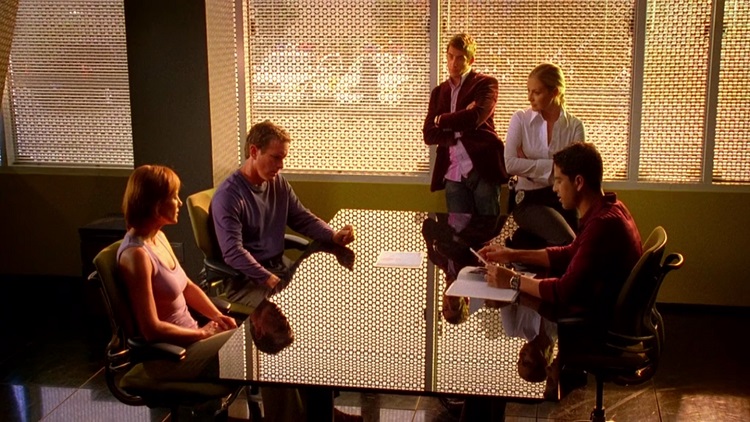
I would wear them again today, no hesitation.

Speaking of out of uniform, given how infrequently everyone on Stargate Atlantis gets to don street clothes, it feels particularly monumental when they show up in those duds of the aughts.

If you want to look for character definition through wardrobe, look no further than The A-Team. Each character is defined by their clothes. Hannibal with his safari jacket, Face with his leather jacket, BA with his gold chains and perpetual lack of sleeves. A ball cap, bomber jacket, and pair of Chuck Taylors is Murdock. You can see that from space.

There was a similar situation on the ’60s Dragnet. Joe Friday and Bill Gannon wore the same suits every episode.

One other thing that I find fun to look out for is how the wardrobe department of shows not only dress characters for their personalities, but also how they coordinate the characters with each other.

One of my favorite things about CSI:Miami is that starting in the second season, wardrobe started doing a little color matchy-matchy between characters. Calleigh’s shirt matching Frank’s tie. Delko and Speed wearing similar colored shirts. By the fourth season, it was full-tilt coordination. It seems like at least one character in each episode is guaranteed to match Frank’s tie. And there are some episodes when there’s obviously a color theme. Everybody sporting a shade of one color. It’s glorious.

On the flip side of that, wardrobe on The Golden Girls did their best to make each woman stand out on their own. Not much in the way of matchy-matchy unless there was a specific reason. There’s one episode that sticks out in my mind in which Dorothy, Rose, and Blanche are sitting on the couch looking like a stoplight -red, yellow, green.

Just like the plots and slang, the fashion of reruns can either be dated or timeless, however it never fails to deliver some sort of statement.

Just pay closer attention to the threads.

Battle of the Sexes

When I watched the first season of Baa Baa Black Sheep, I dreaded getting to the episode titled “W*A*S*P*s”. Right there in the episode description it said that “a battle of the sexes lands on the frontline”.

I loathe a battle of the sexes.

I make no secret of the fact that much of the rerun content I watch (and some of the current content) is “male-oriented”. It’s action stuff. It’s police stuff. Classic cis het guy fare. So there isn’t a lot of quality women content or input. And yes, some of it can be eye rollingly bad. But nothing quite irritates me like the battle of the sexes.

The context is typically of women doing man’s work, whatever the hell that is. I wasn’t raised with gendered work. I was raised with work and somebody better do it and don’t make me tell you twice.

Think of “St. Gilligan and the Dragon”, which I talked about in this post. The women go off on their own because the men are being pricks The women are able to hack it and the men are useless. The implication, of course, is that the men don’t know how to do things like cook and do laundry because it’s something women do and is therefore beneath them. Starving and stinking for their mancards.

Naturally, it’s played for laughs because the battle of the sexes is a frequently used theme in sitcoms.

One such episode that has always stuck with me is The Brady Bunch episode “The Liberation of Marcia Brady”. Basically, Marcia goes on the record that she thinks women can do anything men do and then Greg ends up goading her until she decides to prove herself by joining The Frontier Scouts. For the final initiation, Marcia has to use her Frontier Scout skills to navigate through the woods following a trail that Greg has left.

The twist? Greg has purposely made the trail as hard as possible to follow without breaking the rules. And to everyone’s surprise, Marcia succeeds.

Marcia’s initiation is a perfect example of how the patriarchy works. In order to prove that women can do anything men can do, Marcia actually had to do better than what the guys had to do because the boys were so threatened by the idea of a girl joining their little scouting group they had to actively sabotage her.

Something similar happens in many episodes of Barney Miller whenever there’s a female detective. I can remember it happening with Wentworth, Batista, and with the two officers in “Hot Dogs”. All of the women were seen as overly enthusiastic and aggressive in doing their jobs because it went right over the heads of their male counterparts that they had to be. They had to do everything the men did, but they had to do it more and they had to do it better -and in heels!- lest they be considered failures and ruin it for every other woman on the force.

There’s a similar vibe in the Emergency! episode “The Indirect Method”. Roy and Johnny are charged with training a female paramedic who is described as hard-nosed. Is it any wonder? The pressure is intense. She’s doing man’s work, after all.

As for the Baa Baa Black Sheep episode, I was pleasantly surprised at how much I didn’t hate it. The women were not only good at their job, but also serious about it in a way that was less about being as good as the men, and more about showing their passion for flying. Yeah, the guys tried to treat the ladies like they would any pretty face in the vicinity, but it turns out the women were more like them than they realized. Translation: our fellas got hoodwinked by them.

This battle of the sexes was a little more evenly matched. And while it did have it’s hang-ups and of course, the guys had to save the ladies (though, they didn’t really do anything that fighter escorts wouldn’t do for transport planes other than be a little mushy), at least the respect cultivated between the two groups was genuine and not based on arbitrary standards of excellence.

As a result, the episode got my respect, too.

Heteronormativity Is a Helluva Drug

I didn’t expect to like the reboot of Magnum PI. I only gave the pilot a shot because I’d been watching the 1980 series and decided to compare and contrast. I already knew that Magnum was now Latino and Higgins was now a woman. I went into it thinking it’d be fine, but not for me, like most reboots.

The pilot was a fun ride. I gave it the three episode test (pilot establishes the show; second ep is the adjustments; third ep is the vibe) and ended up hooked.

My one hope for the show was that they wouldn’t default to hooking up Magnum and Higgins.

Well, it was good while it lasted and it lasted until early in the 2nd season. Once it became clear that the endgame is Magnum and Higgins are omg-meant-to-be (and that it’s apparently going to be played out in poorly executed fanfic tropes), it then became a countdown until I got fed up and quit watching. That lasted until half-way through the 4th season. I haven’t given up entirely but I am absolutely half-assing it and I don’t care about the show like I once did.

It’s a shame, but thems the breaks.

And there’s plenty of history behind the continuation of the heteronormative narrative that defaults opposite sex leads or lead/supporting into a romantic tension leading to a relationship.

Obviously, the most known example of this is Dave and Maddie on Moonlighting, a show that so depended on the will-they-or-won’t-they, that when they did, it pretty much cancelled the show (to be fair there were other behind-the-scenes issues that contributed to the show’s demise, too). Also, Agnes and Herb had the much better relationship.

Scarecrow and Mrs. King and Remington Steele drew from the same playbook. On Barney Miller, it played out over five episodes between Wojo and Wentworth before Linda Lavin left to be Alice.

In the case of shows like Tales of the Gold Monkey, it’s less of a will-they-or-won’t-they and more of a when-will-he-commit. Because there’s obviously something going on between Jake and Sarah (hell, they kiss in the pilot), but it’s a situationship that allows Jake to kiss other ladies depending on the plot. There’s a similar sort of set-up happening with Walter and Roxanne on Automan. Are they dating? Kinda, maybe, it depends.

Emergency! actually began with Dr. Kelly Brackett and Nurse Dixie McCall in a romantic relationship, which was dropped in later episodes without explanation (read: break-up). From that point on, Brackett and Dixie were friends and colleagues, caring for and respecting each other in both professional and platonic ways, showing that, hey, it could be done.

I’m not saying that it wasn’t. There were series that didn’t necessarily default to the romantic relationship. Della Street didn’t get involved with Perry Mason or Paul Drake (though Paul did nickname Della “Beautiful” and there was some joking that might be considered flirting). Likewise Britt Reid clearly cared about Miss Case and vice-versa, but there was nothing but boss-secretary friendship happening with The Green Hornet. Clearly, it could be done.

But there’s no denying that it could be a struggle. For most of Hunter‘s seven season run, Rick Hunter and Dee Dee McCall were partners and friends, a caring and satisfying platonic relationship that Fred Dryer and Stepfanie Kramer were happy with. But as the story goes, the network and the fans wanted more. As a result, a Season 6 episode informed the audience that Hunter and McCall had once slept together, but it caused an issue with their work relationship.

It’s the default aspect of the hetereonormative narrative, the well-worn path of it, the perpetuation of the idea that the only chemistry that exists between opposite sexes is sexual and the only important relationships are romantic that really grates. Worse, it’s dull. And it’s dull because it’s expected. No other options are presented or considered.

Magnum PI had an opportunity to explore something beyond the default, to establish a couple of opposite sex platonic soulmates without some sort of caveat or exemption (like one or both of them being queer), to really dig into that kind of relationship and do something different.

Instead, it fell for the same quick and easy high that’s been dulling senses for decades.

It really is a helluva drug.

Rerun Junkie Episodes–“The Peace Pipe”

If you’ve never watched Emergency!, you should. It’s a fun show with a lot of daring rescues and medical drama. It also features a frenemy relationship between paramedic John Gage and firefighter Chet Kelly. These two know how to get on each other’s nerves and many times take delight in doing so, usually with Chet acting as the thorn in Johnny’s side.

In the season 2 episode “Peace Pipe”, Chet spends the episode aggravating Johnny about his Native American heritage.

While you could easily dismiss this episode as Chet just being annoyingly racist (in fact, John does call him a bigot at one point), what you cannot dismiss is that Johnny effectively destroys all of Chet’s stereotypes, something that really hadn’t been done much at the time.

When this episode aired in October of 1972, Gunsmoke was in its 18th season and Bonanza in its 14th and final season, two popular Westerns that had spent decades depicting Native Americans as either noble savages or just plain savages, but either way, something less than white men and their much more progressive ways. At the same time, Hec Ramsey was just beginning its Sunday Night Mystery Movie rotation run. The show centers on a lawman at the turn of the 20th century using the latest techniques to solve crimes. Innovative, but the depiction of Native Americans was largely the same as it had been. Emergency! directly ran against another Western at the time the episode aired, Alias Smith and Jones. So, the TV viewing audience knew well the depiction of Native Americans in Westerns back in the olden days, but their exposure to contemporary Native Americans was limited.

Enter Johnny Gage. Not only was the character Native American (as is the actor Randolph Mantooth), but he was a Native American in the now. He wasn’t living on the reservation, but he’d grown up there. He wasn’t some noble savage, but he had a deep respect and honor for his heritage and traditions. For the most part, his life didn’t differ that much from your average, everyday white guy. Instead of being some distant “other” locked into a specific long-ago time, he was an actual person existing in the present.

The whole back and forth between Johnny and Chet starts with Chet going on about the historical significance of a Western they’d just watched. According to Johnny, however, the whole film is nothing but propaganda to make white guys feel more comfortable and ignores that they were land-grabbing treaty-breakers. Chet does us all the disservice of warning Johnny that his “hot Indian blood is beginning to boil” before letting Johnny know that he’s got some Native blood, too. When Johnny correctly guesses that it was a Cherokee princess on his mother’s side, he tells Chet that they call it White Man Royalty Syndrome.

Later Chet asks Johnny why he left the reservation since according to the anthropologist he’s reading, it’s suppose to be “against his cultural instincts to leave the tribal environment.” Johnny then enlightens Chet on the nature of anthropologists. When he was growing up, they’d come to the reservation to observe them in order to prove whatever their latest theories were, get federal grants to write their books, and then do it all again the next year. Chet, of course, defends the scientists, in particular the one he’s reading. As it turns out, Johnny knows him. He spent ten years and five and a half million dollars studying how to eliminate a tribe’s poverty problems, pointing out that if a small portion of that money had been given to that tribe, they wouldn’t have the poverty problem to begin with.

Chet decides to apologize for joking around about Johnny’s Native heritage and swears no more jokes about it, which Roy protests because he likes a good joke. As John and Roy argue about Johnny’s perceived sensitivity, Chet again wants to apologize, this time for putting friend against friend. He then produces a peace pipe and says they should smoke. This time Johnny tells him it’s not funny and walks away.

In a final act, Chet apologizes for making a joke about the peace pipe, while holding a fire ax adorned with a feather. He then proposes a treaty, which Johnny scoffs at. This last bit is interrupted by an emergency (because that is the name of the show) in which the firefighters and paramedics have to retrieve an injured and unconscious man from a bit of scaffolding as a sniper shoots at them. Johnny gets the idea to use a tarp to help conceal them as they rescue the man. Back at the firehouse, he explains to Chet that it was Native instinct because everyone knows how much they love blankets, effectively ending the prodding from Chet because it’s only fun if Johnny isn’t in on the joke.

The real joke, though, is how even today the history of indigenous people is still white washed and their lives stereotyped. But at least for an episode in 1972, some harsh light was thrown on it.

***

Sadly, Tim Donnelly died suddenly September 17th. A Jack Webb show frequent flyer, he turned up on Dragnet and Adam-12 several times, including two memorable stints on Dragnet, one of which saw him don a super hero costume and another featured him as the pot-smoking father of a child who later dies of neglect and scarred me for life as a kid. He also often turned up in things directed by his brother Dennis, including the film The Toolbox Murders. And he was pitch perfect as the sometimes annoying, sometimes obsessive Chet Kelly.

Station 51 won’t be the same without him.

May he have safe travels beyond the horizon.

Rerun Junkie Show– Emergency!

When Me-TV announced its fall line-up and announced they’d be showing Emergency! I was excited. A 70’s show that I had vague knowledge of, but had never seen! Yes!

Exclamation points!

Exclamation points!

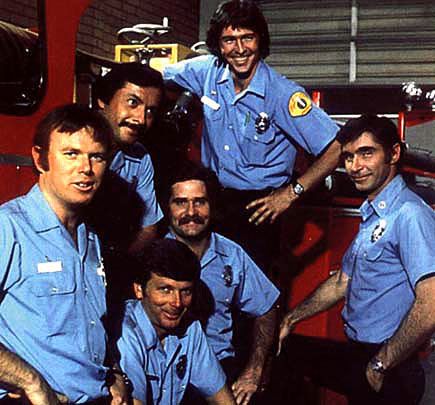
Emergency focused on two paramedic fire fighters, John Gage (Randolph Mantooth) and Roy DeSoto (Kevin Tighe), in the fledgling paramedic program and the doctors and head nurse in the emergency department at Rampart General Hospital, Dr. Kelly “Kel” Brackett (Robert Fuller), Dr. Joe Early (Bobby Fuller), and Nurse Dixie McCall (Julie London). Gage and DeSoto were usually joined by their fellow firefighters at Station 51: Captain Henry “Hank” Stanley (Mike Norell), Chet Kelly (Tim Donnelly), Marco Lopez (Marco Lopez), and Mike Stoker (Mike Stoker). Many times they were joined at the scene by Officer Vince (Vince Howard). The emergency room staff were also aided by the capable, but sometimes harsh Dr. Joe Morton (Ron Pinkard).

Our heroes!

Our heroes!

The show was a real ensemble and the episodes did a good job with that concept, following pretty much the same formula. The opening established the story line for the show and was usually followed pretty quickly by the firefighters responding to their first call of the show. From there, between calls and patients at the hospitals (some more comical than others), the story line was worked out until a resolution at the end, usually following a big rescue of some kind. Some episodes focused more on the paramedics/firefighters and some focused more on the emergency room staff, but the overall show maintained a pretty good balance of both.

Being the 70’s, there was no shortage of familiar faces popping up on the show, including Adam West, Jo Anne Worley, Ruth Buzzi, Dick Van Patten, Grant Goodeve, Mark Harmon (as an animal control officer in a possible pilot), Jamie Farr, Robert Alda, Marion Ross, Sharon Gless, Tony Dow (Wally turned to crime in this ep), Larry Manetti, Joyce Jameson, Dabbs Greer, Melissa Gilbert, Nick Nolte, Ron Masak, John Travolta, Yvonne Craig (Batgirl, to you), Linda Gray, Linda Dano, and Jack DeLeon (Marty Morrison from Barney Miller).

Look, ma! Firefighters!

Look, ma! Firefighters!

One really cool thing about the show was the use of real firefighters in the cast. In the first season real LACoFD Captain Dick Hammer (as himself) headed Engine 51 (he was followed by John Smith as Captain Hammer before Mike Newell took over as Captain Stanley). LACoFD Mike Stoker was with the show for its run. And the oft-heard, rarely-seen dispatcher was LACoFD dispatcher Sam Lanier.

The inclusion of the real firefighters in the show lent to the realism of the whole shebang. I realize there are mistakes in the rescue, response, and ER scenes. But as someone who is not an authority on 1970’s paramedic/firefighter/doctor/nurse procedures, those scenes look legit (except for the lack of blood in some scenes; they are a bit clean on this show). I find some of the big rescues at the end of the episodes pretty spectacular to watch because they feel real. I don’t feel like I’m looking at multiple takes of something. I’m watching two paramedics jumping into the ocean to get a guy out of a sinking helicopter. I’m watching two doctors examine a guy with internal injuries. There’s nothing forced or staged-feeling about it (usually).

And if you’re viewing this like a bit of film from a time capsule (as I like to do with my reruns), it’s wild to basically watch the infancy of the paramedic program that we’ve all grown very used to today. It’s also pretty wicked to see the ginormous walkie talkies the firemen use and the box of phone (bio-phone) that the paramedics use to call Rampart Hospital.

When I first started watching the show, I admit that I found John Gage to be a little annoying and I had doubts that I was going to be able to put up with him. But after a few episodes, he grew on me and the interaction between him and Roy DeSoto is wonderful. There’s a great chemistry there. Also, Chet Kelly has one of the greatest mustaches ever to grace a fire department and he holds a special place in my heart now. Watching Nurse McCall keep Dr. Brackett and Dr. Early in line is great fun.

If you’re looking to be hips deep in personal drama like on Grey’s Anatomy or ER, look elsewhere. The characters do have their stories, but nothing soap opera-ish. Which I appreciate. There seem to be streaks of characters getting injured. Obviously, that’s part of the risk of being a firefighter, but I swear Gage got hurt three times in one week during the big rescue at the end. Of course, anyone injured is usually back the next episode feeling fine.

Some of the most believable calls/rescues/patients are the most ridiculous ones. The family that thinks their mother is dead but she’s only napping, the guy who thinks he’s been cursed, the guy who accidentally glues his hands to a model ship, but doesn’t want the ship destroyed to unglue his hands, the girl that gets her head stuck in a chair (okay, that wasn’t on the show; I really did that when I was a kid). You  have no idea how many calls first responders get that are really like this. The truth is stranger than fiction and this show definitely captures that with some of the absurd incidents. But, like I said, the way those scenes are done, you go right along with it.

It’s the big, dramatic incidents that I sometimes have trouble with. I’ll read the episode summaries and be like, “A plane crashes into an apartment building? Come on!” And then I’ll watch the episode and be like, “A plane crashed into an apartment building! Help! Help!” It’s all in the delivery, I suppose.

I could be easily impressed, too. Always a possibility.

Either way, this show became a quick favorite and I hope it sticks around on my TV for a long time. I need the opportunity to watch these episodes a few times.

Keep up the good work, Chet.

Keep up the good work, Chet.


Where I Watch It