Wasn’t That Guy Already On This Show?

Drawing of an old school TV with antenna, a dark orange casing, brown legs, and a grey screen.I was scrolling through Instagram one day, afflicted by the way it insists on showing me posts from people I do not follow, when I happened across a video in which a young person was questioning a TV show’s choice of using an actor that had already guest starred on the show once to guest star again in a different role. They went so far as to question whether or not the casting department should keep a list so things like this don’t happen.

And I thought, “You sweet summer child. You absolute infant. Let me show you the history.”

Because this was the rule not the exception back in the long, long ago, and even the not-so-long ago, and I had no idea (thanks to my lack of watching many current shows) that it has become something not as common in the present tense.

My first thought upon seeing this video, the first example that popped into my mind was Gunsmoke. It was the source of employment for many actors in the course of its 20 years on the air, and had frequent repeat guest stars who showed up in multiple episodes and never played the same character twice.

My dad is currently binge watching this series, so it feels like every time I come into the room, Victor French (18 episodes), Morgan Woodward (19 episodes), Jack Elam (15 episodes), Denver Pyle (14 episodes), John Dehner (12 episodes), and John Anderson (12 episodes) are on. I’m not complaining. I love them all. But binge watching makes it obvious just how much they were on and how many of those episodes were in the same season.

It was commonplace, particularly in long running shows, to have those kinds of repeats. In the case of Hawaii Five-O and Magnum P.I., the location made it necessary to use a lot of the local talent multiple times. Not only are they showing off the unique and diverse culture of Hawai’i, but also, not everyone could be flown in from the mainland.

When you find a good actor, you want to keep them around. Jack Webb had a sort of stable of actors that he would draw from. Tim Donnelly and Marco Lopez, for example, appeared in multiple episodes of both Dragnet and Adam-12. And those guest spots scored both men a regular gig on Emergency!

Which brings me to the next recurring guest star practice that might blow this questioning young person’s mind.

Guest starring is how some actors found their regular gig. Both Ken Curtis and Buck Taylor appeared as different characters on Gunsmoke before landing their regular roles of Festus and Newly, respectively. Harry Morgan appeared as a general before being cast as Colonel Potter on M*A*S*H.

And sometimes you get the flip side of that.

An actor that had been a recurring character coming back later as a different character. On The Monkees, Henry Cordon spent the first season playing the band’s landlord in several episodes before coming back as a completely different character (in another location even!) in the second season. John Orchard was Captain “Ugly John” Black in the first season of M*A*S*H before coming back much later in the 8th season as a completely different character for an episode.

And even though I can’t think of an example off the top of my head (because I’m too lazy to do actual in-depth research), I’m positive I’ve come across instances in which an actor played a recurring character, guested as a different character in an episode, and then resumed their recurring role. Drop me a comment if you think of one.

I suppose what I’m getting at is that this is the nature of the business and our part is to suspend our disbelief and pretend that Ed Flanders is a different guy every time he decides to take on Steve McGarrett.

Let’s have some fun.

Policing Copaganda

It’s no secret that one of my favorite TV genres is ‘70s cop shows. I don’t know why. You can say it’s because my father was a police officer for twenty-five years, but I think that has little to do with it considering very little of what I’ve seen on the screen reflected what he dealt with policing my small town in the middle of a cornfield.
But that could be why even though I love these shows, I never really thought about them accurately reflecting reality. Maybe because my dad would point out the inaccuracies in these shows. Maybe because as soon as I got my license, my dad drilled it into me that if I got pulled over not to allow the cop to search my car without a warrant. Maybe because my dad has always told me never talk to cops without a lawyer.

I’m sure that’s why I get all swoony when I see someone exercise their rights on these shows. That is like reality in that it doesn’t happen often. Most people don’t know them, let alone use them.

The point of these shows is entertainment, of course. Even Adam-12, which had episodes shown in police academies to illustrate certain situations because it was so accurate to uniformed officer life, had more hostage situations and shoot outs than even a cop in the busiest metropolitan area would encounter.

Action, drama, a witty one-liner or seven, and the good guys (usually) win. I can’t help it. I’m a sucker for it.

And it’s all, of course, fiction.

I think of it as the depiction of ideal policing and justice. It’s what we want it to be, what it’s supposed to be, what the people in power try to convince us that it is (when it’s absolutely not). The police are there to protect and serve, the justice system is fair, the good guys get the bad guys, and the bad guys get punished. It’s all make believe and I prefer to see it on the small screen. Sort of like my affinity for slasher movies. I prefer my violence to happen fictionally.

I blame Jack Webb for some of that. He was a devout believer in law enforcement and the justice system. The Los Angeles police department was wildly corrupt back in the long, long ago (save your jokes) and underwent a huge reform (I said save your jokes), which made an impression on Webb. While Dragnet and Adam-12 depicted a lot of the work detectives and uniformed officers do accurately, it was still idealized. A sanitized depiction of the job, the life, and justice. This is the way things work when everything works as it’s supposed to.

The police involved shootings on most of these cop shows is where this idealization is most evident. Adam-12 probably had the best technical depiction, though Hawaii Five-O had a thorough one as well with “And They Painted Daisies on His Coffin”. Even Joe Friday himself had to have his shooting of a burglary suspect investigated. And while they all present the idea that lethal force is harshly scrutinized and thoroughly investigated, these episodes are also constructed to insure the audience’s maximum sympathy to our protagonist cops. Of course, every shooting is always justified.

It’s been said that cops (including my father) felt that Barney Miller is probably the most accurate and realistic when it comes to the depiction of law enforcement. Maybe because it was a comedy it had no trouble depicting some of the mundane realities of police work: the paperwork, the bureaucracy, the budgets, the lack of manpower, the limitations and inadequacy of the law and the justice system. The 12th precinct wasn’t dealing with non-stop homicides like most cop shows. They were dealing with what cops actually deal with the most: petty shit. The show might be a little too honest to be pure copaganda, but it still does its part, if only in a ‘not all cops” kind of way.

The ideal depiction of police and justice continues today.

According to this article, police procedurals today distort the view of how policing and the justice system actually work. These shows don’t accurately reflect the imbalances in the justice system, the abuse of power by the police, the inherent racism, white supremacy, and wealth-bias that’s integral to the system.

And if you watch enough reruns of cop shows, particularly from the ‘70s, you can see how that groundwork was laid. It’s easy to forgive and/or overlook our protagonists playing fast and loose with the law and people’s rights because they’re the good guys.

After all, they’ll tell you that themselves.

Rerun Junkie Show–Adam-12

When Jack Webb decided to shine a spotlight on the beat cops of LA, he created Adam-12.

"Adam-12 continue patrol and handle this call..."

“Adam-12 continue patrol and handle this call…”

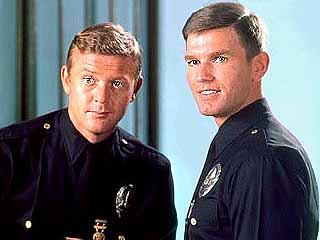
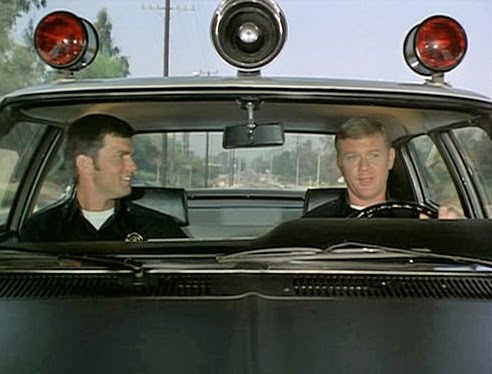
The show featured veteran officer Pete Malloy (Martin Milner) and his novice (and later fellow veteran) partner Jim Reed (Kent McCord) handling the every day street work of two uniformed officers under the direction of their supervisor Sgt. MacDonald (William Boyett) and sometimes with the help of fellow officers Wells (Gary Crosby) and Woods (Fred Stromsoe). They received calls from real-life LA dispatcher Shaaron Claridge (I love it when she denies them a dinner break; her word is law!).

Our brave boys in blue on patrol.

Our brave boys in blue on patrol.

Unlike Dragnet, viewers weren’t treated to one case seen all the way to completion. Instead they got what beat cops got: sent out on several calls during the episode with no follow-up later on. And though there were some high-action, dangerous episodes, there were a lot of episodes that featured the every day, mundane calls that every cop in uniform has handled: traffic stops, domestic disputes over the stupidest things, theft calls in which there was no theft, lonely old ladies needing someone to talk to, nosy ladies constantly ratting on their neighbors.

My favorite was the two ladies fighting over a bruised melon. One wanted the other one arrested for taking it out of the store without paying for it and the other one wanted the owner to get into trouble for selling crap fruit. Malloy had a look of pure “You have GOT to be kidding me” during the whole thing.

You also had the pleasure of watching Malloy and Reed’s relationship develop from student-mentor to true partners. The chemistry between the two was fantastic and the good-natured ribbing is real.  Married Reed could be quite dedicated to convincing bachelor Malloy to join the club sometimes.

They clean up nice, too.

They clean up nice, too.

Like Dragnet before it and Emergency! after it, the show did wonders to boost the public’s understanding of how those jobs paid for by the taxpayers, this one being uniformed officers, worked. It was as much instructional as it was entertaining and I believe episodes are still shown to police officers as examples of how to handle certain situations.

As this was a Jack Webb show, several of his regulars showed up, including: Virginia Gregg (of course!), Burt Mustin, and James McEachin. Marco Lopez, Tim Donnelly, Bobby Troup, Ron Pinkard, and Randolph Mantooth all appeared in episodes as non-Emergency! characters (Kevin Tighe, Julie London, and Robert Fuller made their appearances during the cross-over episode “Lost and Found”). For Emergency! fans, the episode “Log 88-Reason to Run” is a highlight because Randolph Mantooth, Marco Lopez, and Tim Donnelly are all in it, though none of them share a scene. Fun!

Other familiar faces that popped up during the seven season run include: Larry Linville; Maidie Norman; my favorite guest-star J. Pat O’Malley; Frank Sinatra Jr; June Lockhart; Rose Marie; Jean Allison; Butch Patrick; Ellen Corby (before she was Grandma Walton); Keye Luke; future teen idols Willie Aames, David Cassidy, and Barry Williams; baby versions of Ed Begley Jr, Tim Matheson, and A Martinez; Karen Black; Cloris Leachman as a real crap mother; Tony Dow; Angela Cartwright; Barbara Hale; Robert Conrad sans Ross Martin (unless he was in disguise somewhere); George Murdock;

*takes a deep breath*

Micky Dolenz not Monkee-ing around; Harry Dean Stanton (who never looked young); Lindsay Wagner before she was Bionic; Sharon Gless; Scatman Crothers; Vitto Scotti because he was in everything; Dabbs Greer; Dick Clark; Brucke Kirby; Jo Anne Worley playing another roller derby girl; Mark Harmon; Mark Harmon’s sister Kristin Nelson; and Kent McCord’s daughter Kristen.

It was a good guest-breeding ground.

This is one of those shows that I only had the opportunity to start watching recently. And I’m grateful for that. I’ve developed quite the soft spot for Jack Webb and company shows anyway, but as a cop’s kid, this is one I can really relate to.

It also gave me the greatest intoxication measure ever.

Matador-in-an-intersection-drunk.

‘Cause that’s drunk.

These guys, though, they're drunk on justice.

These guys, though, they’re drunk on justice.

Rerun Junkie Shows– Dragnet

Dragnet was one of those shows that I watched on Nick-At-Nite a hundred years ago when I was a kid. It shouldn’t have captured the attention of a hip, 80’s child, but as we all know, I’ve never been hip or normal.

"...I carry a badge."

“…I carry a badge.”

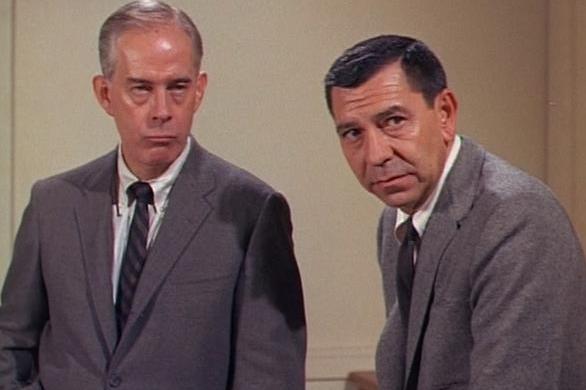
Dragnet features Detective Joe Friday (Jack Webb) and his partner Officer Bill Gannon (Harry Morgan) working a variety of cases from juvenile to bunko to homicide to robbery. The show tackled current society issues like drugs, juvenile delinquency, student dissidence, and such. It was done in a documentary style, with narration at the beginning and ending of the show saying that the stories were seen were true and the names had been changed to protect the innocent (not a whole lotta innocent people on this show) as well as Friday’s running narrative during the episode. The end of the show featured what happened to the perps they caught. Several episodes featured a bad guy at the end that you never saw during the run of the show.

These gentlemen are going to interrogate you.

These gentlemen are going to interrogate you.

The show is remembered best for the rapid fire dialogue, heavy music, and the no-nonsense attitude of the cops.

It also had some pretty memorable episodes, including the famous “blue boy” episode which dealt with LSD, which was still legal. In addition to sending people on trips and encouraging some who were waiting for take-off to smoke marijuana (which I would think would make you too lazy to take the trip, but whatever), it caused one guy to paint himself like he was going to a college football game, half blue and half yellow. This kid also had the supportive “my son would never do anything wrong!” parents that led him to enterprise in LSD and then succumb to its effects when he attempted to go out as far as possible.

It’s an interesting episode as it depicts the frustration the police had while trying to deal with a drug that wasn’t illegal, but really kinda needed to be. You also got introduced to a lot of LSD lingo that pretty much disappeared by the time I was offered a hit in high school (I declined because it was finals week and I still had to take my Bio II final and the last thing I needed was the cat skeleton coming alive and trying to scratch my eyes out).

Though the show is remembered for its seriousness, it actually can be quite funny. There’s a great episode in which Gannon and Friday are trying to watch a football game at Gannon’s house and they’re constantly being interrupted by neighbors and their complaints. I laughed throughout most of that episode.

Not to mention that Mr. Morgan’s sense of humor was never discouraged. Bill Gannon’s personal life could be pretty entertaining at times.

Mr. Webb was pretty dedicated to accuracy when it came to the show. The procedures and lingo were all by the book. That rapid fire dialogue everyone remembers was a necessity. A lot needed to be said in one episode and they only had thirty minutes to do it. Much of the exposition was done in Friday’s voice overs, but that was mostly for scene changes. The dialogue was strictly business. They couldn’t stop to explain things. Kindly, strap in and keep up, thanks.

When it comes to guest stars, this is one of those shows in which you look for the repeaters, not the big names. People like: Virginia Gregg, Sam Edwards, Ralph Moody, Burt Mustin, Henry Corden (who Monkees fans will recognize as Mr. Babbitt), Leonard Stone, Buddy Lester, Ed Deemer, Stuart Nisbet, Virginia Vincent, Robert Brubaker, and Emergency! favorites Bobby Troup, Marco Lopez, Tim Donnelly, and Ron Pinkard. And of course Reed and Malloy (Kent McCord and Martin Milner) from Adam-12 made appearances.

If you’re looking for some names  you know, here are a few: Jan-Michael Vincent, Keye Luke, Scatman Crothers, Doodles Weaver, Barry Williams, Lorraine Gary, Howard Hesseman, and Veronica Cartwright.

Like I said in the beginning, there’s really no reason this show should have appealed to an 8 year old kid. Even today, people call it boring. I call it fascinating. That jam-packed dialogue (done with the aid of a teleprompter), the unexpected wit, the view of a different time. It’s nifty.

There’s a reason this show was used as a police instruction manual. It’s just that good.

They have all the facts, ma'am.

They have all the facts, ma’am.


Where I Watch It

Rerun Junkie Show– Emergency!

When Me-TV announced its fall line-up and announced they’d be showing Emergency! I was excited. A 70’s show that I had vague knowledge of, but had never seen! Yes!

Exclamation points!

Exclamation points!

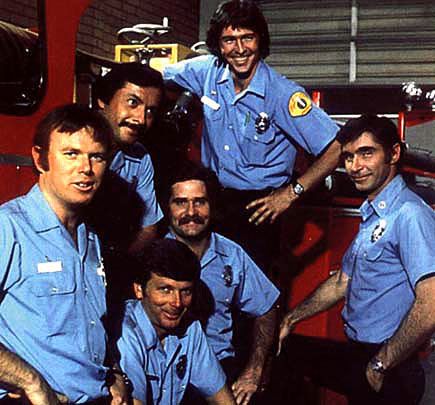
Emergency focused on two paramedic fire fighters, John Gage (Randolph Mantooth) and Roy DeSoto (Kevin Tighe), in the fledgling paramedic program and the doctors and head nurse in the emergency department at Rampart General Hospital, Dr. Kelly “Kel” Brackett (Robert Fuller), Dr. Joe Early (Bobby Fuller), and Nurse Dixie McCall (Julie London). Gage and DeSoto were usually joined by their fellow firefighters at Station 51: Captain Henry “Hank” Stanley (Mike Norell), Chet Kelly (Tim Donnelly), Marco Lopez (Marco Lopez), and Mike Stoker (Mike Stoker). Many times they were joined at the scene by Officer Vince (Vince Howard). The emergency room staff were also aided by the capable, but sometimes harsh Dr. Joe Morton (Ron Pinkard).

Our heroes!

Our heroes!

The show was a real ensemble and the episodes did a good job with that concept, following pretty much the same formula. The opening established the story line for the show and was usually followed pretty quickly by the firefighters responding to their first call of the show. From there, between calls and patients at the hospitals (some more comical than others), the story line was worked out until a resolution at the end, usually following a big rescue of some kind. Some episodes focused more on the paramedics/firefighters and some focused more on the emergency room staff, but the overall show maintained a pretty good balance of both.

Being the 70’s, there was no shortage of familiar faces popping up on the show, including Adam West, Jo Anne Worley, Ruth Buzzi, Dick Van Patten, Grant Goodeve, Mark Harmon (as an animal control officer in a possible pilot), Jamie Farr, Robert Alda, Marion Ross, Sharon Gless, Tony Dow (Wally turned to crime in this ep), Larry Manetti, Joyce Jameson, Dabbs Greer, Melissa Gilbert, Nick Nolte, Ron Masak, John Travolta, Yvonne Craig (Batgirl, to you), Linda Gray, Linda Dano, and Jack DeLeon (Marty Morrison from Barney Miller).

Look, ma! Firefighters!

Look, ma! Firefighters!

One really cool thing about the show was the use of real firefighters in the cast. In the first season real LACoFD Captain Dick Hammer (as himself) headed Engine 51 (he was followed by John Smith as Captain Hammer before Mike Newell took over as Captain Stanley). LACoFD Mike Stoker was with the show for its run. And the oft-heard, rarely-seen dispatcher was LACoFD dispatcher Sam Lanier.

The inclusion of the real firefighters in the show lent to the realism of the whole shebang. I realize there are mistakes in the rescue, response, and ER scenes. But as someone who is not an authority on 1970’s paramedic/firefighter/doctor/nurse procedures, those scenes look legit (except for the lack of blood in some scenes; they are a bit clean on this show). I find some of the big rescues at the end of the episodes pretty spectacular to watch because they feel real. I don’t feel like I’m looking at multiple takes of something. I’m watching two paramedics jumping into the ocean to get a guy out of a sinking helicopter. I’m watching two doctors examine a guy with internal injuries. There’s nothing forced or staged-feeling about it (usually).

And if you’re viewing this like a bit of film from a time capsule (as I like to do with my reruns), it’s wild to basically watch the infancy of the paramedic program that we’ve all grown very used to today. It’s also pretty wicked to see the ginormous walkie talkies the firemen use and the box of phone (bio-phone) that the paramedics use to call Rampart Hospital.

When I first started watching the show, I admit that I found John Gage to be a little annoying and I had doubts that I was going to be able to put up with him. But after a few episodes, he grew on me and the interaction between him and Roy DeSoto is wonderful. There’s a great chemistry there. Also, Chet Kelly has one of the greatest mustaches ever to grace a fire department and he holds a special place in my heart now. Watching Nurse McCall keep Dr. Brackett and Dr. Early in line is great fun.

If you’re looking to be hips deep in personal drama like on Grey’s Anatomy or ER, look elsewhere. The characters do have their stories, but nothing soap opera-ish. Which I appreciate. There seem to be streaks of characters getting injured. Obviously, that’s part of the risk of being a firefighter, but I swear Gage got hurt three times in one week during the big rescue at the end. Of course, anyone injured is usually back the next episode feeling fine.

Some of the most believable calls/rescues/patients are the most ridiculous ones. The family that thinks their mother is dead but she’s only napping, the guy who thinks he’s been cursed, the guy who accidentally glues his hands to a model ship, but doesn’t want the ship destroyed to unglue his hands, the girl that gets her head stuck in a chair (okay, that wasn’t on the show; I really did that when I was a kid). You  have no idea how many calls first responders get that are really like this. The truth is stranger than fiction and this show definitely captures that with some of the absurd incidents. But, like I said, the way those scenes are done, you go right along with it.

It’s the big, dramatic incidents that I sometimes have trouble with. I’ll read the episode summaries and be like, “A plane crashes into an apartment building? Come on!” And then I’ll watch the episode and be like, “A plane crashed into an apartment building! Help! Help!” It’s all in the delivery, I suppose.

I could be easily impressed, too. Always a possibility.

Either way, this show became a quick favorite and I hope it sticks around on my TV for a long time. I need the opportunity to watch these episodes a few times.

Keep up the good work, Chet.

Keep up the good work, Chet.


Where I Watch It