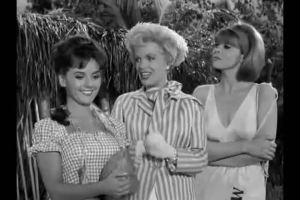
 As I mentioned in my post about educational television, I learned about Lysistrata thanks to Gilligan’s Island.
In a first season episode titled “St. Gilligan and the Dragon”, Mrs. Howell invokes Lysistrata to kick off a battle of the sexes. While the play had the women refuse the men sex, a 1960s sitcom couldn’t get away with that sort of raciness (it could barely handle women’s navels) and instead had the women refuse to do anything for the men.
The women move to a different part of the island and predictably, the men can’t hack it doing women’s work while the women get along just fine. Do the men realize the error of their ways and go to the women to apologize? Of course not. Instead, they come up with a plan to scare the women into needing their help through a dragon-type monster they some how made from paper mâché. The women stumble onto their plan and meet the monster with force (led by Mrs. Howell, who remarks with a joyful viciousness, “We’ll kill it and send its head back to the men!”).
In the end, the women are scared back to the men due to a downed weather balloon that’s billowing in the jungle like some weird, large lady bug looking caterpillar whatsit. Gilligan “kills” it, and kills a chance for rescue. Because after all, Gilligan ruining their chances to ever return to civilization is the theme of the show.
As a kid watching it, I was like, “Wow, these guys are dumb. The girls shouldn’t be scared!”
As an adult watching it I’m like, “Wow, these guys are dumb. The girls shouldn’t be scared!”
Yes, the words are the same, but the tone is different. When I was a kid, I thought it was funny. Run-of-the-mill sitcom tomfoolery. Today, it’s still funny, but in the “oh sweet Mary, this shit is ridiculous” kind of way.
In true sitcom fashion, the men absolutely go to pieces without the women. The implication is, of course, that they’d never had to lower themselves to learn “women’s work”, which is a little baffling considering that Skipper, Gilligan, and the Professor are bachelors. How the hell did any of them survive? I suppose the answer is barely because attempting to do it in the face of some adversity is a complete disaster. Mary Ann can make a coconut cream pie, but these men can’t cook a fish without turning it to ash.
And then there’s an extended fantasy sequence in which they all imagine the women doting on them and needing them.
I’ve come to view this episode as a glorious illustration of the patriarchy. The men believe they deserve to be worshiped simply for being men, but in reality, they would have starved to death without the women. The men are incapable of taking care of their own basic needs because it’s somehow considered unmanly to do so. They’re entitled to be catered to by the women because of reasons. Meanwhile, a woman’s request is framed as nagging. They’re unreasonable and emotional and they can’t survive without the men to protect and provide for them, except that they pretty much do. In fact, in the day to day, the women are the ones keeping this clownshow from going full Lord of the Flies circus.
And so, their progress and independence has to be undermined in the most absurd way: by scaring them with a monster. Sitcom logic, to be sure, but it could just as easily be seen as a metaphor for the big, bad world that could easily devour the women alive. After all, that’s a man’s role: to protect women. Never mind the fact that the monsters are usually men. Kind of like the men pretending to be a rogue dragon from a Chinese New Year celebration. The men create the problem and then the men “solve” it.
Just think. If it hadn’t been for that downed weather balloon, the men might have actually had to apologize.
 Several years ago now, I saw a movie called Chi-Raq which is a retelling of the story of Lysistrata set in present day Chicago. It’s a great movie, but judging by some of the comments I saw at the time, it seemed that some people missed the fact that it was a retelling of a Greek play by Aristophanes.
 aka KikiWrites