I’ll Make You Pay for What I Did!

Drawing of an old school TV with antenna, a dark orange casing, brown legs, and a grey screen.This may be one of my favorite-for-the-wrong-reasons trope. It’s typically found in cop shows, but I’ve seen it in other genres as well.

The basic premise is simple. Someone who did a bad thing in the past has come back to seek revenge on the person who caught them doing the bad thing and/or got them in trouble for it.

A great example of this is the Simon & Simon episode “Double Play”. Rick and A.J. find themselves being framed and the list of suspects is just people they put in jail. None of these people are innocent; they all did what they served time for. Some of them hold grudges, some of them apparently don’t. But the person who framed them absolutely did it out of revenge.

Because they blamed Rick and A.J. for them going to jail.

I can’t count (well, I probably can, but I’m too lazy) the number of times someone rode into Dodge City on Gunsmoke looking for Matt Dillon because he put them in jail once and now they’re looking to get even. More than once did Steve McGarrett have to contend with a blast from the past coming back to exact revenge on Hawaii Five-O because he put them in prison for a crime they committed.

I think what I love the most about this trope is the absolute lack of self-reflection, the 100% denial to take any responsibility for their own actions that it depends upon. Sure, I made all of these dubious, unfortunate life choices, but you can’t honestly punish me for that, can you? How dare you! It’s hilarious. It’s an adult version of a temper tantrum. I was held responsible for my actions. I’ll show you!

I would love to say that it’s an unrealistic trope, but unfortunately, lower stake versions of this sort of thing happens all the time. People will do gymnastics that rival Simone Biles to avoid taking responsibility for their own actions, gladly trying to stick the landing of blaming the person who called them out. Amazing.

I’ve seen one good twist on this trope in an episode of Barney Miller called “The Vandal”. The detectives of the 12th Precinct arrive to find that their squad room has been vandalized, including graffiti specifically calling Barney an unmentionable name. While there’s plenty of speculation of who the culprit is, it turns out to be a man from Barney’s past seeking vengeance for the ticket Barney gave him for littering decades before, an incident that Barney can’t even remember.

The twist comes from the fact that the man isn’t necessarily seeking vengeance for being held responsible for his “crime”, but that because Barney insisted on holding him up to write such a petty ticket, the man missed his job interview which led to his life descending in a downward spiral.

One can argue that if the man hadn’t littered in the first place, he never would have gotten the ticket, but it also shows that Barney wasn’t always the compassionate, understanding leader that we had by that time come to know. It also illustrated how something that can be insignificant for one person, can be monumental for another.

However, this is a rare instance. Most of these people are going to continue to make our heroes pay for catching them.

And I’m going to enjoy every minute of it for all the wrong reasons.

Those Weak and Wily Women of the Wild West

Silhouette of a cowboy on horseback leading another horse against a pink, orange, and blue sunset. Image by Yuri from Pixabay.I am by no means an expert on TV Westerns. (Actually, you could put “I am by no means an expert” on my headstone because I’m not an expert on anything; I’m just really good at running my mouth.) But I have watched all of The Big Valley and Bonanza, and just about every episode of Gunsmoke thanks to my father’s latest binge watching habits, and I’ve noticed something.

Women in the old west were pretty weak. The plot typically calls for them to be at the mercy of something, usually a man. The man is either a bad man who makes everyone miserable or a man she loves who is either a bad man who makes everyone miserable or a good man who makes terrible life choices.

I honestly think the latter makes my eye twitch more.

There’s this insinuation that all a woman wants is to have a man and that she will put up with anything to have one, even if that man is garbage. The number of times I’ve heard, “You have to do X because I am your husband,” or “because you love me” or “because you don’t have a choice.” I would be a widow. Men outnumber women in the Old West. I will find me a new one that does not try my nerves to such an extent.

Which brings me to my next observation.

Men did outnumber women back in the Old West because it was a rough life. It wasn’t for everyone. You had to be pretty tough to survive out there. So, it stands to reason that most of the women out there would be a little more involved in self-preservation. They probably wouldn’t be as tolerant of their man’s bullshit because finding another one would pose no challenge.

Also, women would have to be tougher to survive out there, period. Depending on a man wouldn’t be the best strategy because if your man is shit or if he dies -which was probably pretty likely, especially in a TV Western- a woman would be shit out of luck. And that has been the plot of more than one of these episodes. The women are always looking for a man to save them.

I find this most egregious when it comes to the saloon girls working at the Long Branch on Gunsmoke. We all know what their business really is -wink wink nudge nudge- and the fact is that in order to survive that lifestyle, you had to be a helluva lot tougher than the men. Looking for a fella to save you wasn’t going to work out in your favor and being pushed around by the clientele was bad for business. Miss Kitty was a bad ass broad, but I feel like she should have shot a lot more men.

Which brings me to the flip side. Sort of.

If the women weren’t weak, they were wily. They were plotting, cunning, and conniving, using their feminine wiles to get what they wanted. It frequently manifests as a woman pitting two men against each other, or using a man as a proxy to enact either vengeance or self-enrichment. These women are tough, in their way, and that’s a bad thing. Being tough and resilient is at odds with femininity, at least in the minds of cowboys and the men who wrote them.

Of course, there are exceptions. Miss Kitty and Victoria Barkley are notable in this respect. Both women are fiery, independent, and not apt to take shit from any man. Victoria Barkley was skilled with a whip and even though I thought Miss Kitty should have shot more men, that didn’t mean she didn’t have a gun behind the bar and that she didn’t use it. I also saw her whip a man with a parasol once. I wouldn’t cross either one of those women.

I suppose they didn’t want independent, strong women to have too much representation in the Old West.

The ladies might get ideas.

That Pesky Due Process

A pair of silver handcuffs on a black background. Image by jp from Pixabay.It’s a common trope on a cop show.

The good guys have caught the bad guy, but the bad guy gets off on a technicality. The good guys are then forced to watch their bad guy walk free to create more of their brand of mayhem, usually while giving an impassioned version of “I’m going to nail that guy if it’s the last thing I do,” a lyric that fits into almost any melody a fictional super cop wants to sing.

Naturally, since we’re on the side of our good guys, we’re incensed with them. The justice system is clearly flawed/broken if it would allow a bad guy to walk free, a bad guy that we know is a bad guy because our good guys said so. We’re confident that our cops will see that justice is done no matter what those fancy attorneys and incompetent judges do. And, of course, they do. Just as we knew they would.

It’s a clever trick of copaganda.

“Technicality”. It makes it sound like someone didn’t dot an I or cross a T. And while it is accurate -the defendant wasn’t found not guilty, they were released because of a technical error- it’s also deceptive. The shows tend to gloss over how these “technicalities” are part of due process.

Due process is that pesky part of the Constitution that guarantees a person is granted certain rights and protections when dealing with the legal system. These are guaranteed rights that apply to everyone, not just citizens, not just the innocent. Due process covers such things as habeas corpus, the right to remain silent, the right to counsel, the right to cross examine a witness, the right to a speedy trial, the right to access to the evidence, etc.

Cop shows love to make defense attorneys look morally questionable. After all, they’re defending the bad guys. They also love to make them look sneaky when they use these “technicality tricks”. While they gloss over the nature of the technicalities, they also gloss over the role of the defense attorney. Their job is to defend their client. Part of that defense is to make sure that their client’s rights aren’t being violated.

An episode of Hawaii Five-O deals with the consequences of due process in an interesting way.

In the sixth season episode “Mother’s Deadly Helper”, an accused man has his case dismissed because the prosecution can’t produce a needed witness to proceed with their case. The defense attorney asks for a dismissal based on the fact that the repeated continuations that the state’s attorney has asked for violates his client’s right to a speedy trial.

It feels like a miscarriage of justice because we learn later that this guy is a hitman. But it’s not because even hitmen are entitled to their rights.

His freedom is short-lived as a vigilante snipes him as soon as he leaves the courthouse. The disgruntled citizen in this episode is fed up with “soft-hearted judges” letting criminal walk. The “soft-hearted judges” in question are committing the unforgivable acts of upholding the rights of individuals.

In the context of cop shows, it feels egregious to allow these bad guys the same rights as the innocent folks because what we want to see is our good guys putting them behind bars for good.

I suppose it feels egregious in the context of the real world, too. Especially when it seems like those rights favor a select group of the population.

But we all have them.

Even fictional bad guys.

Wasn’t That Guy Already On This Show?

Drawing of an old school TV with antenna, a dark orange casing, brown legs, and a grey screen.I was scrolling through Instagram one day, afflicted by the way it insists on showing me posts from people I do not follow, when I happened across a video in which a young person was questioning a TV show’s choice of using an actor that had already guest starred on the show once to guest star again in a different role. They went so far as to question whether or not the casting department should keep a list so things like this don’t happen.

And I thought, “You sweet summer child. You absolute infant. Let me show you the history.”

Because this was the rule not the exception back in the long, long ago, and even the not-so-long ago, and I had no idea (thanks to my lack of watching many current shows) that it has become something not as common in the present tense.

My first thought upon seeing this video, the first example that popped into my mind was Gunsmoke. It was the source of employment for many actors in the course of its 20 years on the air, and had frequent repeat guest stars who showed up in multiple episodes and never played the same character twice.

My dad is currently binge watching this series, so it feels like every time I come into the room, Victor French (18 episodes), Morgan Woodward (19 episodes), Jack Elam (15 episodes), Denver Pyle (14 episodes), John Dehner (12 episodes), and John Anderson (12 episodes) are on. I’m not complaining. I love them all. But binge watching makes it obvious just how much they were on and how many of those episodes were in the same season.

It was commonplace, particularly in long running shows, to have those kinds of repeats. In the case of Hawaii Five-O and Magnum P.I., the location made it necessary to use a lot of the local talent multiple times. Not only are they showing off the unique and diverse culture of Hawai’i, but also, not everyone could be flown in from the mainland.

When you find a good actor, you want to keep them around. Jack Webb had a sort of stable of actors that he would draw from. Tim Donnelly and Marco Lopez, for example, appeared in multiple episodes of both Dragnet and Adam-12. And those guest spots scored both men a regular gig on Emergency!

Which brings me to the next recurring guest star practice that might blow this questioning young person’s mind.

Guest starring is how some actors found their regular gig. Both Ken Curtis and Buck Taylor appeared as different characters on Gunsmoke before landing their regular roles of Festus and Newly, respectively. Harry Morgan appeared as a general before being cast as Colonel Potter on M*A*S*H.

And sometimes you get the flip side of that.

An actor that had been a recurring character coming back later as a different character. On The Monkees, Henry Cordon spent the first season playing the band’s landlord in several episodes before coming back as a completely different character (in another location even!) in the second season. John Orchard was Captain “Ugly John” Black in the first season of M*A*S*H before coming back much later in the 8th season as a completely different character for an episode.

And even though I can’t think of an example off the top of my head (because I’m too lazy to do actual in-depth research), I’m positive I’ve come across instances in which an actor played a recurring character, guested as a different character in an episode, and then resumed their recurring role. Drop me a comment if you think of one.

I suppose what I’m getting at is that this is the nature of the business and our part is to suspend our disbelief and pretend that Ed Flanders is a different guy every time he decides to take on Steve McGarrett.

Let’s have some fun.

Rerun Junkie Guest Star- Dub Taylor

I adore Dub Taylor. He might have appeared in more movies than TV shows, but he won my heart in reruns. He was perfectly made for westerns with his gruff look that could go sweet or mean depending on the need. That country accent might have sounded a little out of place in the modern day cityscape, but he made it work.
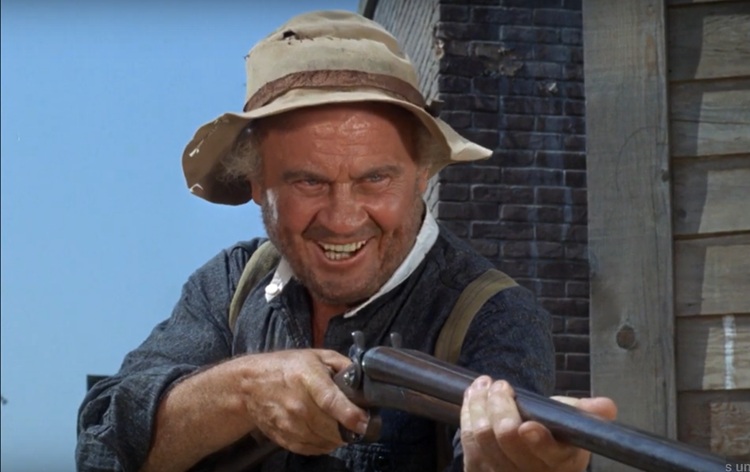
Of his 263 credits on IMDB going back to 1938, surprisingly only one is for a regular character: Wallie Simms on the 1957 series Casey Jones, which starred Alan Hale Jr. as the title character. He had brief recurring stints of a few episodes on Dennis the Menace, Hazel, Tammy, Please Don’t Eat the Daisies, Little House on the Prairie, and Designing Women. Somehow, no series was able to keep him long, which is a shame.

Even though I think Dub Taylor was tailor made for westerns, two of my favorite appearances of his weren’t set in the Old West.

One was in the Chopper One episode “Downtime”. Helicopter cops Foley and Burdick are grounded while their chopper is undergoing repairs, so their captain puts them in a squad car to patrol, something Burdick used to do more than his helicopter pilot partner Foley. They run across Rudy, played by Dub Taylor, an eccentric thief, who’s good at stealing little things, but not good at not getting caught. There’s a scene in which they have him empty his pockets and it’s like a clown car of stolen goods. He later helps them out by pointing them in the direction of a suspect who planted a bomb on a dam.

I would like to think that if the series had continued, that there’d be at least one episode a season of Burdick and Foley patroling on the ground and running into Rudy. Those episode would have been gold.

The other episode I love him in is the second season episode of The Monkees called “Hillbilly Honeymoon”. It’s Romeo and Juliet meets the Hatfield and McCoys with a Monkees twist. Dub Taylor plays Paw Chubber, whose daughter Ellie Mae is first in love with Judd from the rival Weskett clan, but then falls in love with Davy, earning the ire of Judd. Judd and Maw Weskett kidnap Davy with the intent of turning him into mash for moonshine. Meanwhile, Paw Chubber insists that Davy make an honest woman of his daughter since he caught them kissing. It’s a hilarious episode and Dub Taylor does his part as a menacingly funny patriarch armed with a shotgun.

As I said, Dub Taylor was made for westerns and appeared in several, such as The Range Rider, Cheyenne, Lawman, The Life and Legend of Wyatt Earp, Laramie, The Virginian, Laredo, Death Valley Days, The Big Valley, Cimarron Strip, Lancer, The Guns of Will Sonnett, The High Chaparral, Gunsmoke (including an episode with his son Buck Taylor), Alias Smith and Jones, Bonanza, How the West Was Won, Bret Maverick, Iron Horse, and The Wild Wild West.

He named names on The Roy Rogers Show, The Barbara Stanwyck Show, The Lloyd Bridges Show, and The Andy Griffith Show; checked in on Dr. Kildare and Emergency!; was wholesome on My Three Sons, That Girl, Father Murphy, and The Partridge Family; got a little silly on I Love Lucy, My Favorite Martian, and The Real McCoys; enlisted with The Adventures of Rin Tin Tin and Ensign O’Toole; privately investigated on Michael Shayne, Surfside 6, and 77 Sunset Strip; hit the beach on The Beachcomber and Hawaii Five-O; doubled up on Hardcastle and McCormick, The Odd Couple, and McMillian and Wife; got out there with The Twilight Zone and Salvage 1; lawyered up with law enforcement on Perry Mason, Burke’s Law, and Law & Order; spied with The Man from U.N.C.L.E and went undercover on Mod Squad; and hung out with Burt Reynolds on Evening Shade.

Dub Taylor brings a certain rustic charm to every role I’ve seen him in. He’s as comfortable being goofy as he is being mean. And even the in the smallest guest spot, he draws attention. Dub Taylor can’t help but be a star.

I Am Fascinated by the Heterosexual Marriages of Television Yore

For episode 72 of Book ’em, Danno, I watched the sixth season Hawaii Five-O episode “One Born Every Minute” in which a brilliant con man uses a beautiful blonde to rope in married, middle aged men to swindle money from them in an elaborate diamond buying scheme. The con man targets these men because their married nature precludes them from going to the cops once they’ve discovered they’ve been had because they don’t want their wives to find out that they were in the market to cheat.

Which is funny considering cheating was almost normalized on TV during that time. It’s understood that married, middle aged men are going to cheat on their wives as soon as a pretty young thing gives them the opportunity, and not just at the office or on business trips, but even while they’re on vacation with their wives waiting in their hotel room while they’re off cavorting, like two of the swindle victims in the episode.

The heterosexual marriage narrative depicted in television is that by middle age and a couple of decades of marriage, the wives are used up, miserable nags, and the husbands are misunderstood, hen-pecked, and most importantly, still desirable to gorgeous young women, so it’s only logical that they would step outside of the confines of their marriage to experience that freedom. Most of the time, there’s no indication that the men want anything but a little something-something on the side -after all, to leave their wife is to leave the comfort of their needs being consistently met. Girlfriends are for sexy times; wives are for laundry. Yet, there’s also enough concern for consequences (I’d call it shame, but baby, that ain’ it) that these men don’t want their wives to find out about any of these indiscretions.

What a delightful dichotomy that lands husband after husband in hot water, particularly on cop shows.

What an odd expectation of marital life to set. It was inevitable that husbands would cheat on their wives and wives would tolerate it. It was inevitable that husbands and wives would eventually hate each other. It’s a natural progression of marital bliss after the honeymoon period. In a society that puts emphasis on marriage -especially at that time when a woman’s life was forcibly tied to a man (unable to get credit, open a bank account, etc. without a man’s signature)- can you imagine watching your favorite show and being told that’s the life you should not only expect but be grateful for? Hell, week after week on The Honeymooners, Ralph Cramden threatened to send his wife Alice to the moon while she seemed to barely tolerate his existence for the sake of his paycheck, and that was considered to be a normal marriage. Wild.

Of course, not every television marriage was depicted this way. Darrin and Samantha Stephens had a pretty loving marriage on Bewitched; Carol and Mike Brady are both marriage and parenting goals; even some of the married couples that passed through Hawaii Five-O, criminal and law abiding, seemed to have decent relationships. But when The Addams Family exists in direct challenge to everything suburban normal and that includes a loving marriage with spouses who are openly affectionate and infatuated with each other even after two kids and many years, that speaks some volumes. Practically shouts, really.

Watching these shows now, at this distance, with the depiction of the casual philandering and the general ball-and-chain attitude, it’s just fascinating that this was put forth as an ideal. A norm. This was the future every girl should dream of and every man should subject himself to.

Enjoy your marital bliss.

Three More Tropes I Hate

I am back once again with a healthy dose of negativity. I’ve already posted five tropes I hate, and it was only a matter of time before I got around to posting a few more. Why three and not five? Because I thought of three off the top of my head and decided to be irregular about it.

Just a reminder, these are my dislikes, not yours. If you disagree, that’s great. But don’t try to change my mind.

  1. Good Girl/Bad Boy– We know this story. She’s a good girl. If she’s young, she’s a good student, model child. If she’s older, then she’s sweet, possibly innocent, a hard worker, and rule follower. An occasional glass of wine is the most drinking she’ll do. He’s a bad boy. In school, he’s flunking grades and causing trouble. Outside of school, he continues his rule breaking ways, maybe straying into lawbreaking ways. He drinks, he smokes, he probably wears a leather jacket to show his disdain for authority. The idea behind the couple is an opposites attract situation. Of course the good girl would be attracted to the bad boy and vice versa. They both have qualities that the other admires and/or needs. The bad boy can loosen up the uptight good girl and the good girl can instill some discipline and respect in the bad boy. I suppose it’s all fine in theory, but too often it comes across as the “I can change him” fairy tale that’s been the unrealistic foundation of cis het relationships for far too long. Worse, the good girl so believes her love has changed her bad boy that she refuses to see that her man hasn’t transformed a lick, like in the Hawaii Five-O episode “Engaged to Be Buried”. He’s a daddy’s boy who killed your friend and threatened to kill your father. Why are you crying over him? Throw the whole man away.
  2. Oh no! A Girl!– I want to say that this trope has been left in the past, but I know better than to get my hopes up. The trope is a play on the woman in a man’s job stereotype. The men are so weirded out that there’s a GIRL in their midst doing a MAN’S job that their brains short out and they act like the biggest misogynistic assholes shat out of a writer’s pen. There are two main reasons that this trope makes my eye twitch. The first is that it makes the characters we’ve come to know and love unlikable, and in some cases barely indistinguishable from some of the jerks already dealt with in the series. The second is that the women are frequently written to be annoying in their insistence on proving they’re worthy of the job. While that does have the basis in some truth (women have to work twice as hard to be considered half as good), they don’t have to be aggravating about it. Between the men and the women being annoying, I’m irritated and can’t enjoy the episode. One twist on this trope was in an episode of Chopper One called “Deadly Carrier” in which Burdick was first surprised that the doctor was a woman and then proceeded to treat her with a disrespect he’d never show a male doctor. This was later played off as bickering for sexual tension, which means the episode just went from one of my hated to tropes to another.
  3. Let’s Add a Kid– It’s probably most popular to do on a sitcom. The original children are getting older and less cute, so let’s remedy that by adding new children. The Brady Bunch is probably the most notorious for this because of Cousin Oliver (the scapegoat for the show’s cancellation even though the obvious declining quality of episodes is right there), but other shows have done it, too. On Roseanne, the kids were all grown or nearly so when she decided she wanted another baby and they ended up with Jerry. On Step by Step, the blended family ended up with a half-sister when the six kids started hitting puberty. Even Little House on the Prairie featured an influx of orphaned children when Mary and Laura got married and Carrie was one of the older kids at the schoolhouse. The one that irks me the most is on Family Matters. The Winslows started out with three kids -Eddie, Laura, and Judy- and Harriet’s sister Rachel had a baby named Richie. They ended up writing Judy off the show (pretty much Chuck Cunninghamed her) claiming they didn’t have enough stories for her, but then when Richie got older a few seasons later, he suddenly acquired a friend named 3J that ended up living with the Winslows. Didn’t even utilize all of the children they had, but still had to get another one. Guess they thought no one would notice due to all of the Urkel happening at the time.

Do these trope dislikes age me? Make me come across as a crusty, disgruntled old woman?

Good.

There will be more.

The Truth Is Always Best…Unless You’re a Cop

Despite my love of cop shows, I’ve never really been into the Law & Order franchise. Never had the urge or inclination to watch any of the shows. Then Charge changed their line-up, I was too lazy to change the channel, and now I’m hooked on Law & Order: Criminal Intent. I blame Vincent D’Onofrio and Kathryn Erbe.

The character of Detective Robert Goren says at one point during the final season that everybody lies all the time. Granted, this is said during a therapy session because my guy has some issues and he learned this lesson from his father telling him to lie to his mother about his father’s affairs, but it sort of makes sense that he would believe that anyway since he kind of lives this truth in his work. During the course of their investigations, he and Detective Alex Eames lie a whole lot to suspects. They lie about evidence, they lie about conversations, they lie about circumstances. I’m not talking about undercover work -though they do that a bit in the series. I’m talking about straight up lying to the people they’re questioning.

This behavior is totally legal. Cops are allowed to lie to the people they’re questioning. Just another reason why it’s important for folks to exercise their rights and ask for a lawyer.

But these are the good guys. Their lies are justified. It’s all in the pursuit of justice. Evidence is fine. A confession is better. In the world of fictional cops, confessions aren’t just the goal; they’re the norm. There’s a narrative to be served here.

Goren and Eames do have their own moral code when it comes to lying to suspects. For example, they won’t pressure a mentally fragile suspect, but instead lie and manipulate the suspect’s psychiatrist, who is responsible for the suspect’s destroyed mental state and ultimately, his crime.

They also right a wrong of a coerced confession from a group of minors accused of assaulting a woman. The cops in the interrogation video don’t do anything that Goren and Eames haven’t done before -lying to and manipulating their suspects- but the difference is these boys are innocent and the cops know it.

Fun fact: it only became illegal in Illinois for cops to lie to minors they’re interrogating in 2022. It’s still legal in other states. This is also why it’s important for minors to know their rights and for their guardians to know them, too.

I know it seems like I’m picking on Law & Order: Criminal Intent, but this is prevalent in just about every cop show. Steve McGarrett wasn’t above lying to suspects on Hawaii Five-O. In the case of some criminals, I think he took a certain amount of pleasure in lying to them just to see the look on their faces when they were caught. He had mean streak when it came to justice.

I’m sure that even the saintly Barney Miller lied to a suspect or two, but I can’t remember any instances off hand and I’m too lazy to do any research on it. It’s not like the 12th precinct arrested the kind of criminals the required an intensive interrogation. Most of them were caught in the act anyway.

The point of copaganda is to normalize some of the worst behaviors of the police and though it is legal for cops to lie to suspects during questioning, it doesn’t necessarily make it a good thing. It’s a manipulation tactic that’s seen more than a few innocent people put behind bars.

Some things are better left to the likes of Goren and Eames.

Hyperfixation Reruns

I’ve talked before about how I can’t answer the question of what my favorite TV show is. I realized recently that I don’t have favorites because I have hyperfixations.

I’ve never been officially diagnosed with any neurodivergency, but my tendency to hyperfixate on things has been with me all of my life. When I find something that truly grabs my attention for whatever reason, I can and will deep dive on it for days, weeks, months, and sometimes, off and on for years.

With this knowledge, it should come as no surprise that some reruns have reached hyperfixation level.

There are two kinds of hyperfixation for me when I fixate on a rerun. One kind has me watching the show repeatedly and picking it apart, wanting to analyze it and write about every conclusion I come to. I don’t share everything I write, obviously, but believe me, it happens. CSI: Miami is probably the most recent hyperfixation rerun of this type. I’ve pulled that show apart and looked at it from all angles and analyzed all sorts of bits and pieces. I’ve written about it. I’ve kept much of what I want to write about it to myself because I don’t want to overwhelm you. My analysis is stunning in a “get a life” sort of way.

The other kind of hyperfixation is when merely watching and analyzing isn’t enough. I have to learn everything I can about the show, the behind-the-scenes stories, and the people who made it. Jack Webb shows fit this bill. It wasn’t enough for me to watch Dragnet, Adam-12, and Emergency! multiple times and analyze the episodes and characters and cases. I had to dig into the background of the shows and learn about the creator and the actors. I had to know more about them than would be asked on Jeopardy. And then once that was satiated, I was able to move on.

Why do I fixate on the shows that I do? I have no idea. Something about them captures my attention and triggers something that makes it hard for me to let it go. I do not know what that magical attribute is because I’ve fixated on a variety of reruns over the years. Okay, yes, there have been a lot of cop shows, but there have been other, decidedly not cop shows, too. The answer isn’t that simple.

How long do the fixations last? It depends. When it comes to reruns, it averages a few months. Typically, enough time to watch the series through multiple times and let my brain mull it over and pick its bones clean. Some shows stay in my brain for much longer; others fall out of my head in record time. The length of time I spend fixating on a show doesn’t seem to affect the intensity. It’s called a hyperfixation for a reason. Regardless of the time spent, the focus is intense.

The one good thing about this particular hyperfixation thing is that it sometimes makes for some interesting blog posts about reruns. The other good thing is that I learn new things and it puts my critical thinking skills to good use in a different way.

It won’t get me rich, but I’ll have some really offbeat trivia to share in conversation.

Brace yourselves.

Rerun Junkie Books–Quinn Martin, Producer by Jonathan Etter

If you’re at all into reruns (and you must be if you’re here), then you’re probably familiar with the words “a Quinn Martin production”. A legendary producer during the ’60s and ’70s, the man had a gift for running a TV show. Sure, not all of them were multi-season successes and not all of his pilots were picked up, but he’s got more than one classic to his name.

First published in 2003, Quinn Martin, Producer: A Behind-The-Scenes History of QM Productions and Its Founder by Jonathan Etter covers Quinn Martin’s career as a producer via interviews conducted during the ’90s and early ’00s with actors, writers, directors, producers, and other behind-the-scenes staff who worked with Quinn Martin and for QM Productions during its run.

Starting with an introduction that covers the early life of Quinn Martin, including how he chose his name (he was born Irwin Martin Cohn), the book then covers his career show by show, starting with his executive producing stint on The Untouchables. The book goes into detail on Martin’s hit shows like The Fugitive, The FBI, Cannon, The Streets of San Francisco, and Barnaby Jones; the one season wonders like The New Breed, The Invaders, Dan August, and Banyon; and the shows that seemed to be doomed from the start like Caribe, Bert D’Angelo/Superstar, and The Runaways.

Because the history is covered via interviews, there are some unflinching takes, some dirt dished, and some conflicting views. Lynda Day George, who was the most frequent QM guest star, gushes about her experiences on most of the shows, but also isn’t afraid to be kindly honest about less than stellar times. The interviews with the crew, particularly the writers, directors, and other producers, are fascinating, not only dishing the details of Martin’s shows, but also illuminating how television was done back in the day.

Jonathan Etter does a fine job of organizing and incorporating the interviews with his research. He even includes failed pilots, TV movies, and Martin’s brief time producing films.

As this book was first released almost 20 years ago, many of those interviewed are no longer with us. I admit that seeing some of the names (like Robert Forster) was a gut-punch of sadness. But I’m also grateful that these experiences were preserved for posterity.

This book can be acquired at McFarland Books and Amazon.