Educational Television

Several years ago now, I saw a movie called Chi-Raq which is a retelling of the story of Lysistrata set in present day Chicago. It’s a great movie, but judging by some of the comments I saw at the time, it seemed that some people missed the fact that it was a retelling of a Greek play by Aristophanes.

Naturally, people pointed out that they didn’t know that because they’d never learned about it in school.

I never learned about Lysistrata in school either, but I still knew the story. How?

Gilligan’s Island.

The first season episode “St. Gilligan and the Dragon” invokes a G-rated version of the story. The women, frustrated with the men and feeling disrespected, decide to go off on their own and stop doing the “women’s work” for the fellas. Mrs. Howell is actually the instigator, citing Lysistrata to explain to Mary Ann and Ginger what they should do.

So at six years old, I learned about Lysistrata. Thirty-some years later, I finally put that knowledge to use to be smug at strangers on the Internet.

Television has a funny way of educating folks like that. They just sneak it in on you and the next thing you know you’re answering the Daily Double on Jeopardy correctly.

Or realizing what the school curriculum didn’t cover.

After the statue of slave trader Edwin Colston was pulled down and dumped in the sea in Bristol, England, someone on Twitter pointed out that much of the racist history of Britain wasn’t addressed in their history classes there. One of these events that they cited was the Mau Mau Uprising, a violent resistance to colonialism by the Kenya Land and Freedom Army against the British.

It seems odd that the Brits might not to learn something about this, even a glossy, white-washed version it. It makes more sense that an American like myself wouldn’t know about it. After all, our high school history classes barely get past World War II.

But I’d heard of it. Why?

Magnum PI.

The third season episode “Black on White” deals specifically with the Mau Mau Uprising, particularly Higgins’s role in it since the men in his unit who were there are being killed off. It’s not an exact retelling of history, of course, but it does capture the brutality of the conflict, something most Americans might not have otherwise heard of.

A little history lesson snuck in between the action and Aloha shirts.

This sort of thing still happens in today’s television. A whole slew of folks were introduced to the Tulsa Race Massacre thanks to Watchmen. In 1921, white residents attacked the Black residents of the Greenwood district in Tulsa, destroying the wealthiest Black community at the time, injuring hundreds, and killing an estimated 75 to 100 people (according to a 2001 commission; 39 deaths were confirmed). Not many US high school history classes paused to even mention that in the race from WWI to the Great Depression.

They say that too much television can rot your brain. And I suppose it can. Too much of anything isn’t good for you. Television is no different, especially some of the so-called mindless junk (I do love me some intellectual Twinkies as a way to soothe my tendency to overthink). But it’s not all brainless twaddle.

Pay attention next time.

You might just learn something.

Reboots of Reruns

Reboots of TV shows aren’t new. The New Monkees, The New Adam-12, The New Odd Couple, The New Gidget, The New Perry Mason, which aired while the old Perry Mason, Raymond Burr, was starring in Ironside, which would later be rebooted in 2013. Oh, and there’s reportedly another Perry Mason reboot in the works. From Dragnet to Kojak, Love Boat to Fantasy Island, Dark Shadows to Mission: Impossible, reboots have always been a thing.

I’ve changed my stance on reboots somewhat. As much as I would love for the people in charge to stop dipping into the pop culture well of yesterday and instead invest in fresh ideas written and performed by those not necessarily straight, white, cis, and mostly male, I’m no longer screaming about the originals that are being rebooted as being untouchable and sacrosanct.

Why?

The reboots are not for me.

If the reboots were for me, they’d just put the reruns on. I mean I love shows that went off the air before I was born. But. Why can’t they be redone, updated, and polished for a new audience? It worked for Battlestar Galactica. The original ran only one season, written off as a hokey Star Wars rip-off, though it was followed by the single-season sequel Galactica 1980. The reboot ran four season, garnered quite a bit of attention and acclaim, and created quite an enthusiastic fanbase. I never got into it as I prefer my Cylons shiny and the bad guy to have a purple light bulb for a head and wear a disco cloak, but even I know that we were all blessed having Richard Hatch back on our TVs on a somewhat regular basis.

I cried foul when it was announced that Hawaii Five-O was being rebooted. But it’s in its ninth season now. The only episodes of it I’ve watched pertain directly to the original (the remake of “Hookman”, Ed Asner’s character from “Wooden Model of a Rat” coming back, their take on “Cocoon” for the season 9 opener) and while I appreciated those episodes and the fact that show goes out of its way to pay such homage and respect to the original, I’ve never felt compelled to watch it on the reg. It’s not for me. But other people enjoy it plenty.

To me, it’s actually a good example of a reboot. The love for the original is plainly visible. The important elements are intact. The stories and cast have been updated, the characters tweaked, but at their core, they’re very familiar.

The reboot of Magnum PI appears to be going in this direction, which makes sense since the guy who developed it also developed the Hawaii Five-0 and MacGyver reboots. I watched the first few episodes, and I think the respect is very much there. No, Magnum doesn’t have a mustache (though there was a mustache reference in the second episode), but he’s still a handsome and charming war vet turned private investigator and all-around do-gooder and at his core, that’s who Magnum is. There is an unfortunate lack of short-shorts, though. We’re being denied man thighs.

But that’s a personal complaint.

Also greater than the mustache is that this Magnum is Latino. That’s one nice aspect that reboots can provide. Diversity. Yes, there’s always squawking when a male character is recast as a woman (Starbuck on Battlestar Galactica, Kono on Hawaii Five-0, Higgins on Magnum PI), which tells more about the squawkers than it does about the shows. But let’s be real, kids. Television, particularly action and sci-fi shows, are largely sausage fests. There’s nothing wrong with women cast as known characters provided that the characters reflect the change.

Getting non-white actors in those classic roles, too, opens up a world of storytelling provided the change is reflected. There are now new dimensions added because the characters aren’t working what’s considered the default. The reboot of One Day at a Time features a Cuban-American family. Back in the ’80s, The New Odd Couple (not to be confused with the 2015 reboot of The Odd Couple) featured a Black duo played by Ron Glass and Demond Wilson. Reboots also offer the opportunity to create new characters that could be played by non-white, non-male, non-straight, non-cis actors.

Reboots aren’t going away. So long as they can be viewed as a pop culture lure to draw in old fans while creating new, something with a vague scent of money to it, they’re going to keep getting the green light. And some of them are going to be positively horrid bombs that spit all over their source material and they should be rightfully shunned.

But others won’t be. Others will end up being pretty okay. And if we can’t enjoy them, then we should leave them to those that do because we still have the originals.

And if they ever need a consultant, I’m available.

They Didn’t Have Native Americans Back Then

As I discussed in a previous post, all of your favorites are problematic. All of my favorites, too.

One problematic aspect of reruns that’s probably the most glaring is the racist casting. White actors playing non-white roles has been common place for decades and was probably at its most popular in the Westerns of the ’50s, ’60s, and early ’70s. That’s right. Those Native Americans were not actual Native Americans. Those Mexicans? If they had a speaking role, they were most likely not actually Mexican.

John Saxon played a Native American on Bonanza and a Mexican on Gunsmoke. Martin Landau played a Mexican on both The Rifleman and The Big Valley. Michael Ansara not only played a Mexican in a couple of episodes of Rawhide, but he was frequently cast as a Native American, including starring in his own short-lived series called Law of the Plainsman playing Deputy Marshal Sam Buckheart, a character he originally played on The Rifleman.

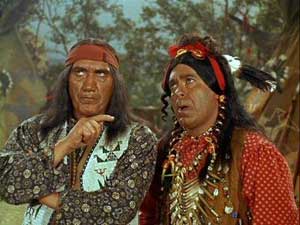
Sadly, one of my favorites, F-Troop, was notorious for casting white actors as their Hekawi tribe members. Frank DeKova, Don Diamond, Edward Everett Horton (who also played a Native American chief on an episode of Batman), J. Pat O’Malley, Jamie Farr, hell even Don Rickles all played Native Americans. It seemed comedic timing was more important than racial accuracy. Not that there aren’t funny Native Americans; but back then, they didn’t even bother to look for them.

Of course, Native Americans and Latinos/Latinas weren’t the only ones having white actors step in for them. Boris Karloff played an Indian Maharaja on an episode of The Wild Wild West. Wende Wagner played a native Hawaiian on an episode of Perry Mason, and her aunt in that same episode was Miriam Goldina, a native Russian. Jim Backus’s wife, Henny, played a native mother on an episode of Gilligan’s Island. Spoiler alert! Russ Grieve, who played her native husband, and Mary Foran, who played her native daughter, weren’t natives either.

Two of the most curious examples of racist casting I have ever seen happened on two of my favorite reruns, both of which I’ve mentioned before, but I’m going to mention again because they are worth mentioning at every opportunity.

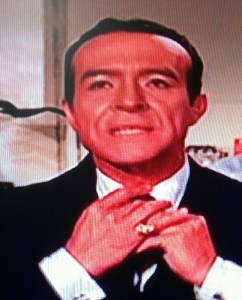
In an episode of Hawaii Five-O called “Samurai”, Ricardo Montalban played a Japanese criminal. Yes, you read that correctly and aren’t you glad that you did. In the second oddest case of yellow face I’ve ever seen (we’ll get to the first one very soon), a very Mexican Ricardo Montalban had his eyes artificially slanted to play a Japanese man. Like, his accent didn’t change at all. And whatever they did to his eyes made him look less Japanese and more like an eye lift gone wrong. The entire effect is very disconcerting and I highly recommend you try to catch that episode because descriptions and pictures don’t do it any justice.

To make an already confusing casting decision even more curious, Hawaii Five-O was typically good at casting Asians, Native Hawaiians, and Pacific Islanders to play Asians, Native Hawaiians, and Pacific Islanders in smaller roles, making things like this even more glaring.

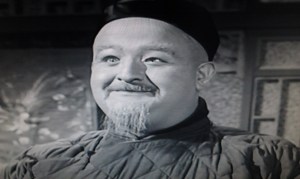
The truly oddest case of racist casting I’ve ever seen, however, belongs to the pilot episode of The Wild Wild West called “The Night of the Inferno”. In this episode Victor Buono played Juan Manolo aka Wing Fat.

Yes, let me break that down for you.

White actor Victor Buono played a Mexican man in disguise as a Chinese man. It’s basically a turducken of racist casting and I can’t help but gawk at it because I have no idea how to even begin to process it. I suppose if you’ve ever watched the series, then you can agree that at the very least, it sets you up nicely for some of the more bonzo episodes of the show.

Thankfully, this sort of whatthefuckery is largely in the past and though racist casting does still happen (whitewashing Asians and Pacific Islanders is still unnervingly common), the backlash is swift and loud. A new normal has been and is being established and even if I don’t watch current shows all that much, I’m still all for it.

After all, one day those shows will be reruns.

All of Your Favorites Are Problematic

One of my favorite episodes of The Monkees is called “Monkees Chow Mein”. The four guys inadvertently intercept a fortune cookie filled with top secret information at a Chinese restaurant. The CIA get involved. BJ Hunnicutt is there. Hijinks ensue.

And Joey Forman plays the head Chinese guy, Dragonman.

If you’re not familiar with Joey Forman let me assure you that he is a very funny man who is definitely not Chinese. His portrayal of Dragonman involved scotch-taped eyes and a stereotyped accent. It’s a somewhat less obnoxious version of yellow face, but there’s no doubt that it’s yellow face.

It’s problematic, to say the very least.

So, how can it be one of my favorite episodes? Two reasons. One, it’s funny and most of the humor in it could have been achieved just as successfully by Joey Forman (and his right hand man, Gene Dynarski) not doing yellow face. The lines and the antics would have been just as funny because it had nothing to do with the stereotype they were portraying.

Yes, I realize there’s a lot of privilege involved that it allows me to approach this episode from that angle.

And two, being a rerun junkie means that I’ve learned to accept that my favorites are going to be problematic.

It’s a simple matter of history, really. These shows are a product of their time, whatever their time is. That’s why you see a lot of racist casting (e.g. white people playing minorities) in the ’50s, ’60s, and even into the ’70s. The stereotypes continued all through the ’80s and beyond.  Misogyny and sexism has run rampant for decades, so it’s always available in reruns. To be fair, the shows can’t help it. And it’s far too late for them to change.

That’s not to say any of it is right, of course. These things might have been common then, but even at the time, folks had problems with it. Pernell Roberts reportedly objected to the racist stereotypes of the minorities on Bonanza. And Van Williams repeatedly tried to get Bruce Lee a bigger role on The Green Hornet, which the producers reportedly refused because they didn’t want to give too much focus to a non-white actor instead of the star.

So, when it comes to reruns, it’s a matter of acknowledging that at the time this was the practice. They’re time capsules of cringe-worthiness, syndicated reminders of our sketchy, shady, seedy TV past.

Even shows that did their best to be socially conscious (for their time) still stumbled. For example, Barney Miller often tackled topical 1970’s issues, some of which are still relevant today. And it largely succeeded in addressing those issues, at least in an illuminating sort of way. But there are some episodes that missed the mark and as a result have aged terribly. The episode “Rape” attempted to address the laws (or lack of laws) pertaining to marital rape. However, done in the confines of a 30-minute comedy…yeah. The tone-deafness only rings clearer as the years go by.

These are the landmines you risk as a rerun junkie. It can make for uncomfortable viewing and in some cases all of the logical rationale can’t save you from the oogy feelings. There are now episodes of my favorite shows that I avoid because I just can’t.

Retaining perspective is the key. It’s a good thing that these issues are noticed and that they cause discomfort. It’s a sign that things have progressed (somewhat) and that the old status quo has long spoiled.

Ideally, I’d like to do in-depth posts about the different issues that crop while rerun-watching.

But for now, I continue to come to terms with my problematic favorites.