Rerun Junkie Episodes–Favorite Christmas Episodes

Bah humbug.

Yes, we’re all very aware that Christmas isn’t my favorite time of the year. Too many years working retail and running the holiday gauntlet have put a permanent crimp in my holiday spirit. And that goes for my reruns, too. I find most Christmas episodes to be too saccharine and overly-sentimental. They run that commercialized holly jolly through the society-approval filter and trim it with some moral lessons and it’s just enough to be nauseating.

However, there are a few episodes that have captured my heart, either because they forego these tropes, skewer them, or dress them in a silver pantsuit that’s absolutely to-die-for.

“‘Twas the Night Before Christmas”, The Golden Girls– The women are all planning on spending Christmas with their families. The bemoaning of the commercialization of Christmas leads them to exchanging homemade gifts, including Rose’s whittled maple syrup spigots and Blanche’s “Men of Blanche’s Boudoir” calendar, opened the night before they leave. On Christmas Eve, Blanche and Dorothy show up at the counseling center to pick up Rose, who is working a morning shift, only to be held up by a Santa (Terry Kiser), who demands they all celebrate Christmas together. Thanks to Sophia, they’re able to get out of that jam and to the airport, only to see their flights home cancelled. Later, at a diner, the women realize that they already are spending Christmas with family.

The ending is a bit sweet, what with it snowing in Miami and all, but Rose hitting “Surfin’ Safari” on the jukebox instead of a Christmas song saves it. Though I’ve always found it bizarre that they decorated the house, tree included, even though they wouldn’t be there for Christmas, I’m glad they did. They have some really lovely decorations and the tree is gorgeous. And Blanche’s pantsuit is fabulous.
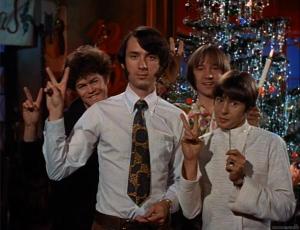
“The Christmas Show”, The Monkees– The Monkees, in their forever pursuit of the next gig, end up getting hired to mind Melvin (Butch Patrick), a disgruntled forty-year old trapped in a twelve-year old’s body, while his aunt is away on a Christmas cruise. Turns out, Melvin isn’t much for Christmas. When the boys try to get him into the holiday spirit, they end up blowing through all of their money and aggravating Melvin to the point that he goes home. It’s only then that Mike realizes what’s been missing the whole time.

It could be a typical “lesson of Christmas” episode, but it’s The Monkees. They don’t do typical. Instead, they do madcap that involves them chopping down their own tree (while apparently stoned), Peter wrecking a department store while shopping for toys, Micky and Davy dressing as Santa and his elf and going down the chimney, a happy ending, and capping the whole thing off with an a capella version of “Riu Chiu”. It’s zany and sweet and the crew getting their time in front of the camera during the credits is a lovely gesture.

“Dear Sis”, M*A*S*H– In a letter home to his sister, Father Mulcahy expresses his frustration in not feeling very useful. Most everyone in camp has the holiday blues, but it seems that it’s hitting Father Mulcahy the hardest as nothing he does is really helpful. He even ends up decking a combative patient (who hit him first, so he had it coming). It’s only during the Christmas party in the mess tent that Father Mulcahy realizes that he has made something of a good impact, first when Charles thanks him for having his mother send him his old toboggan cap, and then later when Hawkeye singles him out during a toast.

M*A*S*H did several Christmas episodes during its eleven year run, but this one stands out to me for several reasons. One, it centers much of the episode on Father Mulcahy, which didn’t happen very often. Two, instead of singing a traditional Christmas song, Hawkeye leads everyone in singing a lovely version of “Dona Nobis Pacem”. And three, the episode ends with one of my favorite lines from the series. As the party is broken up by incoming casualties, the voiceover reading of Father Mulcahy’s letter to his sister says, “You know, sis, it doesn’t matter whether or not you feel useful when you’re moving from one disaster to another. The trick, I guess, is to just keep moving.”

“The Christmas Story”, Dragnet– A local church’s baby Jesus has gone missing from its nativity scene and Friday and Gannon are on the case. The statue has little monetary value, but it’s sentimental value can’t be measured and the parishioners would be very sad to go a Christmas without it. Being diligent detectives, Friday and Gannon follow a tip provided by an altar boy (Barry Williams) that leads them to a suspect (Bobby Troup), but he only borrowed a friend’s car and got into a little fender bender; he didn’t take any baby Jesus. Dejected, Joe and Bill go to the church to let the padre know they didn’t find the baby Jesus, but they’d keep looking. Just as they start to leave, a little boy pulling baby Jesus in a wagon comes into the church. It turns out that he’d prayed to baby Jesus for a new wagon and promised Him that if he got it, he’d give Him the first ride.

I’m not one for religion. I tend to cringe and shy away when people ram home the “Christ” in Christmas. But this episode is an exception and it’s all in the handling of the case and the ending. Our detectives are pursuing this matter seriously, as they usually do, but the justice is less nabbing a thief and more doing right for a congregation. The little boy who took the statue was fulfilling a promise, something that is more in tune with the holiday spirit than any of the sappy treacle that often gets splattered on the screen.

“Christmas with the Addam’s Family”, The Addam’s Family– It’s the common holiday problem that all sitcom parents face at one point or another: Santa. Pugsley and Wednesday are told by the Addams’s unkind neighbor that Santa doesn’t exist. The family bands together and elects Uncle Fester to play the role to restore the children’s faith. When he gets stuck in the chimney, each member of the clan takes it upon themselves to prove that there really is a Santa.

This could easily be a mediocre, overly-sweet episode, but this is the Addams family. This delightfully loving family is weird and wonderful and only they could pull off a Santa overload with such sincerity.

“Operation: Silent Night”, Magnum P.I.– While ferrying Magnum, Rick, and Higgins to their various destinations before he catches a flight home to New Orleans, T.C.’s chopper crashes on a deserted island that the Navy uses for target practice. Though Rick is convinced they’re all going to die, everyone else is pretty confident that they’ll get off the island soon enough. T.C. works on the chopper while Higgins forages for food and Rick and Magnum gather firewood for a signal fire. They end up discovering a downed Japanese WWII plane, which Higgins salvages to create a boat, which later sinks. Rick falls in a bog that he thinks is quicksand, which causes him to imagine his own funeral. T.C. despairs over his inability to fix the chopper and as such, he’ll miss his flight home. And Magnum, who was going to play Santa to some orphans, dons the outfit once again and provides the group with a Christmas tree to boost their spirits. All the while, the guys are unaware that off-shore, a Navy commander (Ed Lauter) with no Christmas spirit is about to bombard the island for practice.

What I love about this Christmas episode is how it’s so tangentially related to Christmas. There are obvious Christmas references and elements (Magnum dressed as Santa is hard to ignore), and there’s even a Scrooge in the form of the Navy commander insisting that his crew do drills on Christmas Eve/Christmas Day. But the episode isn’t dressed up in garland and lights and bows. There’s no heavy-handed true Christmas spirit bashing us over our heads. It’s four friends coming together in a difficult situation not because of some of magical holiday emotion but because that’s just what they do. There’s also the nod to another December holiday celebration. In addition to Christmas, T.C. also celebrates Kwanzaa, which he educates Higgins (and the audience) about.

Okay, I might have gone on a little long, but don’t for a minute think that’s because I’m having a change of heart about Christmas or Christmas episodes.

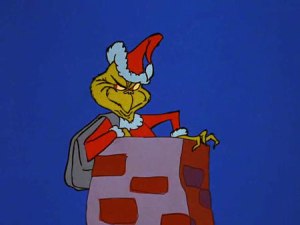
Oh no. Does my heart look three sizes bigger to you?
Reboots of Reruns

Reboots of TV shows aren’t new. The New Monkees, The New Adam-12, The New Odd Couple, The New Gidget, The New Perry Mason, which aired while the old Perry Mason, Raymond Burr, was starring in Ironside, which would later be rebooted in 2013. Oh, and there’s reportedly another Perry Mason reboot in the works. From Dragnet to Kojak, Love Boat to Fantasy Island, Dark Shadows to Mission: Impossible, reboots have always been a thing.

I’ve changed my stance on reboots somewhat. As much as I would love for the people in charge to stop dipping into the pop culture well of yesterday and instead invest in fresh ideas written and performed by those not necessarily straight, white, cis, and mostly male, I’m no longer screaming about the originals that are being rebooted as being untouchable and sacrosanct.

Why?

The reboots are not for me.

If the reboots were for me, they’d just put the reruns on. I mean I love shows that went off the air before I was born. But. Why can’t they be redone, updated, and polished for a new audience? It worked for Battlestar Galactica. The original ran only one season, written off as a hokey Star Wars rip-off, though it was followed by the single-season sequel Galactica 1980. The reboot ran four season, garnered quite a bit of attention and acclaim, and created quite an enthusiastic fanbase. I never got into it as I prefer my Cylons shiny and the bad guy to have a purple light bulb for a head and wear a disco cloak, but even I know that we were all blessed having Richard Hatch back on our TVs on a somewhat regular basis.

I cried foul when it was announced that Hawaii Five-O was being rebooted. But it’s in its ninth season now. The only episodes of it I’ve watched pertain directly to the original (the remake of “Hookman”, Ed Asner’s character from “Wooden Model of a Rat” coming back, their take on “Cocoon” for the season 9 opener) and while I appreciated those episodes and the fact that show goes out of its way to pay such homage and respect to the original, I’ve never felt compelled to watch it on the reg. It’s not for me. But other people enjoy it plenty.

To me, it’s actually a good example of a reboot. The love for the original is plainly visible. The important elements are intact. The stories and cast have been updated, the characters tweaked, but at their core, they’re very familiar.

The reboot of Magnum PI appears to be going in this direction, which makes sense since the guy who developed it also developed the Hawaii Five-0 and MacGyver reboots. I watched the first few episodes, and I think the respect is very much there. No, Magnum doesn’t have a mustache (though there was a mustache reference in the second episode), but he’s still a handsome and charming war vet turned private investigator and all-around do-gooder and at his core, that’s who Magnum is. There is an unfortunate lack of short-shorts, though. We’re being denied man thighs.

But that’s a personal complaint.

Also greater than the mustache is that this Magnum is Latino. That’s one nice aspect that reboots can provide. Diversity. Yes, there’s always squawking when a male character is recast as a woman (Starbuck on Battlestar Galactica, Kono on Hawaii Five-0, Higgins on Magnum PI), which tells more about the squawkers than it does about the shows. But let’s be real, kids. Television, particularly action and sci-fi shows, are largely sausage fests. There’s nothing wrong with women cast as known characters provided that the characters reflect the change.

Getting non-white actors in those classic roles, too, opens up a world of storytelling provided the change is reflected. There are now new dimensions added because the characters aren’t working what’s considered the default. The reboot of One Day at a Time features a Cuban-American family. Back in the ’80s, The New Odd Couple (not to be confused with the 2015 reboot of The Odd Couple) featured a Black duo played by Ron Glass and Demond Wilson. Reboots also offer the opportunity to create new characters that could be played by non-white, non-male, non-straight, non-cis actors.

Reboots aren’t going away. So long as they can be viewed as a pop culture lure to draw in old fans while creating new, something with a vague scent of money to it, they’re going to keep getting the green light. And some of them are going to be positively horrid bombs that spit all over their source material and they should be rightfully shunned.

But others won’t be. Others will end up being pretty okay. And if we can’t enjoy them, then we should leave them to those that do because we still have the originals.

And if they ever need a consultant, I’m available.

Best Characters to Join a Show After the First Season

One day a question floated across my Twitter timeline: Who’s the best character to join a show after the first season?

And my immediate response was, “I can’t answer this with a tweet. I need a blog post!”

So here I am, months later, finally getting around to answering that highly subjective question. In order to keep from rambling, I only picked characters from shows I’ve written about here. And even then, I restrained myself to keep it down to a dull roar.

Let’s start off with a couple of the more subjective ones and work our way (okay, my way) closer to objective.

Ben Kokua (Al Harrington) and Duke Lukela (Herman Wedemeyer), Hawaii Five-OYeah, you’re going to have to fight me on this one. Ben replaced Kono (Zulu) at the beginning of the fifth season and stayed through the seventh season. I feel he made a nice addition to the team. Solid, native, not flashy, except when he was undercover and had to wear ugly shirts as part of the gig. Al Harrington had already been on the show a few times, playing other (and usually bad) guys, and has since had a recurring role on the new show (playing yet another character). Clearly, every version of this show needs Al Harrington in some form, though I maintain Ben was the best.

Duke is a legend in my mind. Though Herman Wedemeyer was there from the beginning, the character of Duke didn’t actually happen until the fourth season. Of the 155 episodes that Herman Wedemeyer is credited for, only seven were not as Duke Lukela. Better yet, we get to watch as Duke goes from uniformed officer bit role to a detective with a starring credit in the final season. How marvelous is that? And if you still doubt that Duke should be on this list, then let me point out that the current show also has a Duke Lukela and he’s played by Dennis Chun, the son of the original Chin Ho, Kam Fong. Now that’s legend.

Sheriff Mort Metzger (Ron Masak), Murder, She Wrote–When Tom Bosley left the show, Cabot Cove needed a new sheriff. With Amos Tupper retired, the new law in town came in the form of Mort Metzger, a city cop who didn’t understand why the murder rate of a small town was so high and why some old woman was so involved in solving them. It was the fish-out-of-water aspect of Ron Masak’s character that not only separated him from Amos, but from everyone else in town. He spent half of his time bewildered by the goings-on of the locals, his hard line approach not so effective in a town where everybody knows everybody. Considering Ron Masak was in episodes of both The Monkees and Land of the Lost, it’s no wonder he was able to bring a touch of brilliance to this character and even make his never-seen, often-referred to wife Adelle come to life.

Detective Arthur Dietrich (Steve Landesberg) and Officer Carl Levitt (Ron Carey), Barney Miller–Both Steve Landesberg and Ron Carey appeared on the show as different characters prior to becoming the two of the characters on this list. Steve Landesburg first appeared as Father Paul in the first episode of season 2. The 12th episode of that same season, he made his first appearance as Dietrich, a dry-humored, incredibly intelligent detective who came in as Fish was going out. Of course, the two would appear together for over a season until Abe Vigoda’s official departure at the beginning of season 4. Many of his first episodes involved him trying to find a place in the 12th precinct. By the time the show ended, it was hard to imagine what it was like without him.

Ron Carey’s first appearance was as a character called The Mole in the last episode of the second season. It was only the third episode of the third season when he made his first appearance as Carl Levitt, a short, overly-enthusiastic uniform keen on making detective some day and taking every available opportunity to get into plain clothes. Not just a punchline, Levitt got to be the hero by saving some kids, ratted out the squad room with petty grievances to both protect them and to express his displeasure from being put down all the time, and eventually made detective in the final episode. As well he should.

Festus Haggen (Ken Curtis), Gunsmoke–This twenty-year show was on the air nine years before Festus Haggen settled in Dodge City permanently. It’s hard to imagine Gunsmoke without Ken Curtis, especially since most of the syndication packages typically show the later episodes, but Dennis Weaver played Chester Good for 290 episodes (1955-1964). Festus’s first appearance actually came in 1962, but he became a regular in 1964 after Dennis Weaver left and ended up becoming such an iconic character that it’s hard to imagine Ken Curtis as anyone else (he was, though, playing a few different characters on the show before becoming Festus). Dodge City wouldn’t be the same without him.

This list is far from complete, of course. And it’s far from objective, as I warned. I might just answer this question again sometime in the future. New list, new shows, new characters. The answers are endless.

Who do you think the best characters are that joined a show after the first season?

Rerun Junkie Show Analysis–The Pride of the Ol’ 1-2

Since it’s Pride Month, I wanted to do a post on the gay representation on Barney Miller, just a quick overview of it because there’s really quite a bit I could pick apart and analyze and also because Marty Morrison really deserves his own character post.

Anyway.

Barney Miller was known for depicting the less dramatic, weirder side of law enforcement. It also pushed and poked at many social issues of the time. Some of them were very specific to that moment, like the budget crisis and the fallout from Vietnam, but many of the issues the show presented are still very relevant today. One striking aspect of the show is the representation of gay men in the form of recurring characters Marty Morrison (Jack DeLeon), Mr. Darryl Driscoll (Ray Stewart), and Officer Zatelli (Dino Natali). I read somewhere that show creator Danny Arnold worked with gay groups to get the portrayal of these characters right.  Instead of relying heavily on stereotypes (thought Marty is a classic catty gay man) or presenting them as unnatural or deviant, the show depicted them as humans facing societal challenges, bigotry, and discrimination due to their sexual orientation.

I love Marty Morrison and the pizzazz that Jack DeLeon brought to that character. He was out because it was impossible for him to be in. A petty criminal, he stole my heart as well as purses. In his first appearance on the show there’s a scene in which Barney tells Marty to get a real job and Marty tells him that he’s had “more jobs than you have hair on your head”. He also tells him that he tried to join the police force, but that they turned him down for being gay (“What’s wrong with a gay cop? There are gay robbers.”). Perhaps it’s just me reading into the scene, but there’s a suggestion there that part of the reason for Marty’s criminal behavior is because of his difficulty to hold a job as an out gay man in the 1970s. Or even get one. At the time, I would imagine that most jobs okay with his sexuality were few and far between and most likely limited to very specific industries.

It was through Marty that the show introduced Mr. Darryl Driscoll. The character was first somewhat effeminate, but throughout the appearances, that lessened in favor of Ray Stewart giving the character a more sophisticated personality. His first introduction to the squad room saw him being hustled by a fake cop, threatened with violence if he didn’t give the man money. His reluctance to actually go to the police to file a report echoes the real fear the gay community had (and still has) in regards to law enforcement. Later on in the series it was revealed that Mr. Driscoll had been married and had a son, something not uncommon for gay men. The resulting custody dispute on the surface seemed to be the result of the former Mrs. Driscoll’s opposition to Mr. Driscoll’s sexuality and shielding their son from that. In reality, the reason was more mundane: Mrs. Driscoll was tired of being the bad guy because Mr. Driscoll indulged his son during his visitations.

It was Officer Zatelli who got the truth from Mrs. Driscoll. A uniformed officer in a similar duty role to Ron Carey’s Officer Levitt, Officer Zatelli first showed up in the fourth season. However, it was in the 6th season that an anonymous letter claiming there was a gay police officer led to Zatelli outing himself as both the letter writer and the gay officer. Dino Natali’s portrayal of Zatelli was “straight”. He wasn’t much different from any of the other cops and that was the point. Though the detectives in the squad room knew he was gay and though he told  Mrs. Driscoll that he was gay when she was making a fuss about her son being around “those kind of people” and though Barney encouraged him to come clean to the department because policy prevented punishment for his sexuality (a policy change from the first season as indicated above), Zatelli couldn’t do it. As Barney warned, it was an accidental outing thanks to Wojo that exposed his secret. Instead of termination or forced resignation (like Lt. Scanlon wanted), Zatelli was transferred to a much cushier job, which he believed was a sign that he had a like-minded friend in high places.

Speaking of Wojo, Max Gail was presented with an interesting challenge for his character in regards to his evolution in opinion about gay men. The first season, particularly the first handful of episodes, saw Wojo as kind of a brutish caveman. His dislike of Marty came more from him being a thief rather than him being gay. However, the introduction of Mr. Driscoll, pairing the two men up the way they did, brought Wojo’s discomfort, ignorance, and prejudice into a sharper focus. In a two-part episode called “Quarantine” that saw the members of the 12th as well at Inspector Luger, Marty, Mr. Driscoll, and a sex worker named Paula Capshaw all -you guessed it- quarantined due to either smallpox or chicken pox depending on the outcome of the tests done on a sick criminal, Wojo insists that Marty and Mr. Driscoll sleep on opposite sides of the squad room. Like the two men would just bow-chicka-wow-wow right there if they were allowed to be in close proximity of each other when the lights went out. Wojo lost that argument, but it was an excellent illustration of his prejudice and misconceptions surrounding gay men. Over the course of the series, we got to see Wojo’s own learning experience and watch him as his opinions grew, matured, and evolved. In a way, he was almost a stand-in for no doubt many men in the viewing audience. (I’m singling out the men here because Wojo’s issues with homosexuality was very masculinity-based, but really, that’s another post for another time.)

Like I said, this is just a quick overview. There’s so much more I could get into and just might at some point in time. The gay representation on Barney Miller is really rather unique given the time period. It’s a reflection of the way social norms were evolving at the time as well as a bold step for both a cop show and a comedy.

The characters still resonate and the humor still plays today because the focus was always on the humanity, not stereotypes-as-punchlines.

And that’s pretty special.

Rerun Junkie Episodes–Hawaii Five-O Favorites Seasons 9-12

Here we are. The end of our journey through some of my favorite episodes from each season. You can read the previous entries here and here.

The episode selection for these last four seasons was difficult, as were the previous seasons, but maybe for slightly different reasons. I haven’t watched these seasons as much and for me, there aren’t as many standout episodes. After season 10, there’s no Chin Ho. After season 11, there’s no Danno. So, yeah. The subjectivity is high here, kids. Consider yourselves warned.

“Heads, Your Dead” Season 9, Episode 7. Air date: November 11, 1976. Directed by Bruce Bilson. Written by Herman Groves.

Based on a real-life case, hijackers get themselves hired to be the crew of luxury yachts, then murder the owners and steal the boats to sell elsewhere. Danno and Officer Sandi Welles are sent undercover to investigate. Sandi, along with a group of people, is taken hostage by the hijackers and their fate rests on a flip of a coin.

A big part of the reason why I like this episode is because I like Officer Sandi Welles (Amanda McBroom) in it. I also like bad guys. They’re pretty ruthless. There’s a certain amount of psychological terror involved in telling your already terrified hostages that you’re going to throw them overboard and whether or not they get a life raft depends on a coin flip. But that’s what makes it so compelling.

“The Descent of the Torches” Season 10, Episode 5. Air date: October 20, 1977. Directed by Charles S. Dubin. Written by Alvin Sapinsley

An archaeological dig reveals tunnels that could lead to the grave of King Kamehameha I. And someone is so convinced of it that they dress up in a royal robe and mask to frighten off and eventually kill members of the dig.

I very nearly picked “A Death in the Family”, but honestly, it’s not really a favorite in the sense that I enjoy it, but more in the sense that it ripped out my heart and dumped it on the steps of Iolani Palace. Anyway. The reason why I picked “The Descent of the Torches” instead is because of the Hawaiian culture. This episode gets into that and I really like it. Let’s face it. For the majority of the run, it’s a pretty white show. There are some Hawaiian faces and there’s the presentation of life on the islands, but not too much on the Hawaiian culture. Yes, there are better episodes in this season, but this one scratches an itch for me.

“Stringer” Season 11, Episode 17. Air date: February 22, 1979. Directed by Ray Austin. Story by Paul Williams and Robert Janes. Teleplay by Robert Janes.

Members of Tony Alika’s Hawaiian kumu mob shoot out a tire on a police car that’s trailing their out-on-bail boss, causing an accident that kills one officer and nearly kills my much-adored Duke. The whole thing is caught on film by a “stringer” (free-lance photographer) named Tim Powers, who decides to try to blackmail Tony Alika and the political boss he was making a deal with.

I really need to do a whole post on Tony Alika, as he was a recurring villain during the 11th and 12th season and I’m always looking for a reason to write about my beloved Ross Martin. But I went ahead and picked this episode for my season 11 favorite because of the Paul Williams aspect. Not only does he get the story by credit, but he also plays the stringer of the title. A man who’s probably known more for his songwriting, I always love it when he shows up in things. He’s small and interesting and hard to ignore.

“Woe to Wo Fat” Season 12, Episode 19. Air date: April 5, 1980. Directed by Barry Crane. Written by Frank Telford.

The final episode. Three scientists who all attended a space-based, laser defense symposium have been abducted. McGarrett impersonates the fourth in order to be abducted and find out what’s going on. Of course, it’s Wo Fat going on.

Wo Fat is another character that deserves his own post. Khigh Dhiegh portrayed Steve McGarrett’s arch nemesis throughout the show’s 12 year run. But, when it comes to favorites, I have to give my pick to the last episode of the series. Not one of the best episodes maybe, but endings are always hard. And it’s only fitting that the last episode feature the final battle between McGarrett and Wo Fat.

I hope you enjoyed some of my favorite episodes and I hope these posts tide you over until I actually get around to doing my Book ’em, Danno podcast.

Until then, relax…

Rerun Junkie Episodes–Hawaii Five-O Favorites Seasons 5-8

It was only after I put this post together that I realized the episodes I picked featured three written by Jerome Coopersmith and two directed by Charles S. Dubin. I suppose this could be used as evidence of me liking their work.

Anyway.

Reminder that the process of picking one favorite episode from each season was difficult. If you’re curious as to how I couldn’t have possibly picked “Hookman” for season 6, it’s because I sort of wrote about it already. And you can read about my favorite episodes from seasons 1-4 here.

“I’m a Family Crook–Don’t Shoot!” Season 5, Episode 13. Air date: December 19, 1972. Written by Jerome Coopersmith. Directed by Bob Sweeney.

The Lovejoys are a family of grifters who come to Hawaii to work their magic. They end up stealing the briefcase of a collector for a mob protection racket which contains the collected protection money and his ledger. Naturally, the mob wants this briefcase back. And Five-O would like it, too. Shenanigans ensue.

This episode got the nod for this blog post because it didn’t seem right to pick the “V for Vashon” trilogy. That deserves its own post. But that’s not to say that “I’m a Family Crook–Don’t Shoot” didn’t earn it’s place as a fave. It’s Andy Griffith and Joyce Van Patten as con artists. How can you not love that? What’s more is that even though they’re “bad guys” in the sense that they’re criminals, you still really like them. You definitely don’t want to see the mobsters get them, but you also don’t want Five-O to throw them in jail. It’s a fun episode that provides some real tension once the mobsters go after the Lovejoys’ daughter.

“Draw Me a Killer” Season 6, Episode 2. Air date: September 18, 1973. Written by Walter Black. Directed by Charles S. Dubin.

A mentally ill young man fixated on the Judy Moon comic strip believes that he must repeatedly save the heroine and ends up murdering the comic villains’ real life look-a-likes. When the young man spots (and begins to stalk) a woman who resembles Judy Moon, things get intense. In order to flush out the killer, Danno allows himself to be drawn as the next villain.

Mental illness wasn’t necessarily handled with the deftest hand back in the day. Hey, it still isn’t now in the present. But this episode was an interesting take on someone whose grasp on reality wasn’t the best. There’s no doubt that our killer (played excellently by Elliot Street, who was also played the mentally challenged son of baseball player Pernell Roberts in a season 3 two-parter) is dangerous. But the character is also sympathetic. After all, he’s only moved to murder in order to save someone. Unfortunately, he’s mixing up fiction with reality through no fault of his own. His boss, played by Audrey Totter (The Postman Always Rings Twice), helps provide a little more dimension to a character that could easily just be a run-of-the-mill “skitzo”.

“Welcome to Our Branch Office” Season 7, Episode 11. Air date: December 3, 1974. Written by Jerome Coopersmith. Directed by Charles S. Dubin.

A pair of con men break into Five-O headquarters and take pictures of the offices. They replicate them in an abandoned building and then hire and train men to act like the real Five-O. It’s an elaborate scheme meant to extort money from wealthy businessmen. Naturally, McGarrett isn’t thrilled to find himself and his men accused of strong arming folks.

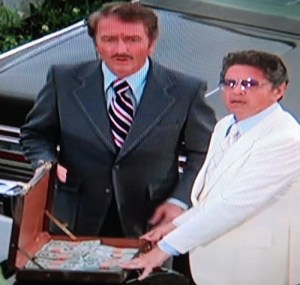
This is another fun episode I enjoy purely because it is fun. First of all, the masterminds behind this fake Five-O scheme are Cameron Mitchell (Swiss Family Robinson TV show, The Toolbox Murders) and Frank Gorshin (The Riddler himself). Talk about a fun couple. A good part of the episode shows the two of them getting together the fake gang and setting up the fake office. And the one victim who ends up reporting the fake Five-O has a wife who wears a magnificently loud dress. He also says that it was definitely McGarrett he saw. Which is hilarious because, with the exception of Danno, NONE of the look-a-likes look that much like their counterparts. Danno is the exception because James MacArthur took on a dual role to play his double, parting his hair on the wrong side to emphasize the difference. It’s an entertaining episode that provides a nice break from some of the more serious ones.

“Retire in Sunny Hawaii…Forever” Season 8, Episode 9. Air date November 7, 1975. Written by Jerome Coopersmith. Directed by Bruce Bilson.

Danno’s Aunt Clara comes out for a visit. When a man she became friendly with on the flight over is attacked by two men and ends up dead, Five-O is on the case. Aunt Clara’s quality time with her nephew now involves being used by Five-O in a ploy to catch the killers and unravel the whole illegal scheme.

Again, subjectivity plays a huge role in my choices of favorites, and this is definitely one of those episodes. Danno’s Aunt Clara is played by James MacArthur’s real-life mother Helen Hayes. I’m a sucker for things like that. Seeing mother and son work together onscreen is a true delight.  Throw in TV guest star journeyman Ian Wolfe as the unfortunate Mr. Miller and Charles During as Havens, and the episode comes together so well that you wish Aunt Clara would have visited more often.

You can read the final installment of favorite Hawaii Five-O episode posts, seasons 9-12, here.

Rerun Junkie Episodes–Hawaii Five-O Favorites Seasons 1-4

If you’ve been listening to Eventually Supertrain (and you should be!), then you know that Dan and I sometimes kid about me doing a Hawaii Five-O podcast called Book ’em, Danno because I can often make connections between Hawaii Five-O and The Green Hornet.

Now, I don’t know if my lazy self will ever go through with such a threat, but it did give me the idea to do a blog post about my favorite episodes. And when I was going through the seasons picking out my favorites, I realized that I needed to show some kind of restraint.

So, here’s what I did.

I picked one episode from each season that I love and would recommend to someone else. I tried to pick ones that I haven’t already mentioned on the blog. Since there are twelve seasons of the show, this is going to be split up into three different posts with four episodes a post. And even though this show went off the air the same year I was born, I’ll do my best to avoid spoilers.

Believe me when I say that this wasn’t easy and I will most likely be writing about the episodes I’m not mentioning here.

Until then…

“One for the Money” Season 1, episode 17. Air date: February 5, 1969. Story by Robert Sampler. Teleplay by Palmer Thompson. Directed by Paul Stanley.

McGarrett receives a cryptic letter and a photo of a woman with her face crossed out. The woman’s been stabbed to death. After a second victim/letter/photo combo appears, it looks like there’s a serial killer on the loose. Both victims were employed by the same company, run by a woman named Martha. Her two nephews, Charlie and Arthur, also work for her. It turns out this killer has quite the agenda involving this company.

This is a delightfully twisty episode. Aunt Martha is played by my favorite Jeanette Nolan and the nephews are played by Farley Granger (Strangers on a Train) and Paul Collins (JAG). Between the captivating story and the guest cast, it’s an excellent episode that keeps you on the edge until the very end.

“Most Likely to Murder” Season 2, episode 21. Air date: February 21, 1970. Written by Robert Hamner. Directed by Nicholas Colasanto.

Police officer Lew Morgan’s wife is murdered. As Lew’s friend, this case is pretty personal for Danno. It turns out the good cop’s wife was having affairs and it’s her latest lover, a criminal, that’s the favorite suspect. Five-O needs to find him before the apparently grief-stricken husband finds him first.

Another tightly twisted episode featuring a mustache-less Tom Skerritt as Lew Morgan. Sam Melville (The Rookies) plays number one suspect Gary Oliver and Linda Ryan, who plays one of Gary’s former lovers, Gloria Warren, appeared on the show eleven times over twelve seasons, only playing the same character twice. She also inspired me to get my own pixie cut. Anyway, Danno’s personal involvement in the case gives the story a nice weight, creating a couple of good gut punches towards the end.

“Over 50? Steal” Season 3, episode 11. Air date: November 25, 1970. Written by E. Arthur Kean. Directed by Bob Sweeney.

Lewis Avery Filer is an insurance investigator forced into early retirement. In apparent revenge, Filer steals from businesses insured by his former employer using a variety of tricks and disguises that captures the attention of the press and all of our hearts. Okay, except for Five-O, who has a devil of a time catching up to him. Filer returns in season 4’s “Odd Man In”.

If you were to ask me what my all-time favorite episode of Hawaii Five-O is, I’d probably blurt this one out. Hume Cronyn is Lewis Filer and he is having an absolute ball with this character. The cleverness of the crimes and the likeability of the character really has you on his side. He’s a crook you can love! And when you find out his ultimate goal for the money, you really don’t want him to be caught. Filer is just as much fun when he comes back in “Odd Man In”.

“Goodnight, Baby-Time to Die!” Season 4, episode 21. Air date: February 15, 1972. Written by Abram S. Ginnes. Directed by Alf Kjellin.

A convicted murderer who’s been threatening a woman has escaped from jail. McGarrett and company go to the woman’s house to both protect her and hopefully catch the convict. As they wait, they receive calls and updates about the man while McGarrett talks to the woman about her connection to the killer.

This is one of those episodes where I can only tell you to watch it. The first time I did, the swerve broke my neck. No joke. It’s a very well done episode featuring Beth Brickell (Gentle Ben) as Carol Rhodes, the target of escaped convict LB Barker, played by William Watson (Gunsmoke, M*A*S*H). It’s a taut thriller of an episode that’s still good on repeated viewings.

Read about the favorite episodes from seasons 5-8 here.

Rerun Junkie Show–Automan

The world’s first automatic man.

Automan is not a show I knew about until recently, coming across the title while doing research on something else. In November of 2017, Red Giant put out a short based on Automan that was written and directed by Aharon Rabinowitz and starring David Hewlett as the title character, Hewlogram. Between this hilarious short (please go watch it and the making-0f video because it’s just as much fun) and watching the opening for the actual series, I put this one on my to-watch list.

And as luck would have it, I received the series on DVD for my birthday.

(I also received Hewlogram poster that I won that same week. My 38th birthday week was lit in a hologram sort of way.)

Automan aired in 1983 for just 13 episodes. Starring Chuck Wagner as Automan, Desi Arnaz Jr. as his creater Walter Nebicher, Heather McNair as Roxanne Caldwell, Gerald S. O’Laughlin as Captain Boyd, Robert Lansing as Lt. Jack Curtis, and Cursor as himself. No, really. The little cursor thing got a credit.

If you bothered watching Hewlogram, then you’d have the basic premise of Automan. Walter Nebicher is a computer programmer and police officer whose captain prefers him in his little computer room and not out on the streets. He creates Automan, a hologram so powerful that it can hit a dude across a room. Only Walter’s co-worker and sort of love interest Roxanne knows that Automan is a hologram. Oh, and Cursor is a little firefly looking thing that can draw anything and make it real, like a suit over Automan’s Tron body or a super fast car. It’s also a bit of a perv. Because Automan requires a certain amount of power to exist, he sometimes has to disappear when he feels his battery getting low or find creative ways to recharge. All of this in the name of fighting crime.

The buddy cop duo we need and deserve.

The show only ran 13 episodes and that’s both criminal and totally understandable. In only 13 episodes, we had mobsters, tropical locations, corrupt cops, corrupt sheriffs, bikers, Laura Branigan, a male exotic dance club called Zippers, bombing threats, diamond smuggling, and I’m pretty sure every episode featured covers of popular songs of the time as well as the laughing freeze frame at the end. You can’t pack that much awesome into such a short run. The star that burns that brightly, burns out too soon.

It also suffers from the some questionable dialogue that boarders on painful, the obvious jokes and cheesiness that permeated the ’80s, and some less-than acting, though I blame the dialogue for a lot of it. Seriously, some of those lines are face-smackingly cringey.

But, it’s an incredibly fun show! Chuck Wagner is adorable as Automan. He embodies this hologram that is, in his own words, an eleven on a scale from one to ten while also being rather naive about the ways of humans. To help him learn about humans, Walter had Auto watch movies and TV shows. Auto inadvertently watching multiple episodes of a soap opera is a highlight.

Speaking of Walter, he’s not just an inept computer nerd. Yeah, in a few episodes things don’t go his way and he gets his ass handed to him, but he’s not incompetent. And he does get in his licks. He’s also not a total loser with the ladies. After all, Roxanne is one hot chick and he doesn’t seem to have any trouble with her.

Together, Walter and Auto are, well, maybe not unstoppable or unbeatable, but they get the job done and they’re entertaining.

Giving a new meaning to the boys in blue.

The plots are typical ’80s grand with titles like “Staying Alive While Running a High Flashdance Fever”,  “Murder MTV”, “Murder, Take One”,  “Death By Design”, and “Club Ten”. In one episode called “Renegade Run”, you have Richard Lynch as a corrupt sheriff that pits him against biker Billy Drago. I know, right? How great is that? Pretty great.

In addition to Richard Lynch, Billy Drago, and Laura Branigan, the show also featured guest stars Clu Gulager, Mary Crosby, Patrick Macnee, Ed Lauter, John Vernon, Anne Lockhart, France Nuyen, Robert F. Lyons, Delta Burke, William Windom, Terry Kiser, Don Galloway, Richard Anderson, Doug McClure, Walter Brooke, Sid Haig, Mickey Jones, and Ola Ray.

Check out that crop. Nothing but cream.

Okay, Automan is a little on the silly side. It’s the early ’80s turned up to eleven. It is glorious.

Just ask Cursor.

The little perv.

They Didn’t Have Native Americans Back Then

As I discussed in a previous post, all of your favorites are problematic. All of my favorites, too.

One problematic aspect of reruns that’s probably the most glaring is the racist casting. White actors playing non-white roles has been common place for decades and was probably at its most popular in the Westerns of the ’50s, ’60s, and early ’70s. That’s right. Those Native Americans were not actual Native Americans. Those Mexicans? If they had a speaking role, they were most likely not actually Mexican.

John Saxon played a Native American on Bonanza and a Mexican on Gunsmoke. Martin Landau played a Mexican on both The Rifleman and The Big Valley. Michael Ansara not only played a Mexican in a couple of episodes of Rawhide, but he was frequently cast as a Native American, including starring in his own short-lived series called Law of the Plainsman playing Deputy Marshal Sam Buckheart, a character he originally played on The Rifleman.

Sadly, one of my favorites, F-Troop, was notorious for casting white actors as their Hekawi tribe members. Frank DeKova, Don Diamond, Edward Everett Horton (who also played a Native American chief on an episode of Batman), J. Pat O’Malley, Jamie Farr, hell even Don Rickles all played Native Americans. It seemed comedic timing was more important than racial accuracy. Not that there aren’t funny Native Americans; but back then, they didn’t even bother to look for them.

Of course, Native Americans and Latinos/Latinas weren’t the only ones having white actors step in for them. Boris Karloff played an Indian Maharaja on an episode of The Wild Wild West. Wende Wagner played a native Hawaiian on an episode of Perry Mason, and her aunt in that same episode was Miriam Goldina, a native Russian. Jim Backus’s wife, Henny, played a native mother on an episode of Gilligan’s Island. Spoiler alert! Russ Grieve, who played her native husband, and Mary Foran, who played her native daughter, weren’t natives either.

Two of the most curious examples of racist casting I have ever seen happened on two of my favorite reruns, both of which I’ve mentioned before, but I’m going to mention again because they are worth mentioning at every opportunity.

In an episode of Hawaii Five-O called “Samurai”, Ricardo Montalban played a Japanese criminal. Yes, you read that correctly and aren’t you glad that you did. In the second oddest case of yellow face I’ve ever seen (we’ll get to the first one very soon), a very Mexican Ricardo Montalban had his eyes artificially slanted to play a Japanese man. Like, his accent didn’t change at all. And whatever they did to his eyes made him look less Japanese and more like an eye lift gone wrong. The entire effect is very disconcerting and I highly recommend you try to catch that episode because descriptions and pictures don’t do it any justice.

To make an already confusing casting decision even more curious, Hawaii Five-O was typically good at casting Asians, Native Hawaiians, and Pacific Islanders to play Asians, Native Hawaiians, and Pacific Islanders in smaller roles, making things like this even more glaring.

The truly oddest case of racist casting I’ve ever seen, however, belongs to the pilot episode of The Wild Wild West called “The Night of the Inferno”. In this episode Victor Buono played Juan Manolo aka Wing Fat.

Yes, let me break that down for you.

White actor Victor Buono played a Mexican man in disguise as a Chinese man. It’s basically a turducken of racist casting and I can’t help but gawk at it because I have no idea how to even begin to process it. I suppose if you’ve ever watched the series, then you can agree that at the very least, it sets you up nicely for some of the more bonzo episodes of the show.

Thankfully, this sort of whatthefuckery is largely in the past and though racist casting does still happen (whitewashing Asians and Pacific Islanders is still unnervingly common), the backlash is swift and loud. A new normal has been and is being established and even if I don’t watch current shows all that much, I’m still all for it.

After all, one day those shows will be reruns.

The Ghosts of Shows Past

This post features spoilers for the season 4 episode of NCIS: New Orleans, “Viral”, which aired October 24, 2017. Read at your own risk.

One of the interesting tics of being a rerun junkie is seeing the ghosts of episodes of shows long past in current shows. I have no idea if these influences are intentional or not, if the writers of these current shows have these old episodes in mind when they’re writing or if they’re unconsciously haunted by the phantoms of them or if they even know about them at all. The idea that I’m projecting isn’t something I’ve dismissed.

But my brain still makes connections whether they’re there or not, intentional or not.

For example, the other night I was watching NCIS: New Orleans, which is one of the few currently-in-production shows I watch with any regularity. In this episode called “Viral”, my beloved Sebastian, forensic field agent extraordinaire, shot someone during the course of a chase. If that wasn’t bad enough, it looked like he shot an innocent, unarmed man, not the armed and dangerous suspect he’d been chasing.

A cop shooting a suspect or an innocent person is a common story, both in the news and on police shows. However, this episode reminded me of two bygone episodes of cop shows from over forty years ago.

After the shooting, Sebastian is interrogated by an FBI agent about what happened. The way he’s questioned reminds me of an episode of Adam-12, “Log 33: It All Happened So Fast” (air date February 1, 1969). In that episode, Officer Jim Reed shoots a young man who’s shooting at him and his partner (also my TV boyfriend) Pete Malloy. A majority of the episode shows the repeated questioning that Reed is subjected to, some of which infuriates him because of the insinuations that he’s not telling the truth. He’s also upset over the fact that he had to shoot someone (as was Sebastian). Sebastian is subjected to similar questioning, though not for as long, obviously. There’s a mystery to be solved and a dangerous assassin to catch.

The real hitch in clearing Sebastian is, though he swears the suspect shot at him and that he saw him with a gun, there’s no gun to be found. This reminds me of an episode of Hawaii Five-O, “…And They Painted Daisies on His Coffin” (air date November 7, 1968). In that episode, my TV boyfriend Danno chases a young man with a gun into his apartment. When Danno shoots the lock, he believes he unintentionally shoots the man. However, there is no gun found on the suspect. Why? His girlfriend has taken it and fled the scene (running to the notorious Big Chicken), something that also happens to Sebastian when the wife of the dead “innocent” man (it turns out this couple isn’t so innocent) takes the dropped gun to protect herself and her husband and then shows up a few minutes later as the wildly grieving wife.

The twist in this case is less cop show, more masked hero adventure. The “innocent” couple was supposed to deliver the gun to the assassin so he could do a job. The shooting interrupts things and the assassin ends up killing the wife in order to get the gun. The gun is an air gun that shoots glass bullets. That made me think of The Green Hornet episode “The Silent Gun” (air date September 9, 1966). As the title suggests, the gun in question is a rare 17 caliber gun that’s absolutely silent when fired. This leads to a lot of people wanting this gun. (You can listen to me and Dan talk about this episode and all of the many names of people therein on Episode 33 of Eventually Supertrain.) The gun in “Viral” is just as coveted, at least by the assassin, and equally unique, though a little more believable. An air gun gets through security and glass bullets “disappear” on impact.

Like these old episodes, this new one ends happily. Sebastian is cleared (like Reed and Danno) and the bad guy is caught (the Green Hornet gets the gun AND Lloyd Bochner).

Because the good guy winning is an ending worth repeating .